 The Community Edition
A BRIEF OVERVIEW OF THE TAROT
For centuries, across cultures, people have spoken of a world beyond the physical. Some call it the supernatural or God, others the subtle body, the collective unconscious or the ethereal. Whether connecting with something deep within or something divine beyond us, this non‑physical realm has long fascinated both sages and scholars. Though modern science and mysticism often clash, I have always been drawn to their boundary—a liminal space where metaphysics and quantum theory blur into what some call the ‘secrets of the universe.’
Historically, people have developed tools and methods to commune with this unseen world. With this column, I hope to explore these divination practices—both to demystify the idea that we can engage with the unseen and to consider how they might help us connect more deeply with ourselves and each other. Theorists like Albert Einstein, who envisioned an interconnected universe, and Carl Jung, who wrote about archetypes and the collective unconscious, have suggested a hidden web. I believe divination can help us tap into it, offering insight and self‑understanding.
One of the most well‑known tools today is the tarot. While tarot as we know it differs from its origins, the practice of cartomancy (using cards as divination tools) began in the Tang dynasty in seventh-century China before traveling west and evolving into the 15th‑century Italian tarot deck. Contemporary tarot decks still maintain the 78‑card structure developed in the Renaissance era, which is divided into the Minor and Major Arcana.
The Minor Arcana mirrors a traditional deck of playing cards, with four suits—pentacles (or coins), swords, wands and cups—each aligning with one of the four elements: earth, air, fire and water. Within each suit, ten numbered cards trace a personal journey through the challenges, growth and lessons of that element.
These culminate with the court cards—Pages, Knights, Queens and Kings—which reflect stages of maturity. Pages carry the curiosity of beginnings and knights the restless energy of adolescence, while queens and kings embody mastery of the inner and outer realms. Together, the suits form a story of self‑actualization through the elements that shape our lives.
The Major Arcana, a set of 22 cards, speaks to our broader existential journey. They follow the fool through symbolic stages of life. The fool encounters figures like the Empress, Strength, Death, and the Star that echo the hero’s journey described by Joseph Campbell. These archetypes appear across global mythologies, alchemical traditions, and Jungian psychology, offering a symbolic map of transformation.
In essence, a tarot deck is a guide to the process of becoming. It’s an archetypal narrative found everywhere from ancient myths to Alice in Wonderland and Star Wars. It mirrors what spiritual practitioners call the dark night of the soul: the leap into the unknown, the trials, the adventures, and eventually the revelations.
For this month’s collective reading, I’ve chosen the Smith-Waite deck. It was illustrated in 1909 by artist and occultist Pamela Colman Smith. Commissioned by Arthur Edward Waite, the deck was created through Smith’s intuitive practice, and her imagery has since become the foundation for countless tarot decks.
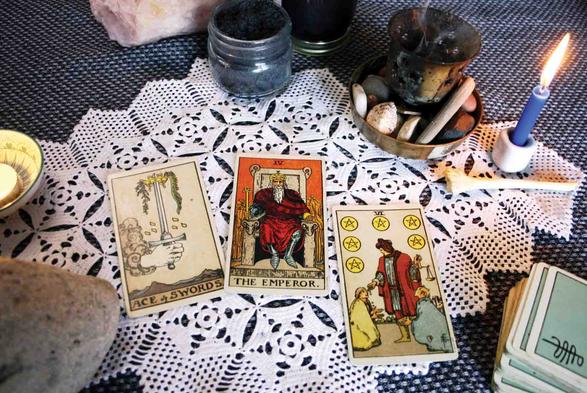
Every reader approaches tarot differently, but I begin by grounding myself, often with a quiet prayer or affirmation, before shuffling and pulling the cards the spread calls for. This month, I’ve drawn three cards for the collective: one for our past, one for the present moment, and a third for what awaits us.
In the past position, we have the Ace of Swords. This suggests the collective has recently moved through a period of sharp, and maybe even uncomfortable clarity. An essential truth has been revealed. The Ace appears when illusions fade and we’re asked to see things as they truly are. For many, this may have been a moment of honesty, a shift in perspective, or the realization that something could no longer be overlooked.
In the present, we meet The Emperor. He brings structure, discipline, and a call for grounded authority. After the clarity of the Ace, the Emperor asks us to act on what we now understand. This is a moment to establish boundaries and take leadership into our own hands. Collectively, it signals a need to envision new systems, routines, or foundations that support long‑term stability and growth.
Looking ahead, the Six of Pentacles points toward a future shaped by reciprocity and balanced exchange. We are invited to consider how we share our resources and to do so with fairness, generosity, and integrity.
Together, these cards paint a trajectory from clarity to structure to compassionate action. What we understand now becomes the blueprint for a more balanced and mutually supportive future. While I hesitate to use these tools for fortune‑telling, I use them instead as cues for reflection, and this reading suggests a collective movement toward reciprocity, —something I can happily stand behind.
#arcana #campbell #CarlJung #Column #curiousMethods #divination #edwardWaite #ElfieKalfakis #jungian #majorArcana #Photo #pyschology #tarot