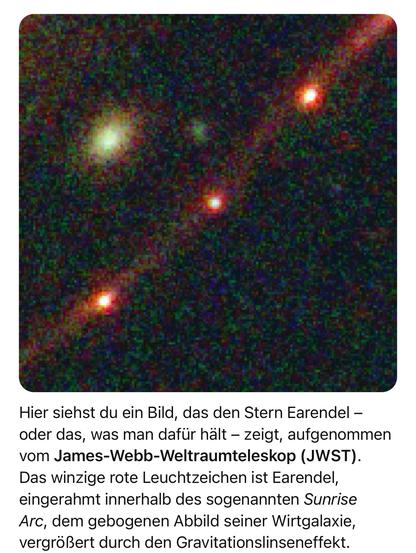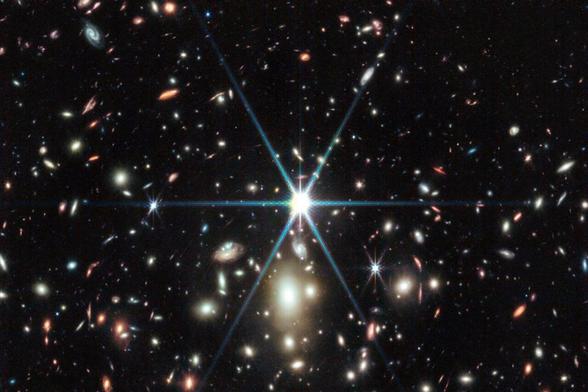
„Morgenstern“ Earendel: Sternhaufen statt Stern? Frühester direkt beobachteter Stern könnte auch ein ferner Kugelsternhaufen sein. #Earendel #Stern #Sternhaufen #Morgenstern #Astronomie #JWST
https://www.scinexx.de/news/kosmos/morgenstern-earendel-sternhaufen-statt-stern/
"Morgenstern" Earendel: Sternhaufen statt Stern?

Rätselhaftes Objekt: Der 12,9 Milliarden Lichtjahre entfernte Stern "Earendel" gilt als der früheste direkt beobachtete Stern. Doch das könnte ein Irrtum

scinexx | Das Wissensmagazin
Der #MorgenStern … weit, weiter, am weitesten … Schwingung, die Brücke zwischen #demKleinsten&demGrößten … selbst #Earendel, ob Stern oder Sternhaufen, erreicht uns nur als Welle aus längst verflossener Zeit. #OntologieDerSchwingung … Resonanz unendlich ist. Alles ist Schwingung. Alles. 🖖
Earendel potrebbe non essere una stella: la nuova ipotesi degli astronomi
@scienza
https://focustech.it/scienza/earendel-potrebbe-non-essere-una-stella-la-nuova-ipotesi-degli-astronomi/?utm_source=rss&utm_medium=rss&utm_campaign=earendel-potrebbe-non-essere-una-stella-la-nuova-ipotesi-degli-astronomi

#News #Scienza #Earendel #Stella #scienza
Quando nel 2022 il telescopio spaziale Hubble individuò Earendel, l’universo sembrò aprire un nuovo capitolo della sua storia. Questa
Earendel potrebbe non essere una stella: la nuova ipotesi degli astronomi

Una nuova ricerca mette in discussione la natura di Earendel, la “stella più distante” mai osservata: potrebbe trattarsi di un ammasso stellare.

Focustech
Deze beroemde ster bestaat mogelijk helemaal niet
Earendel is mogelijk niet slechts één ster maar een hele groep.
#bolhoop #Earendel #HubbleSpaceTelescope #ster #VersteSter #WebbSpaceTelescope #ZwaartekrachtLensing
https://www.kuuke.nl/deze-beroemde-ster-bestaat-mogelijk-helemaal-niet/
#Earendel, l’« étoile la plus lointaine »… : et si ce n’était pas une étoile ? http://sci3nc.es/TMZHRQ
🔭 Earendel: l'étoile la plus lointaine jamais observée serait un tout autre objet

L'objet céleste le plus lointain jamais observé, surnommé Earendel, pourrait bien n'être qu'une illusion d'optique...

Techno-Science.net
Is Earendel a Star Cluster? Metal Poor Globular Cluster Progenitors at z~6: https://arxiv.org/abs/2507.05483 -> "The strongly-lensed Sunrise galaxy offers an incredible opportunity to investigate star formation in the early universe on parsec or smaller scales. The highly magnified object #Earendel within the Sunrise was previously identified as a candidate star or binary due to size constraints placed by the lensing magnification, however recent works have suggested this constraint may be relaxed to even the size of star clusters. Here, we explore the hypothesis that Earendel may actually be a star cluster, and simultaneously evaluate other star clusters within the host galaxy."
Is Earendel a Star Cluster?: Metal Poor Globular Cluster Progenitors at $z\sim6$

The strongly-lensed $z\sim 6$ Sunrise galaxy offers an incredible opportunity to investigate star formation in the early universe on parsec or smaller scales. The highly magnified object Earendel within the Sunrise was previously identified as a candidate star or binary due to size constraints placed by the lensing magnification, however recent works have suggested this constraint may be relaxed to even the size of star clusters. Here, we explore the hypothesis that Earendel may actually be a star cluster, and simultaneously evaluate other star clusters within the host galaxy. Leveraging deep, archival James Webb Space Telescope NIRSpec PRISM spectroscopy, we determine a spectroscopic redshift for the Sunrise galaxy $z=5.926 \pm 0.013$, and we fit simple stellar population (SSP) models from three premier libraries to evaluate the physical parameters of Earendel and another distinct star cluster in the Sunrise dubbed `$1b$'. We find the rest-UV through optical continuum of Earendel to be well-described by an SSP, nearly equivalently to $1b$ which is confidently a star cluster. We infer they have intermediate ages $t_{\rm age}\sim 30$--$150\,$Myr, are metal poor ($Z_\star\lesssim10\%\,Z_\odot$), and are consistent with the formation age-metallicity trend seen in local globular clusters. Such intermediate age clusters are seldom probed spectroscopically in the high redshift universe, and we explore the extent to which these clusters can be characterized via the spectroscopic continuum.

arXiv.org
From 14 May: Some of the Oldest Stars Were Just Found in Our Own Galaxy - Some stars in our very own Milky Way are some of the earliest ever seen, according to researchpublis... https://gizmodo.com/oldest-ancient-stars-found-milky-way-galaxy-metal-poor-1851475722 #anna-frebel #dwarf-galaxy #earendel #galactic-center #galactic-halo #galaxies #human-interest #milky-way #rave #stellar-archaeology #stellar-halo #technology-internet #whl0137-ls
Some of the Oldest Stars Were Just Found in Our Own Galaxy

Several stars that appeared to have formed 12 to 13 billion years ago were spotted in the Milky Way halo—basically, our galaxy's suburbs.

Gizmodo

#NASA and #jameswebbspacetelescope finds the most distant star #Earendel

It's name means wandering dawn/ personification of the dawn star in the proto Germanic; fitting for both the way we've found it and it being the most distant star from us.

This is so exciting as we've entered into a new era of #spaceexploration
In one hand we being the process of colonization and development, in the other our scientific tools pave the way for our understanding of the universe and ourself.

#astronomy #stars #galaxies #JWST #Earendel

Two articles, one published in "The Astrophysical Journal" and one in "The Astrophysical Journal Letters", report various aspects of a study of Earendel, the most distant single known star. Two teams of researchers with several members in common used observations conducted with the James Webb Space Telescope to obtain new details of this star.

https://english.tachyonbeam.com/2023/08/15/earendel-the-farthest-single-star-detected-so-far-studied-with-the-james-webb-space-telescope/

Earendel, the farthest single star detected so far, studied with the James Webb Space Telescope

Two articles, one published in 'The Astrophysical Journal' and one in 'The Astrophysical Journal Letters', report various aspects of a study of Earendel, the...