 Slow Mover
In the Manner of a Corpse
The phrase perinde ac cadaver means “as if a corpse” or “in the manner of a dead body.” It is associated especially with Ignatius of Loyola and Jesuit obedience. In the Jesuit context, the idea was that one living under religious obedience should allow oneself to be “carried and governed” by divine providence through one’s superiors, as a dead body can be carried wherever another wills. A Jesuit Studies summary notes that Ignatius’s teaching on obedience was centered on Christ and extended beyond outward action toward the will and understanding, while still allowing a person to represent difficulties to a superior. (Portal to Jesuit Studies) A 1908 quotation of the relevant Latin renders the image starkly: the obedient person should be like a body that “allows itself to be carried in any direction and treated in any way.” (The Spectator Archive)
So the phrase has a dangerous edge. It can become a theology of domination: the living person reduced to a usable instrument. But it also touches an older ascetic question: how does the self become free from the tyranny of self-will? The problem is not desire itself, nor personality, nor conscience, nor agency. The problem is the ego enthroned — the self that must be obeyed, defended, admired, justified, and protected at all costs.
A Caelinian Reflection: Concerning the Corpse, the Cross, and the Living Self
From the lesser folios of Brother Caelinius, copied in the dim cloister of the Morastery, concerning the death that is not death, and the life that is not possession.
There is a saying among the old disciplined orders: perinde ac cadaver — as if a dead body.
And many have trembled before it, as well they should.
For no phrase that compares the soul to a corpse ought to be handled without fear. A corpse cannot speak. A corpse cannot protest. A corpse cannot discern whether the hands that carry it are gentle or cruel. Therefore let no abbot, bishop, prince, pastor, committee, empire, army, market, or machine take this phrase into its mouth too easily. For there are many who love obedience in others because they love power in themselves.
But there is another reading, hidden beneath the severe garment of the words.
Not the corpse of domination.
Not the corpse of erased conscience.
Not the corpse of holy silence before unholy command.
Rather, the corpse of the false self.
For the ego too must die.
Not the self God created.
Not the face beloved before the foundation of the world.
Not the child laughing in the garden of being.
Not the soul with its strange music, its wounds, its gifts, its tears, its fire.
That self must live.
But the other self — the swollen self, the defended self, the self that must always be seen, always be right, always be vindicated, always be centered, always be special, always be wounded more deeply than all others, always be praised for its humility — that self must be laid out upon the table.
Let it be washed.
Let it be wrapped.
Let it be carried away.
For there is a death that does not destroy the person, but releases the person from the prison of self-occupation.
This is not becoming zero in the sense of becoming nothing. It is becoming unowned by the ego. It is the long, daily, humiliating, merciful work of dying to the self that has mistaken itself for God.
Christ does not say, “Erase the image of God within you.”
Christ says, “Deny yourself, take up your cross, and follow me.”
And what is denied?
Not love.
Not conscience.
Not joy.
Not beauty.
Not creativity.
Not the holy ache of being alive.
What is denied is the little throne within the breast, where the anxious monarch sits and demands tribute from every room it enters.
The ego says:
“Who noticed me?”
“Who ignored me?”
“Who has more than I have?”
“Who threatens my place?”
“Who failed to honor my pain?”
“Who saw my brilliance?”
“Who wounded my image?”
“Who must I defeat so that I may exist?”
But the soul alive in Christ learns another speech:
“I am already seen.”
“I am already held.”
“I do not need to win in order to be real.”
“I do not need to dominate in order to be safe.”
“I do not need to disappear in order to be humble.”
“I may become small because I am held by a Love too large to measure.”
Here, then, is the mystery: the one who dies to self does not become less alive, but more alive.
The corpse-image fails if it ends in passivity. But it becomes fruitful if it passes through the tomb into resurrection.
For the Christian is not called merely to be dead.
The Christian is called to be dead to sin and alive to God in Christ Jesus.
Dead to the old compulsions.
Alive to mercy.
Dead to rivalry.
Alive to communion.
Dead to the hunger to possess.
Alive to receiving.
Dead to the need to be the hero of every story.
Alive to becoming a servant within God’s story.
Dead to reputation as an idol.
Alive to faithfulness in secret.
Dead to vengeance.
Alive to reconciliation.
Dead to the clenched fist.
Alive to the open hand.
Thus Brother Caelinius writes:
Blessed is the one whose ego has become a corpse,
yet whose heart has become a garden.
For such a one is not carried by tyrants,
but raised by Christ.
The work continues because the ego is not slain once only. It is a many-headed thing. It dies in the morning and returns by noon. It dies in prayer and rises in conversation. It dies in confession and reappears in ministry. It dies in one wound and returns disguised as wisdom.
Therefore the disciple must not say, “I have no ego.”
That is usually the ego wearing a monk’s robe.
The disciple says instead:
“Lord Jesus Christ, have mercy on me.
Teach me to notice the old self without obeying it.
Teach me to lay down the false self without despising the true self.
Teach me to die without becoming dead.
Teach me to live without needing to be enthroned.”
For the goal is not corpse-like obedience to human hierarchy.
The goal is cruciform freedom.
Not the dead body as object, but the living body of Christ. Not the person emptied for use, but the person emptied for love. Not submission to domination, but surrender to resurrection.
And so the old phrase is taken down from the wall of fear and placed upon the altar of discernment.
Perinde ac cadaver — yes, but only if what lies dead is the tyranny of ego.
And beyond it, written in brighter ink:
Vivo autem, iam non ego, vivit vero in me Christus.
“I live; yet not I, but Christ lives in me.”
#aliveInChrist #AnabaptistReflection #BrotherCaelinius #ChristianArt #ChristianReflection #contemplativePrayer #cruciformLife #devotionalArt #Discipleship #DyingToSelf #egoDeath #falseSelf #Humility #IgnatiusOfLoyola #JesuitObedience #kenosis #minimalistArt #monasticSpirituality #mysticalTheology #perindeAcCadaver #resurrection #selfEmptying #spiritualFormation #surrender #symbolicIllustration #trueSelf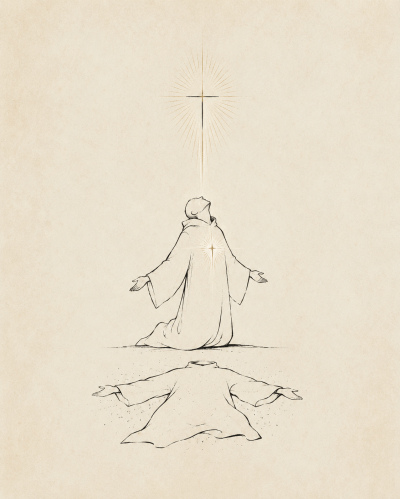
 Intentional Faith