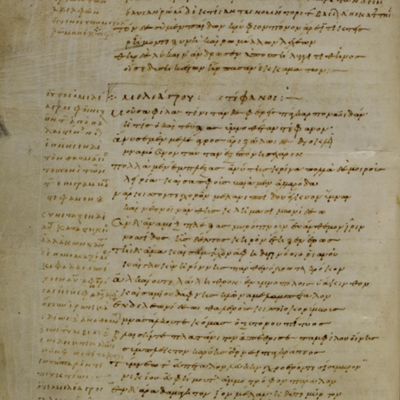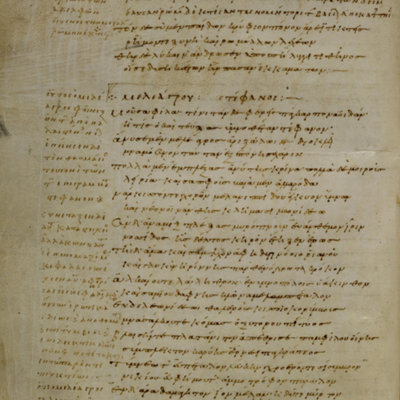
Anthologia Graeca
@anthologiagraeca • Joined: Apr 14, 2024

Bot of the Greek Anthology Project https://anthologiagraeca.org/ #DH #DigitalClassics

#bot #BotsOfMastodon

Am 5. Mai 2026, 17:30–19:00 Uhr CEST hält Hannah Busch (@cesare_blanc) den Online-Workshop „From the #Manuscript to the #DigitalScholarlyEdition“ innerhalb der Reihe „Digital Scholarly Editions in #Classics, #Byzantine, and #Medieval Studies“ @UniKoeln @unileipzig der #SunoikisisDC 2026.

Link: https://www.youtube.com/live/MHMYAW-oZlc

Eine Anmeldung ist nicht erforderlich, eine Vorbereitung mit den Unterrichtsmaterialien sei dennoch ans Herz gelegt: https://github.com/SunoikisisDC/SunoikisisDC-2025-2026/wiki/Summer-2026-Session-3

#DigitalClassics #DigitalHumanities

SunoikisisDC SS 2026 - Session 3

YouTube
eScriptorium became an important tool in our workflow while preparing critical editions ... #htr #atr #manuscripts #DigitalClassics https://escriptorium.eu/blog/2026-04-15-a-new-chapter-for-escriptorium/
A New Chapter for eScriptorium

In the next few months you will likely be seeing a new version of eScriptorium come to your instance. If you’re using INRIA, you may have already seen the changes. This year has brought a new milestone with major additions and improvements to eScriptorium. These updates were so significant that we had even started naming this release ‘version 1.0’, (and they are even so significant that starting version 1.0, we’ll change our naming scheme, see below).

eScriptorium

Question for the #digitalclassics or #digital #neolatin crowd (and @diyclassics in particular, I guess): What would be the best semantic embedding models for (Neo-)Latin currently available (not word embeddings but embeddings of text chunks)?

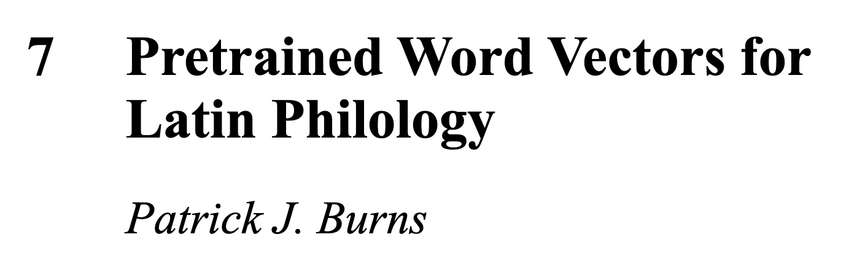
Recommended reading btw.: Burns, P. J. (2025). Pretrained Word Vectors for Latin Philology. In Evolving Perspectives on Digital Classics. Routledge.

Wir freuen uns sehr auf die Realisierung des @DIZH Projekts "Vox Lapidum". In den nächsten drei Jahren wird die Kollaboration zwischen den Institutionen Pädagogische Hochschule Zürich (Charlotte Axelsson, Ursula Stohler, Marcial Koch) und der @uzh (Anne Kolb, Jens Bartels, Phillip Ströbel) mit Unterstützung der Partner Freies Gymnasium Zürich, Vindonissa-Museum und Augusta Raurica Museum & Römerhaus versuchen, neue Massstäbe zu setzen, wie im Bereich #Bildung, #Kulturvermittlung und #Forschung mit historischen #Inschriften umgegangen werden kann. #Antike #Geschichte #DigitalHumanities #Kultur #Museum #staytuned #DigitalClassics

https://www.dizh.uzh.ch/2026/02/11/vox-lapidum/

Vox Lapidum - DIZH

Ein KI-gestützter Inschriften-Chatbot für Forschung, Bildung und Kulturvermittlung Inschriften sind unmittelbare Zeugnisse realer Menschen (von Soldaten über Amtsträger und Handwerker bis Familien) und eröffnen einen direkten Zugang zum Leben der… Weiterlesen »Vox Lapidum

DIZH

Felix Maier und ich freuen uns darauf, am IDA-Workshop zu den digitalen Altertumswissenschaften teilzunehmen und die @uzh dort vertreten zu dürfen! Danke an die Berner Kolleg:innen für die Einladung!

#digitalhumanities #digitalclassics #digitalhistory #history #workshop

🤖: Anthologia Graeca
@anthologiagraeca
Joined: Apr 14, 2024
Bio: Bot of the Greek Anthology Project https://anthologiagraeca.org/ #DH #DigitalClassics

#bot #BotsOfMastodon

Interested in contributing to editing the Digital Classicist Wiki (https://wiki.digitalclassicist.org)?
Join our Digital Classicist Wiki Editing and Tutorial, led by Gabriel Bodard (ICS) & Martina Filosa (University of Cologne), taking place online on 27 February 2025, from 2:00 PM to 3:00 PM (GMT).
Details: https://ics.sas.ac.uk/events/digital-classicist-wiki-editing-and-tutorial
#digitalhumanities #digitalclassics #digitalclassicist
The Digital Classicist Wiki

Seconda giornata del convegno "Orizzonti della filologia digitale" oggi in italiano - in diretta qui https://horizons.ecrituresnumeriques.ca/ #DH #DigitalClassics
Accueil

Horizons de la philologie numérique. L'Anthologie grecque pour repenser formats, paradigmes et collaboration (16-18 avril 2024, Università degli Studi di Napoli Federico II & Université de Montréal).

Horizons de la philologie numérique
🔖 Palladino, Chiara, Farnoosh Shamsian, und Tariq Yousef. 2022. „Using Parallel Corpora to Evaluate Translations of Ancient Greek Literary Texts. An Application of Text Alignment for Digital Philology Research“. Journal of Computational Literary Studies 1 (1). https://doi.org/10.48694/jcls.100.
#digitalclassics
Using Parallel Corpora to Evaluate Translations of Ancient Greek Literary Texts. An Application of Text Alignment for Digital Philology Research

<p>This paper presents a workflow to systematically compare translations of Ancient Greek into English and Persian through the analysis of parallel corpora aligned manually at word level. We extracted the translation pairs, measured word intersections, alignment types, and part of speech matches, in order to investigate quantitative indicators of closeness to the original and similarity across translations. The corpus includes passages from the <i>Iliad</i> and the <i>Hippolytus</i> by Euripides. In addition to direct translations, we have included some indirect translations of the <i>Iliad</i> in Persian, where French was used as a mediating language. </p>

Journal of Computational Literary Studies