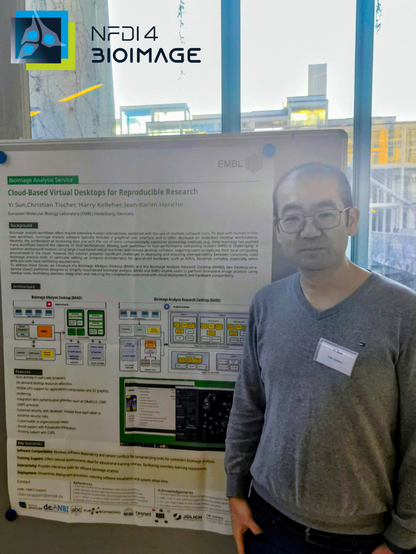
On March 2, Yi Sun (@nfdi4bioimage, @embl) presented his poster "Cloud-Based Virtual Desktops for Reproducible Research" at the first Stuttgart Research Software Day which took place prior to the 6th Conference for Research Software Engineering in Germany #deRSE26 in Stuttgart.

Find more info about the different types of cloud-based virtual desktops Yi Sun and his colleagues provide here:
👉 https://zenodo.org/records/17092303

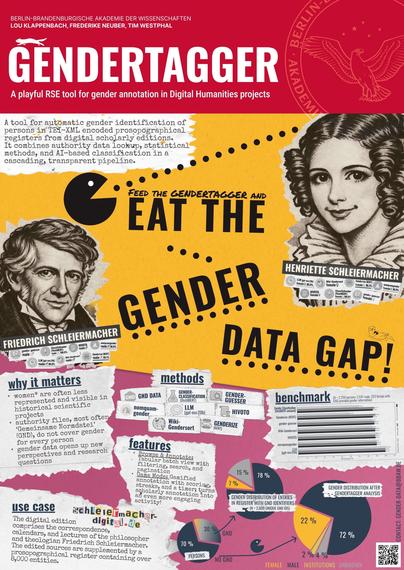
Letzte Woche haben LKlappenbach, TWestphal + ich den Posteraward bei der #deRSE26 in Stuttgart gewonnen! Unser Feminist-Post-Punk-inspiriertes Poster „genderTagger: Ein spielerisches RSE-Tool zur Gender-Annotation in Digital-Humanities-Workflows” ist hier verfügbar: https://zenodo.org/records/18863389

Der genderTagger ist ein Tool zur Gender-Klassifikation in Personenregistern digitaler Editionen u setzt dabei auf ein kaskadierendes Verfahren aus Normdatenabgleich, statistischen Methoden und LLMs.

new blog entry of my impressions of the #deRSE26 conference in Stuttgart.

https://magi.marsupium.org/2026/03/derse26.html

#RSE #RSEng

deRSE26 - Conference for Research Software Engineering in Germany, Stu

1st Stuttgart Research Software Day I arrived early in Stuttgart to join the first Stuttgart Research Software Day. Research S

Are interested in computational reproducibility?

We ( @rupdecat , Raül Sirvent and me) wanted to know how researches address computational reproducibility. We conducted a community survey, spread via HPC and Cloud user mailing lists.

First results were presented at #deRSE26 you can find the poster on Zenodo:
https://zenodo.org/records/18860612

#ResearchReproducibility #Reproducibility #Survey #hpc

Reproducibility Practices in Scientific Computing: A Community Survey

Reproducibility is a cornerstone of scientific practice, enabling researchers to verify findings and adapt methods for their own investigations. The importance of reproducibility has prompted several surveys within the scientific community to assess its current state. Notably, a widely recognized study conducted by Nature revealed that more than half of responding researchers acknowledged the existence of a significant reproducibility crisis [1].Recently, systematic replication studies — particularly in cancer biology — have identified and quantified specific factors rendering published experimental results not reproducible [2]. While these studies have illuminated reproducibility challenges mainly in traditional experimental sciences, we hypothesize lack of computational reproducibility and hence transparency also poses significant problems in computational sciences, including bioinformatics, astrophysics, computational chemistry, and many more computation-reliant fields, due to the interdisciplinary nature of computing.To assess community needs and identify gaps that must be addressed to improve current practices, we conducted an online survey (N = 422) among users of national and institutional HPC and cloud resources. The questionnaire explored:- computational reproducibility awareness and implemented measures,- interest in Workflow Management Systems (WMS) to formalize and automate complex analyses,- current adoption patterns and preferred tools (e.g., Snakemake, Nextflow), and - perceived barriers to reproducible, transparent data and software management. The survey design allowed us to capture perspectives across different computational disciplines, providing insights into how reproducibility awareness and practices vary among research communities. Preliminary findings indicate strong interest in WMS, though only a fraction of respondents report regular use. Additionally, concerns about data provenance, version control, and long‑term archiving emerged as recurring themes. This poster will present the survey design, key statistics, and an early discussion of how HPC centers and software developers might help reduce these obstacles, fostering more reproducible scientific workflows. Results are preliminary and will be refined for a forthcoming peer‑reviewed publication. [1] Baker, M. 1,500 scientists lift the lid on reproducibility. Nature 533, 452–454 (2016). https://doi.org/10.1038/533452a[2] Errington, T. M., Mathur, M., Soderberg, C. K., Denis, A., Perfito, N., Iorns, E., & Nosek, B. A. Investigating the replicability of preclinical cancer biology. eLife 10, e71601 (2021). https://doi.org/10.7554/eLife.71601

Zenodo

It's been a busy week away from the office for our Director of Curriculum Toby Hodges who attended the #deRSE26 conference at the University of Stuttgart!

He presented a talk on the developments around the AI Carpentry project, and also co-led two HPC Carpentry-related sessions.

Toby's talk, "Training to Protect Research Integrity in the Age of AI-assisted Coding," explored some of the open questions surrounding the use of LLMs for coding in research, including: what role should RSEs take in an environment where it has never been easier for researchers to produce code? https://events.hifis.net/event/2945/contributions/21155/

The talk was very well attended and received lots of really positive feedback afterwards about the direction the AI Carpentry project is headed, giving us confidence that we are on the right track. Thanks everyone for your contributions to the project so far!

And thank you, Toby, for all that you do for The Carpentries and our curricula! 🙏💙

Today's Friday croissant+coffee features the newly acquired cup from #deRSE26

Thx for a 🥳 conference, incl networking opportunities with research software infrastructure projects funded by DFG, the national and international RSE community and of course discussions around research software and RSE within #NFDIrocks
I would also like to highlight the keynotes, on www.dealii.org and @swheritage which made clear that community and users are key to the success of such infrastructures #openscience

#deRSE26 For those dealing with delays on your trip back home, there is https://bahn.bet to humorously kill some of your 'extra' time :)
Bahn.Bet — Bet on German Train Delays

Prediction markets on Deutsche Bahn departure delays

Bahn.Bet
Morane Gruenpeter shared her #deRSE26 keynote slides on #DigitalSovereignty and the mission of Software Heritage to preserve this vital intellectual heritage. https://zenodo.org/records/18848442
Thanks for the organiser of the bird of fear "Developing the role and career pathways of RSEs in Germany: Current perspectives and future aims" during #deRSE26. The fish bowl 🐟🥣 structure was fabulous for the discussion.

I had the chance to present a poster about our HPC cluster BinAC 2 at #deRSE26

We're providing computational resources for researchers in Baden-Württemberg working in the fields of Bioinformatics, Astrophysics, Geosciences, Pharmacy and Medical Informatics:
https://wiki.bwhpc.de/e/BinAC2

If you're a researcher at an university in Baden-Württemberg from another field, check out the other HPC clusters bwHPC provides:
https://www.bwhpc.de/cluster.php

Poster on Zenodo:
https://zenodo.org/records/18860391

#hpc #bioinformatics #astrophysics #geosciences #bwhpc #lustre #Slurm