A substantial body of research has investigated the determinants of conspiratorial beliefs, yet little is known about different conspiracy theory endorsement profiles, that is, what types of conspiracy believers are there.

Our latest study used cluster analysis on a set of 52 conspiratorial statements tapping into six conspiracy theory types to identify and validate conspiracy theory endorsement clusters in a randomly drawn sample of the Finnish population (N = 1077). The cluster solution was then further validated in a social media-based convenience sample (N = 772).

Four conspiracy theory endorsement clusters with distinct profiles were identified and validated across the samples. The main difference between the clusters was the level of endorsement: the more one endorses one type of conspiracy beliefs, the more they tend to endorse other types of conspiracy beliefs. Participants who belonged to more conspiracy theory-endorsing clusters held more pseudoscientific beliefs and had lower political trust than participants in the less conspiracy theory-endorsing clusters.

The results provide strong evidence for the existence of four conspiracy theory endorsement profiles and support the notion of a general conspiracy mindset.

https://doi.org/10.1002/ejsp.70080

#ClusterAnalysis #ConspiracyProfile #ConspiracyBelief #PoliticalTrust #PseudoscientificBeliefs
I've updated my #Stata cluster utilities

These utilities add to Stata's cluster capabilities, particularly when clustering from a distance matrix, rather than variables. Stata's "cluster stop" commands do not work in the manner you might expect with distance matrices.

The updates are mainly minor changes to keep up with newer versions of Stata. #clusteranalysis #sociology #quantmethods #datascience

Install:
. net from https://teaching.sociology.ul.ie/statacode
. net install clutils

Index of /statacode

https://cosmicheroes.space/blog/index.php/2023/02/18/advanced-dungeons-and-dragons-monster-clustering/ #ADnD #monster #ClusterAnalysis - finally dug this out again, first one I looked at and some categories that will fit on a screen, as opposed to the massive variety that is HD.
Advanced Dungeons and Dragons Monster Clustering

A few years ago I looked at this, have found it again, so here’s a start. Not, many mess categories as you know, but here’s a plot from 2 that will fit on a screen. Vermin and plants, s…

FASERIPing

I just replied to a query re optimal size of cluster solutions, a bit outside my area of expertise.

I pointed at Everitt et al as a classic: https://books.google.fr/books/about/Cluster_Analysis.html?id=htZzDGlCnQYC&redir_esc=y

Bouveyron, Celeux, Murphy & Raftery, much more up to date https://math.unice.fr/~cbouveyr/MBCbook/

My own code to estimate Calinski-Harabasz & Duda-Hart for #Stata (since Stata's built-in code doesn't work from distance matrices, only the raw data):
https://ulsites.ul.ie/sociology/sites/default/files/wp2016-01_0.pdf

My main point was, however, "there is no correct answer"

#ClusterAnalysis

Cluster Analysis

Cluster analysis comprises a range of methods for classifying multivariate data into subgroups. By organising multivariate data into such subgroups, clustering can help reveal the characteristics of any structure or patterns present. These techniques are applicable in a wide range of areas such as medicine, psychology and market research. This fourth edition of the highly successful Cluster Analysis represents a thorough revision of the third edition and covers new and developing areas such as classification likelihood and neural networks for clustering. Real life examples are used throughout to demonstrate the application of the theory, and figures are used extensively to illustrate graphical techniques. The book is comprehensive yet relatively non-mathematical, focusing on the practical aspects of cluster analysis.

Google Books
Now I see it, thanks HCA!
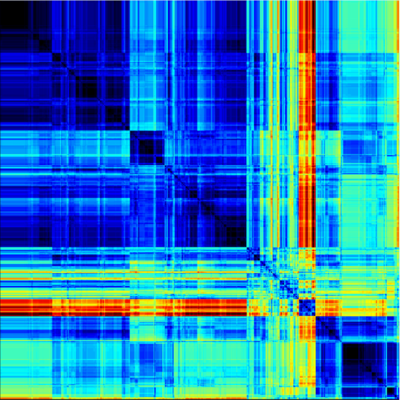
Just as I like my plots, colorful 😍
/s
#programming with #r for #digitalhumanities #clusteranalysis