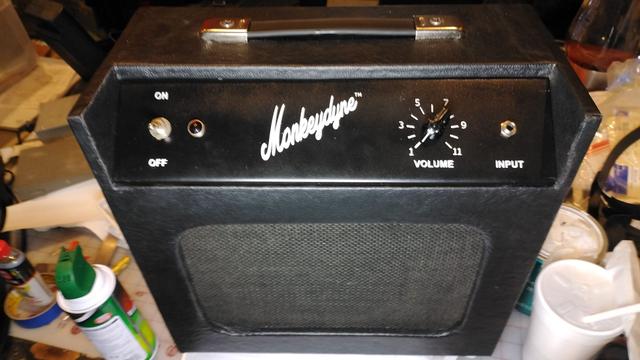
Know Audio: Amplifier Nuts And Bolts
As we've followed a trail through Hi-Fi and audio systems from the listener's ear towards the music source, we've reached the amplifier. In our previous article we gave a first introduction to distortion and how some amplifier characteristics can influence it, and here we'll continue along that path and look at the amplifier itself. What types of audio amplifier circuits will you encounter, and what are their relative merits and disadvantages?
A Few Amplifier Basics
Horowitz and Hill's Transistor Man
If you know anything about a transistor, it's probably that it's a three terminal device whose output pin forms part of a potential divider whose state is dependent on what is presented to its input pin. The Art of Electronics had it as a cartoon of a man standing inside a bipolar transistor and adjusting a variable resistor between collector and emitter while watching an ammeter on the base.
Properly biased in its conducting range, a transistor can behave as a linear device, in which the potential divider voltage moves in response to the input in a linear relationship, and thus the voltage on the output is an amplified version of the voltage on the output. This is the simplest of transistor amplifiers, and because different types of amplifier are referred to by lettered classes, it's known as a class A amplifier.
The class A amplifier's linearity makes it a good choice for the audio designer seeking low distortion, but it comes with a disadvantage. The potential divider action means that it is always passing current whatever state it may be in, thus the transistor must always be able to dissipate that power as heat. This gives the class A amplifier significant inefficiency, and thus one that is powerful enough to drive a loudspeaker must also emit the same power it delivers to the speaker, but as heat. Thus class A power amplifiers require extra cooling lest they get uncomfortably hot, and consume unnecessary power. There are class A audio power amplifiers on the market, but they remain unusual.
Having Your Cake And Eating It: The Class AB
A theoretical Class AB amplifier. The diodes ensure that the transistors are in their class A conducting region around the centre point. Fvultier, CC BY-SA 4.0.
The class A's inefficiency comes from its transistors conducting continuously, it's quite possible to reduce the bias to the point at which the transistors are in the off position but conduct only when a signal appears and pushes them in to conduction. This type of amplifier is referred to as a class B amplifier, and it typically only amplifies a portion of the incoming waveform. It solves the class A's inefficiency but introduces a significant distortion to its output, which is why you will not encounter it in a simple form as an audio amplifier except perhaps in some very early tube radios.
Given that a class B circuit can amplify half of the waveform cycle without distortion, an obvious progression is to combine two of them; one to amplify the upper half of the cycle and another the lower half.The idea is that the complete amplified waveform can be reconstructed from the two amplifiers, and yield a low-distortion and efficient result.
This works to an extent, but such a circuit still retains some distortion because the point at which the two waveforms meet is almost impossible to achieve without some kind of break, and this little glitch is known as crossover distortion. The solution to this problem comes in clever biasing, that operates the transistors in class B over almost all of their range but gives them enough bias to work in class A over its midpoint at which the two halves of the amplifier hand over from one to the other. This arrangement is referred to as a class AB amplifier, it delivers very low distortion alongside the all-important power efficiency, and forms the vast majority of analogue Hi-Fi amplifiers.
You might expect us to now move to the next letter of the alphabet and describe the class C amplifier here, but instead the final audio configuration is a class D amplifier. (Class C amplifiers are on-off squarewave amplifiers that have high efficiency but huge distortion. They're no good for audio but find a use in RF power amplifiers, where LC circuits filter out the resulting harmonics.)
A Fully Digital Audio Amplifier: Class D
Most Hackaday readers will be familiar with the idea of pulse width modulation, the act of varying the energy delivered to a load by sending it pulses with a variable ratio of on-time to off-time. This is how many microcontrollers produce a pseudo analogue output for linear control of LED brightness or motor speed, to name but two examples. Given a high enough switching frequency PWM can be used to encode rapidly-changing analogue signals such as audio, and thus a PWM stream can be fed to a high power buffer to produce an audio output.
A basic Class D amplifier. Rohitbd, CC BY-SA 3.0.
A practical class D amplifier uses PWM in this way, with its output transistors simply working a high-speed switches. There's a passing similarity to a class C amplifier, but the difference is that the class D switches at many times the signal frequency while the class C operates at its signal frequency. The class D amplifier produces a high-power PWM pulse train, which is converted into high-power audio to drive a speaker by means of a low-pass filter network. The advantage of a class D amplifier is that it can deliver extreme efficiency, meaning that it can be built smaller and lighter than a linear circuit and with less need for heat management.
There are a few further classes of amplifier which are worth mentioning, classes E and F which are more RF amplifiers that rely on pulsing resonant LC networks with short pulses to derive an output, and classes G and H which are variations on a class AB amplifier with a PSU that varies to minimise standing current. You may encounter ICs that offer classes G and H, but from an audio point of view they can be considered as simply more efficient versions of a class AB amplifier.
We've taken a look at the circuit topologies behind the amplifiers you will find in your Hi-Fi system, and also in every audio-producing device you own. So then, the question is: which is better, class A, class AB, or class D? The answer to that isn't cut-and dried, as the performance of an amplifier depends not necessarily on its principle but upon how its designer has executed it. It's possible to make audio amplifiers in all of the above topologies that are either truly awful or exquisite-sounding, so perhaps it's best not to get too hung up on it. A class A amplifier gives you bragging rights and keeps your house warm, a class AB amplifier is what you'll find in most Hi-Fi separates, and a class D amplifier will be lighter and cooler. Amplifiers: there, we fixed it!
#hackadaycolumns #homeentertainmenthacks #amplifier #audio #classa #classab #classb #classd
 Retro Markus 🇩🇰🇩🇪
 DoomsdaysCW
 i4cy 📌
 HUGEBIRD9000
 m0bi
m0bi Mark
Mark 

 Könich

 hackaday unofficial