Astronomers Find New Circumbinary "Tatooine-like" Planet Candidates
https://atlas.whatip.xyz/post.php?slug=astronomers-find-new-circumbinary-tatooine-like-planet-candidates
<p>There&#039;s a distinct category of exoworlds out there that orbit two stars
#circumbinary #astronomers #candidates #tatooine

Astronomers Find New Circumbinary "Tatooine-like" Planet Candidates

There's a distinct category of exoworlds out there that orbit two stars. They're called "circumbinary" planets and up until recently, astronomers had only found about 18 of them am...

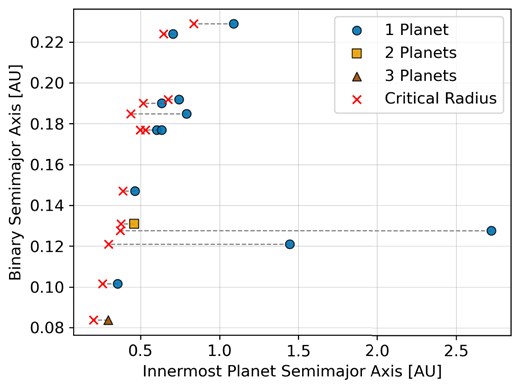
Detection of 27 candidate #circumbinary planets through apsidal precession of eclipsing binaries observed by TESS: https://academic.oup.com/mnras/article/548/3/stag515/8524019?login=false -> New Star Wars-like planet candidates with two suns discovered / For NASA’s TESS, Stellar Eclipses Shed Light on Possible New Worlds: https://news.unsw.edu.au/en/almost-30-real-life-tatooine-planet-candidates-discovered / https://science.nasa.gov/missions/tess/for-nasas-tess-stellar-eclipses-shed-light-on-possible-new-worlds/
Detection of 27 candidate circumbinary planets through apsidal precession of eclipsing binaries observed by TESS

ABSTRACT. Most circumbinary planets have been discovered by their transits, limiting our understanding of such systems to those with mutually coplanar arch

OUP Academic
The formation of #circumbinary planets through disc fragmentation: https://academic.oup.com/mnras/article/548/3/stag476/8661676?login=false -> Two suns are better than one - planets thrive around binary stars: https://www.lancashire.ac.uk/news/two-suns-are-better-than-one
The formation of circumbinary planets through disc fragmentation

ABSTRACT. Over 50 circumbinary exoplanets have been discovered in recent years, with several of them being gas giants on wide orbits (${\gt} 10$ au). The a

OUP Academic
I started this thread because I thought a new #circumbinary system had been discovered this week in a paper entitled "A planetary system around a binary star, including a mini-Neptune in the habitable zone". However, despite the system apparently being "around a binary star", this is actually just a traditionally-orbiting planet around a star which also happens to have a stellar companion. Booo. https://arxiv.org/abs/2404.18997
Planet Hunters TESS V: a planetary system around a binary star, including a mini-Neptune in the habitable zone

We report on the discovery and validation of a transiting long-period mini-Neptune orbiting a bright (V = 9.0 mag) G dwarf (TOI 4633; R = 1.05 RSun, M = 1.10 MSun). The planet was identified in data from the Transiting Exoplanet Survey Satellite by citizen scientists taking part in the Planet Hunters TESS project. Modeling of the transit events yields an orbital period of 271.9445 +/- 0.0040 days and radius of 3.2 +/- 0.20 REarth. The Earth-like orbital period and an incident flux of 1.56 +/- 0.2 places it in the optimistic habitable zone around the star. Doppler spectroscopy of the system allowed us to place an upper mass limit on the transiting planet and revealed a non-transiting planet candidate in the system with a period of 34.15 +/- 0.15 days. Furthermore, the combination of archival data dating back to 1905 with new high angular resolution imaging revealed a stellar companion orbiting the primary star with an orbital period of around 230 years and an eccentricity of about 0.9. The long period of the transiting planet, combined with the high eccentricity and close approach of the companion star makes this a valuable system for testing the formation and stability of planets in binary systems.

arXiv.org
NB - There is an outdated nomenclature which I think should be left to die: "S" and "P"-type orbits. "#Circumbinary" is a perfectly good term which is far more descriptive and intuitive than "P-type". While S-type in in many ways inseparable from just a normal planet-star orbit? It's like giving a unique term to any roundabouts that have a second smaller roundabout within a few kilometers.
The weird/interesting type of planets in binary systems are #circumbinary planets. Here, a binary pair of stars orbit close together (few days to weeks period), and planets orbit the pair of them (typically with periods of a few months or longer). Close binaries are much rarer, and finding planets around them is difficult, so only a few are known. Understanding where circumbinary planets are stable, and how they could have formed is a tricky problem. Examples: PH-2, Kepler-16, Tatooine, etc.

A circumbinary planet is a planet that orbits two stars instead of one.

#science #sciencefacts #circumbinary #circumbinaryplanet #binarystar #exoplanet