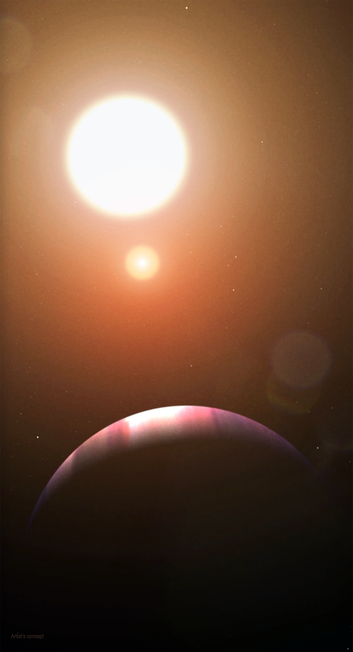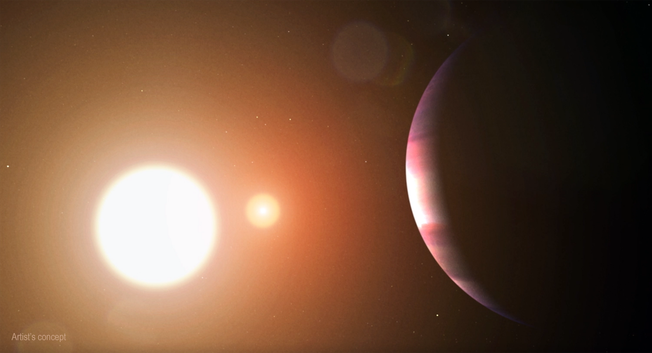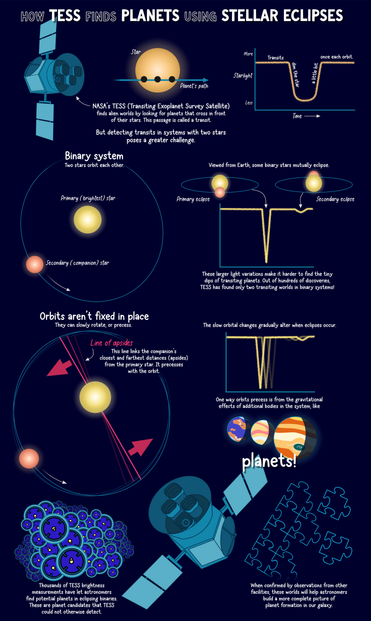
Constraining properties of dust formed in #WolfRayet binary WR 112 using mid-infrared and millimeter observations: https://arxiv.org/abs/2511.19572 -> ALMA and JWST reveal nanometer-scale carbon #dust grains emanating from a massive #BinaryStar system: https://public.nrao.edu/news/a-quintillion-to-one-giant-stars-tiny-dust/
Constraining properties of dust formed in Wolf-Rayet binary WR 112 using mid-infrared and millimeter observations

Binaries that host a carbon-rich Wolf-Rayet (WC) star and an OB-type companion can be copious dust producers. Yet the properties of dust, particularly the grain size distribution, in these systems remain uncertain. We present Band 6 observations of WR 112 by the Atacama Large Millimeter/submillimeter Array telescope (ALMA), which are the first millimeter observations of a WC binary system capable of resolving its dust emission. By combining ALMA observations with James Webb Space Telescope (JWST) images, we were able to analyze the spatially resolved spectral energy distribution (SED) of WR 112. We found that the SEDs are consistent with emissions from hydrogen-poor amorphous carbon grains. Notably, our results also suggest that the majority of grains in the system have radii below one micrometer, and the extended dust structures are dominated by nanometer-sized grains. Among four parameterizations of the grain radius distribution that we tested, a bimodal distribution, with abundant nanometer-sized grains and a secondary population of 0.1-micron grains, best reproduces the observed SED. This bimodal distribution helps to reconcile the previously conflicting grain size estimates reported for WR 112 and for other WC systems. We hypothesize that dust destruction mechanisms such as radiative torque disruption and radiative-driven sublimation are responsible for driving the system to the bimodal grain size distribution.

arXiv.org

I think we can all at least agree, that the Solar System is non-binary.

Estimates for binary stars in the Milky Way vary, but many sources suggest that roughly 50% to 85% of all stars are in binary or multiple-star systems.

Multiple star systems sound interesting, hmm, but the point is! Our Solar System is non-binary 🚥

#nonbinarylogic #binarystar

Zwei Spiele, ein Modul und jede Menge Vektorgrafik-Action: Outta Space! von Binary Star Software bringt 2025 frischen Homebrew-Schwung auf die gute alte #Vectrex!
Arcade-Shooter trifft auf Astrosmash-Vibes – dazu liebevolle Details und technische Finesse.
Mein Review gibt’s hier:
https://www.jungsi.de/outta-space-vectrex

#Homebrew #RetroGaming #Vectrex #BinaryStar #ArcadeAction #JungsisCorner

https://www.jungsi.de/outta-space-vectrex/

Outta Space [Vectrex]

Outta Space Outta SpaceAutor: Binary Star SoftwareJahr: 2025System: VectrexBezugsquelle Outta Space! – Vectrex-Homebrew aus dem All 🛸 Mit Outta Space! ist Anfang 2025 ein weiteres Highlight für die…

Jungsis Corner
Scientists uncovered a #binarystar system close to #blackhole near center of #MilkyWay, confirming a hypothesis made by happenstance nearly a century ago, according to a paper published in Nature Communications. Scientists previously predicted the existence of a binary #star system -- one in which two stars are gravitationally bound to one another around a common center of gravity -- in the vicinity of the black hole at the center of the galaxy, called #SagittariusA*.
https://abcnews.go.com/Technology/binary-star-system-found-milky-way-black-hole/story?id=116763825
Binary star system found near the Milky Way's black hole: An 'amazing' discovery, astrophysicists say

The discovery could lead to the finding of more planets.

ABC News
A Binary Star Found Surprisingly Close to the Milky Ways Supermassive Black Hole

Binary stars are common throughout the galaxy. Roughly half the stars in the Milky Way are part of a binary or multiple system, so we would expect to find them

Ground News

T CrB
https://theskylive.com/sky/stars/hr-5958-star
Oh. It's brightening..!? This is within normal ranges for it, however. Guess we'll see...

(Still dim, but it was magnitude 11.1 a week or two ago. Fingers crossed 🤞)

#TCrB #CoronaBorealis #Nova #RecurrentNova #binarystar
#astronomy #astrophysics #RedGiant #WhiteDwarf

T Coronae Borealis - Star in Corona Borealis | TheSkyLive

T Coronae Borealis is a variable subdwarf star of magnitude 2 in the constellation of Corona Borealis. Find complete information about T Coronae Borealis on TheSkyLive.com.

"However, that assumes the long pulsation cycle is internal. If it’s actually due to a second star, then Betelgeuse is likely still fusing helium in its core, which means it has a lot longer left to go before it detonates, over a hundred thousand years. If you’re waiting for it to explode, and this second star turns out to be real, well then you’d better pack a lunch. It’ll be a while."

😭 🥪

https://badastronomy.beehiiv.com/p/is-betelgeuse-binary

#alphaorionis #betelgeuse #binarystar #supernova #astronomy

Is Betelgeuse binary?

The bloated star may have a little buddy, which would explain its odd behavior

Bad Astronomy Newsletter
Wolfman Jack, by Binary Star

3 track album

One Be Lo
Once in a lifetime: The faint #binarystar T CrB will be visible as the 8th star in the #NorthernCrown for a few days during its 80-year periodic #Nova event sometime this summer. Who's waiting with us?
More details: https://www.nasa.gov/centers-and-facilities/marshall/nasa-global-astronomers-await-rare-nova-explosion/
NASA, Global Astronomers Await Rare Nova Explosion - NASA

Around the world, professional and amateur astronomers alike are closely watching T Coronae Borealis – the “Blaze Star,” a binary system some 3,000 light-years from Earth – waiting for an impending nova explosion event so bright it will be visible on Earth with the naked eye.

NASA
> The binary star system in the constellation Corona Borealis — “northern crown” — is normally too dim to see with the naked eye.
>
> But every 80 years or so, exchanges between its two stars, which are locked in a deadly embrace, spark a runaway nuclear explosion.

https://phys.org/news/2024-04-huge-star-explosion-sky-lifetime.html

https://en.wikipedia.org/wiki/T_Coronae_Borealis

#astronomy
#binaryStar
#binarySystem
#BlazeStar
#CoronaBorealis
#recurrentNova
#TCoronaeBorealis
#TCrB
Huge star explosion to appear in sky in once-in-a-lifetime event

Sometime between now and September, a massive explosion 3,000 light years from Earth will flare up in the night sky, giving amateur astronomers a once-in-a-lifetime chance to witness this space oddity.

Phys.org