BridgeDb Java 3.0.30 is released: https://github.com/bridgedb/BridgeDb/releases/tag/release_3.0.30 https://doi.org/10.5281/zenodo.18157075

"This release updates to BridgeDb Datasources 20260105 adding a few hundred more species and updates various dependencies and Maven plugins."

BridgeDb Java is the library that implements a Java API to access identifier mappings (e.g. from #ChEBI to #Wikidata, or from Ensembl to UniProt) from local files.

Release BridgeDb 3.0.30 · bridgedb/BridgeDb

This release updates to BridgeDb Datasources 20260105 adding a few hundred more species and updates various dependencies and Maven plugins. Full Changelog: release_3.0.29...release_3.0.30 The below...

GitHub

Any idea how to get the (#cheminformatics) structures for a #ChEBI ontology term? Like, how do I get all the terpenoids, CHEBI:26873?

https://www.ebi.ac.uk/ols4/ontologies/chebi/classes/http%253A%252F%252Fpurl.obolibrary.org%252Fobo%252FCHEBI_26873?lang=en says there are 11,119 terpenoids but I see no way to download them.

Trying the web API, https://www.ebi.ac.uk/chebi/backend/api/public/ontology/all_children_in_path/?relation=has_functional_parent&entity=CHEBI%3A26873&three_star_only=false&page=1&size=15&download=false says there are 547 (482 if three_star_only=true).

With 'download=true' I get the data in full (unpaged) data in tsv format, with the same counts.

What am I missing?

Ontology Lookup Service (OLS)

OLS is a repository for biomedical ontologies that aims to provide a single point of access to the latest ontology versions

BridgeDb Java 3.0.29 is released: https://github.com/bridgedb/BridgeDb/releases/tag/release_3.0.29

"This update release brings in BridgeDb Datasources 20270728, improves the backwards compatibility with old Apache Derby versions, adds a BridgeDb.getVersion() method, and updates various dependencies."

BridgeDb Java is the library that implements a Java API to access identifier mappings (e.g. from #ChEBI to #Wikidata, or from Ensembl to UniProt) from local files.

Release BridgeDb 3.0.29 · bridgedb/BridgeDb

This update release brings in BridgeDb Datasources 20270728, improves the backwards compatibility with old Apache Derby versions, adds a BridgeDb.getVersion() method, and updates various dependenci...

GitHub

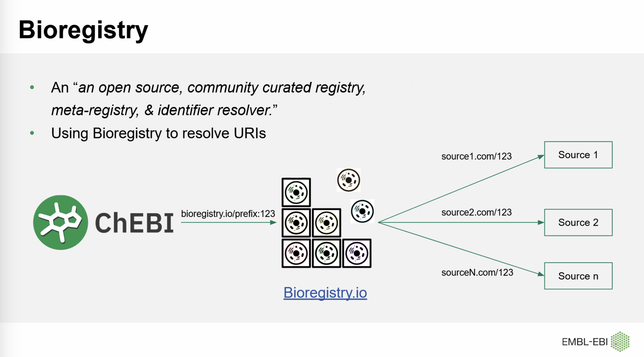
At the ChEBI 2.0 workshop, Muhammad Arsalan is presenting how ChEBI is using the Bioregistry to standardize its cross-references, generate URLs on their front-end, and more

#chembl #ebi #chebi #sssom #cheminformatics

BridgeDb Java 3.0.27 is released: https://github.com/bridgedb/BridgeDb/releases/tag/release_3.0.27

"This update release brings in BridgeDb Datasources 20240725, a new organism (Solanum tuberosum), and various small stability improvements."

BridgeDb Java is the library that implements a Java API to access identifier mappings (e.g. from #ChEBI to #Wikidata, or from Ensembl to UniProt) from local files (there is API support for online services too, but we need help maintaining this code).

Release BridgeDb 3.0.27 · bridgedb/BridgeDb

This update release brings in BridgeDb Datasources 20240725, a new organism (Solanum tuberosum), and various small stability improvements.

GitHub

I've published a detailed article about #ChatGPT hallucination minimization using predefined #SPARQL-based query templates scoped to Linked Open Data (LOD) Cloud Knowledge Graphs such as #UniProtKB, #RHEA, #chEBI, and #OMIM.

Read: https://www.linkedin.com/pulse/reducing-hallucinations-chatgpt-using-predefined-query-idehen-4qxje/ .

#HowTo #UseCase #VirtuosoRDBMS #SemanticWeb #LinkedData #KnowledgeGraph #AI #GenAI

Reducing Hallucinations in ChatGPT using Predefined Query Templates scoped to Knowledge Graphs

In the fast-paced world of artificial intelligence, chatbots using language model strategies are becoming more common. However, these chatbots sometimes generate responses based on incorrect or fabricated information, a problem often referred to as “hallucinations.

Remodeling other groups data is attractive but in the long run a waste of time.

Working together to remodel with the other group however is great.

Which is why I am looking forward to #CHEBI 2.0 in the ontology layer.

Applications session: Talk

3. Elisabeth Coudert talks about Annotation of biologically relevant ligands - such as substrates of enzymes, cofactors, activators, inhibitors as well as their binding site - in UniProt using ChEBI

#biocuration2023 #Applications #uniprot #chebi