 EL PAÍS: el periódico global [Unofficial]
Dimite la presidenta de los estudiantes de Medicina: “Los sindicatos admiten en privado que sus reivindicaciones son imposibles”
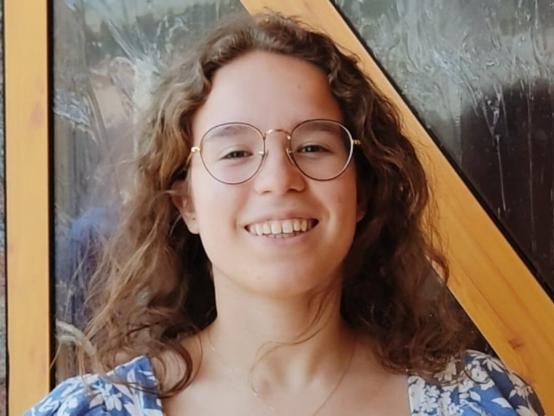
Dimite la presidenta de los estudiantes de Medicina: “Los sindicatos admiten en privado que sus reivindicaciones son imposibles”
PODCAST Épisode 83 #Écho #CESM | Terres Australes et Antarctiques Françaises #TAAF : enjeux et acteurs

70 ans d’existence, 2,5 millions de km² de zone maritime, un rôle unique pour la science, la souveraineté et la biodiversité : bienvenue dans les Terres australes et antarctiques françaises (TAAF).
PODCAST Épisode 14 #Carré #CESM | Livre "Voyage en France Australe" : Bruno Fuligni explore les #TAAF

Cap sur l’extrême sud de l’océan Indien : les Terres australes et antarctiques françaises (TAAF). Dans ce nouvel épisode du Carré, Horizons Marines reçoit Bruno Fuligni, écrivain, historien et maître de conférences à Sciences Po, pour parler de son ouvrage Voyage en France australe qui vient de paraître aux Éditions Allary.
Physics-based indicator predicts tipping point for collapse of Atlantic current system in next 50 years
by Krystal Kasal
"The Atlantic Meridional Overturning Circulation (#AMOC) is an enormous loop of ocean current in the Atlantic Ocean that carries warmer waters north and colder waters south, helping to regulate the climate in many regions. The collapse of this critical circulation system has the potential to cause drastic global and regional climate impacts, like #droughts and #ColderWinters, especially in Northwestern Europe.
"Previous research has already indicated a weakening in the AMOC, but there has been uncertainty about when the AMOC will collapse under future climate change or whether it will collapse at all. But new research, now published in the Journal of Geophysical Research: Oceans, indicates that collapse of the AMOC is likely and that it might begin sooner rather than later.
"Using a new physics-based indicator and the Community Earth System Model (#CESM), the study authors have produced new simulations of the AMOC collapse under various conditions.
"The researchers believe the new indicator better represents the water circulation compared to previously used parameters, such as the ocean's surface temperature. Instead, it represents a tipping point indicated by a sign change in surface buoyancy flux (Bflux) over a key part of the North Atlantic Ocean from 40°N to 65°N. They also compared their results to historical observations and data.
"Their simulations tested out 25 different climate models. They say that the AMOC was fairly stable until about 2020, but since then, there have been signs of weakening. Future modeling shows that, in high-emission scenarios, the AMOC collapse tipping point began as early as 2023 and as late as 2076, with a median tipping point at 2055. Under more intermediate scenarios, the tipping point was placed between 2026 and 2095, with a median of 2063.
"The study authors note, 'If the AMOC starts to collapse, it takes more than 100 years to reach a substantially weaker state. During that transition, the Northwestern European climate would change drastically and is expected to see colder winters, less rainfall, and more severe winter storms.'
"The study authors also note that many prior simulations only ran until around 2100, but letting simulations go further into the future might provide more accurate results. They say, 'Given these risks of AMOC tipping under climate change, we encourage modeling groups to simulate to at least the year 2200.'
"There were some limitations in this research; for example, most models did not include enhanced #GreenlandIceMelt, which could actually accelerate AMOC weakening. In some cases, background circulation can balance surface buoyancy gain. In these cases, the proposed indicator can also give false positives, but this is rare.
"There is still time for societies to limit the impact of eventual AMOC collapse or to develop adaptation strategies, but the study authors offer a stark warning, saying, 'To limit the risk of AMOC weakening and a potential collapse in the foreseeable future, global society needs to be on track of a #LowEmission scenario and urgent #ClimateAction is needed to guarantee this.' "
Read more:
https://phys.org/news/2025-09-physics-based-indicator-collapse-atlantic.html

The Atlantic Meridional Overturning Circulation (AMOC) is an enormous loop of ocean current in the Atlantic Ocean that carries warmer waters north and colder waters south, helping to regulate the climate in many regions. The collapse of this critical circulation system has the potential to cause drastic global and regional climate impacts, like droughts and colder winters, especially in Northwestern Europe.

This collection of data includes post-processed Weather Research and Forecasting model (WRF) outputs to understand the extreme Texas drought and flood years. Specific statistical analysis methods used include: Probability of Detection (POD), False Alarm Rate (FAR), Relative Operating Characteristics (ROC), Probability distribution of daily precipitation frequency and pattern correlation maps. Data format includes: Matlab and NetCDF. This data collection is part of research material for a Journal of Geophysical Research - Atmosphere manuscript. Refer to Statistical analysis templates for the Weather Research and Forecasting model and Community Earth System Model for the associated code files. For inquiries regarding the contents of this dataset, please contact the Corresponding Author listed in the README.txt file. Administrative inquiries (e.g., removal requests, trouble downloading, etc.) can be directed to [email protected]
🎙️ À partir d'aujourd'hui, deux (2) fois par mois, sera diffusé des épisodes sélectionnés par la rédaction de « le marin ». Deux (2) émissions : Écho, un échange avec un expert sur un sujet stratégique & Périscope, un format long d'une heure. #france #cesm #marine #podcasts [ https://lemarin.ouest-france.fr/defense/nouveau-les-podcasts-du-centre-detudes-strategiques-de-la-marine-diffuses-par-le-marin-fdfe0562-d1ab-11ef-8aa9-6a8073542db7 ]
Premier podcast Écho :

Institut d’expertise du ministère des Armées dédié à la Marine nationale et au maritime, le Centre d’études stratégiques maritimes (CESM) publie des études mais aussi des podcasts pour décrypter sur le fond le monde maritime. À partir de ce 15 janvier, deux fois par mois, « le marin » diffusera une sélection d’épisodes sélectionnés par la rédaction. Détails du travail réalisé sur ces podcasts avec le directeur du CESM, l’amiral David Samson.
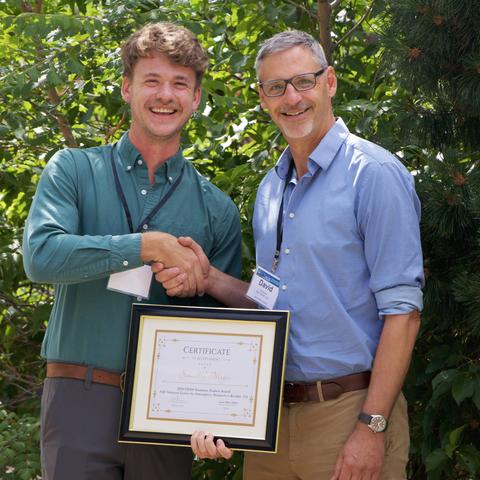
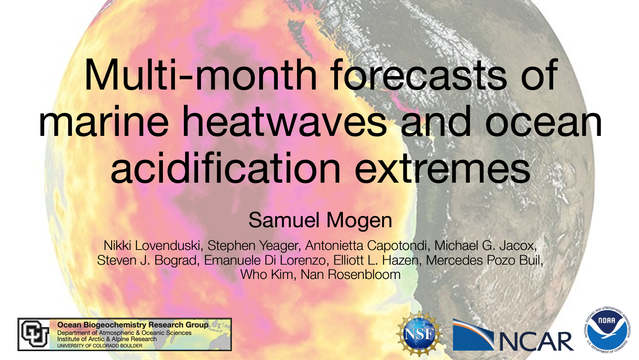
🏆 Today at the 2024 #CESM Workshop (Community Earth System Model), grad student SAMUEL MOGEN (INSTAAR/ATOC) was awarded for his collaborative forecasts of marine heatwaves & acidification extremes. Way to go Samuel! 👏🏽
Workshop info
Agenda https://buff.ly/4edTGiL
YouTube https://buff.ly/4bWWYFI

Today we dive into exploration of the Oceans.
Our first speaker is Laure Zanna with a wonderful talk on Ocean and Atmosphere Dynamics, and its future developments in the age of data and AI. Ocean dynamics and climate modeling concepts will set the path for the following tutorials.
We’ll use different tools such as Xarray, NCAR CGD CESM2 climate models and data from @CopernicusECMWF Era5 dataset to explore the ocean and atmosphere interactions, and understand complex events like El Niño and La Niña
#elniño #laniña
#cesm #dynamics #oceans #climate #era5
Na #Galiza segue a #greve indefinida de pessoal médico do Serviço Galego de Saúde convocada pola Confederación Estatal de Sindicatos Médicos (#CESM*).
* CESM não tem representação na mesa sectorial e coletivos com presença de diferentes categorías criticam algumas das suas reivindicações.
https://praza.gal/politica/mobilizacion-sanitaria-por-riba-e-por-baixo

O sindicato CESM convoca un paro desde este martes e reclama unha xornada de 35 horas semanais, axendas de 30 pacientes como máximo en Atención Primaria ou que o plus salarial para quen só traballa na pública se estenda a quen o fai tamén na privada. A Asociación Galega en Defensa da Sanidade Pública cualifica de "oportunista" a convocatoria.
 Polar Observer
 DoomsdaysCW
 ReDATA, University of Arizona
 chirp
chirp INSTAAR
 Carabanchelnet 🔻 #7291VICTIMAS 🍉
 Climatematch
 o ifrit 🌱