 Dr. Raphael Weyland
Don't #greenwash us, fossil industry. Says French court to #TotalEnergie. #Casework #RuleOfLaw https://www.politico.eu/article/totalenergies-misled-customers-with-green-claims-french-court-rules/

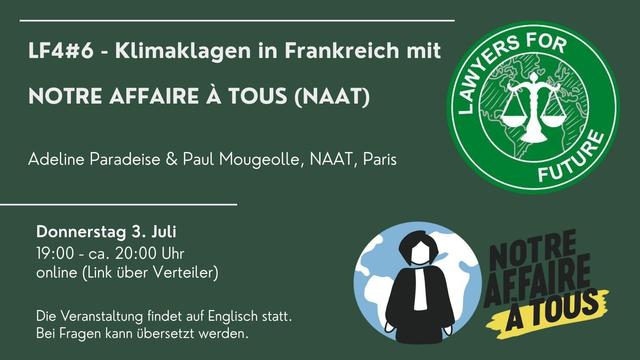
📆 3 July, 7pm, online (in EN): As #Lawyers4future we are pleased to discuss with #notreaffaireatous about French & German #climate #casework, to learn from each other & leverage the best out of #ParisAgreememt & the #RuleOfLaw ⚖️ Become part of our network: https://www.lawyersforfuture.eu/mitmachen/
Important win for @greenpeace_de NL supported by i.a. VBN in the #Nitrogen case. Court ruling shows that NL government needs to continue to make #agriculture sustainable, with less meat etc. This is good for people & health, water and nature! #RestoreNature #Casework https://www.greenpeace.org/nl/algemeen/56408/waarom-greenpeace-een-rechtszaak-voor-de-natuur-voert-en-tegen-het-trage-stikstofbeleid/#:~:text=Als%20de%20stikstofuitstoot%20van%20de,meest%20kwetsbare%20natuur%20te%20redden

Dit is waarom de overwinning in de stikstofzaak zo belangrijk is | Greenpeace Nederland | Voor een groene, leefbare aarde 🌍 - Greenpeace Nederland
De overheid hoort de natuur te beschermen, omdat 17,5 miljoen Nederlanders de natuur nodig hebben voor hun welzijn, schone lucht, schoon drinkwater en als bondgenoot tegen klimaatverandering.
 Karl D
 Ben Taylor
With my Trade Union hat on I supported someone a little while back who was accused of something particularly unpleasant. He strenuously and emotionally denied everything. I chose to believe him, because it felt like someone had to and my job as his TU rep was to support him, which was much easier if I decided he was telling the truth. And he was at a similar or slightly earlier stage to me in life with similar problems to what I'd gone through (otherwise similar, anyway), I saw some of myself in him.
For different reasons both he and I left the company before his case came to trial, I didn't find out what the outcome was until just now. He wasn't telling the truth. That will be his victim re-traumatised, his wife betrayed, his family presumably broken, his child growing up with that stigma on his father, and that's leaving aside the toll on him, personally.
I feel incredibly sad. There are no winners here. There were never going to be as soon as he did what he did.
📗 Published yesterday in Environmental Science: Our joint article on the legal character of the #KunmingMontreal CBD #ForNature Agreement re. its interpretation in the light of the #HumanRights Law 😊 #OpenAccess #CaseWork #NatureCrisis https://link.springer.com/article/10.1186/s12302-023-00786-5

Legally binding and ambitious biodiversity protection under the CBD, the global biodiversity framework, and human rights law - Environmental Sciences Europe
Beyond climate change, the planet faces several other environmental challenges that are at least as threatening, such as the loss of biodiversity. In each case, the problems are driven by similar factors, such as fossil fuels and intensive livestock farming. This paper presents a legal analysis concerning the binding nature of the Convention on Biological Diversity’s (CBD) overarching objective to halt biodiversity loss, within the framework of international environmental and human rights law. Using the established legal techniques encompassing grammatical, systematic, teleological, and historical interpretations, the article demonstrates that the CBD’s objective to halt biodiversity loss is indeed legally binding and justiciable. This conclusion is directly drawn from interpreting Article 1 CBD. Furthermore, a comparable obligation emerges indirectly from international climate law. The imperative to curtail biodiversity loss also finds grounding in human rights law, albeit necessitating a re-evaluation of certain aspects of freedom, similar to what has been explored in the context of climate protection. Moreover, the article underscores that various other biodiversity-related regulations within international law, including those laid out in the CBD, the Aichi Targets, and the Kunming–Montreal Global Biodiversity Framework, also carry partial legal significance. Nonetheless, it is crucial to note that these regulations, including the Kunming–Montreal Framework, do not modify the obligation mandate to halt biodiversity loss, which was established at the latest when the CBD entered into force in 1993. Because this obligation has been violated since then, states could potentially be subject to legal action before international or domestic courts for their actions or inactions contributing to global biodiversity loss.
 Eurojust
📩 Coming soon to our subscribers' mailboxes:
📰 The #Eurojust Newsletter - with all the latest on what we did in Q2, including on
🇺🇦 #ICPA & #Ukraine
⚖️ #Casework
📗 #Publications
➕ much more
✍️ If you haven't subscribed yet, this is your chance:
👉 https://europa.eu/!Y6ttTJ https://t.co/vGE4Vw4NdL
🐦🔗: https://n.respublicae.eu/Eurojust/status/1679801425683947522
⌛️ Short on time but interested in the Q1 highlights of #Eurojust? ⚖️🇪🇺
🆕 Fresh from the (digital) press: our Eurojust #Newsletter, covering the latest developments!
Including
🇺🇦 #Ukraine
🚨 #Casework
👥 #Events
📚 #Publications
➕ more
Get it here 👉 https://europa.eu/!cWQBHc
🐦🔗: https://n.respublicae.eu/Eurojust/status/1648995098825203713
 Steph
StephReposting my #Introduction I followed @sarahtaber over here in the first wave of #Twitterexodus
I’m Steph #GenX an old #Rugby #WomensRugby player I live along the #MississippiRiver. I love #Gardening #Cooking what we grow. I’m currently restoring a1970’s #Airstream with my retired husband and kids #KinshipFamily. I’m hooked to my #Hydrow And there is always a #Puzzle on my dining room table.To pay for all this fabulousness I work in #Manufacturing #Casework and #FumeHoods for the #lab industry
I’m Steph #GenX an old #Rugby #WomensRugby player I live along the #MississippiRiver. I love #Gardening #Cooking what we grow. I’m currently restoring a1970’s #Airstream with my retired husband and kids #KinshipFamily. I’m hooked to my #Hydrow And there is always a #Puzzle on my dining room table.To pay for all this fabulousness I work in #Manufacturing #Casework and #FumeHoods for the #lab industry
This is what Eurojust is about: getting #JusticeDone for a safe Europe 👇
💻 Takedown of online investment fraud
💶 Action against large-scale VAT fraud
🎨 Return of a 17th-century painting
etc.
All of our recent #casework in the Q3 newsletter:
💼 https://bit.ly/Eurojust_Newsletter