 Bryan King
Beyond the Screen: Forging Real Skills in a Theoretical World
1,945 words, 10 minutes read time.
This isn’t about arts and crafts. It’s not about making plastic dinosaurs to sit on a shelf. If you’re looking for a “fun activity” to kill an hour of classroom time, go find some glitter and glue. But if you want to equip the next generation with the mental armor and mechanical intuition they need to survive an increasingly complex world, you put them in front of a 3D printer and tell them to build something that works. Teaching kids about 3D printing is about the brutal transition from the theoretical to the physical—it’s about moving beyond the screen and into the reality of engineering, where the only thing that matters is the final part in your hand.
The Death of the Abstract: Why Tactical Learning Matters
The modern education system is currently drowning in a sea of digital abstractions. We give kids tablets and tell them they are “tech-savvy,” but most of them couldn’t explain how a simple screw works, let alone how to manufacture a custom bracket for a drone. By bringing 3D printing into the classroom, we are staging a coup against the “theoretical” model of learning. We are forcing students to take a concept that lives in the safe, clean vacuum of a computer screen and subject it to the unforgiving laws of physics. It is the ultimate reality check; a machine that doesn’t care about your intentions, only your execution.
When a student designs a part in CAD (Computer-Aided Design), they are speaking a language of precision. They aren’t just drawing; they are defining dimensions, calculating tolerances, and anticipating material behavior. This is visceral learning at its finest. If they mess up a measurement by half a millimeter, the part won’t fit. If they ignore the need for support structures, they end up with a pile of plastic spaghetti. There is no “partial credit” in the physical world. There is only the functional part or the scrap bin. That kind of immediate, high-stakes feedback builds a level of accountability and mechanical literacy that no textbook or multiple-choice test can ever hope to touch.
Forging Resilience Through the “Failed Print”
In a world that coddles kids and protects them from every minor setback, the 3D printer is a veteran coach who tells it like it is. One of the most powerful tools in an educator’s arsenal isn’t the successful print; it’s the failure. A failed print is a high-value intelligence report. It is a physical manifestation of a logic error. When a kid walks over to the build plate and sees a warped, stringy mess instead of the part they spent three hours designing, that is the moment the real education begins. We shouldn’t be apologizing for the failure; we should be demanding a post-mortem.
This process of iterative failure builds a specific kind of “grit-lit” resilience. It teaches a student to look at a disaster, diagnose the root cause—was it a bed leveling issue, a cooling problem, or a fundamental design flaw?—and go back to the digital drawing board with a better plan. This mimics the highest levels of industrial prototyping at places like NASA or SpaceX. We are teaching them that failure isn’t the end of the road; it’s just data you haven’t used yet. By the time they finally pull a perfect, functional part off that build plate, they haven’t just learned about 3D printing; they’ve learned how to solve a problem under pressure.
The “Print-to-Part” Pipeline: Building Real-World Competency
To properly support 3D printing in schools, we have to treat it like the foundational skill it is. This isn’t an elective; it’s a tactical necessity. The goal is to establish a “Print-to-Part” pipeline where students are responsible for every stage of the manufacturing lifecycle. This starts with CAD, moves through the “slicing” process where they must understand the toolpath and layer heights, and ends with post-processing and testing. We are moving them from being passive consumers of technology to being active architects of it. They need to understand that every object in their lives was designed by someone who understood these exact same principles.
We are facing a massive skill gap in high-precision manufacturing and engineering. The industry is screaming for people who actually know how things are made. By giving kids access to additive manufacturing early, we are bridging that canyon. We are giving them a skill set that is undeniable and a mechanical intuition that is bulletproof. This isn’t just about preparing them for a career; it’s about giving them the confidence to know that if the world breaks, they have the tools and the brainpower to fix it. We are building the builders of tomorrow, and we’re doing it one layer at a time.
Breaking the Tyranny of the Screen: Spatial Intelligence in the Trench
The modern classroom is obsessed with two dimensions. We’ve spent the last decade staring at flat rectangles, pretending that “digital fluency” is a substitute for physical understanding. It’s a lie. When you force a student to move beyond the screen and into the three-dimensional workspace of a CAD environment, you are engaging parts of the brain that have been lying dormant. This isn’t just about learning software; it’s about developing spatial intelligence—the ability to visualize how objects occupy space, how they intersect, and how they interact with the forces of the real world. You can’t get that from a swipe or a click; you get it by grappling with the geometry of a physical part that has to perform a job.
By the time a student reaches high school, they should be able to look at a mechanical problem and mentally “slice” it into a solution. 3D printing provides the feedback loop necessary to sharpen that mental blade. When they hold their printed object, they are performing a visceral audit of their own spatial reasoning. They feel the weight, they test the fit, and they see exactly where their mental model differed from reality. This is the “meat-and-potatoes” of cognitive development. We are training them to think in three dimensions so they can navigate a world that doesn’t exist on a flat plane. We’re giving them back the spatial intuition that years of screen-time have tried to strip away.
The Industrial Call-to-Arms: Preparing for the Meat-Grinder
Let’s be blunt: the global economy does not care about your child’s “potential.” It cares about their utility. We are moving into an era of on-demand manufacturing and distributed supply chains where the ability to design and print a replacement part on-site is a baseline requirement for survival. If we aren’t teaching this in schools, we are essentially sending our kids into a high-tech gunfight with a pocketknife. Industry leaders in aerospace, medicine, and defense are already living in an additive world. They need operators, designers, and engineers who don’t need their hands held when the printer jams or the material specs change.
When we integrate 3D printing into the curriculum, we are aligning the classroom with the shop floor. We are teaching students about material science—why PLA is fine for a prototype but PETG or Nylon is needed for the “real deal” that’s going to sit under the hood of a car or in the heat of a desert. We are teaching them about the ethics of production and the security of the supply chain. This is the grit-lit version of “career readiness.” It’s about ensuring that when they walk into a job interview, they can point to a portfolio of functional, physical parts and say, “I designed this, I printed this, and I know exactly why it works.” That is the kind of undeniable competency that opens doors in the real world.
Conclusion: The Hard Truth of the Build Plate
We can keep talking about “inspiring the next generation” with flowery speeches and empty certificates, or we can actually give them something worth having. 3D printing in schools is the ultimate “foxhole buddy” for an educator who actually gives a damn. It provides a platform for raw, unfiltered learning where the stakes are real and the results are tangible. It turns the classroom from a room of spectators into a workshop of creators who understand that their ideas have the power to take up space in the physical world.
The future belongs to the people who can make things. Not just “content,” but things. Real, physical objects that solve problems and advance the species. By putting 3D printers in schools and demanding that students master them, we are doing more than just teaching technology; we are restoring the dignity of the builder. We are telling these kids that they have the agency to reshape their environment, layer by layer. The heat is on, the filament is loaded, and the build plate is waiting. It’s time to stop talking and start printing.
Call to Action
The time for theoretical posturing is over. We’ve spent enough years watching the gap between the classroom and the shop floor grow into a canyon. You have a choice: you can keep feeding the next generation a diet of digital abstractions and “good enough” platitudes, or you can give them the tools to actually build the world they’re going to inherit.
Stop treating the 3D printer like a trophy in a display case and start treating it like a tactical necessity.
If you’re an educator, clear off the clutter and get those machines running. Demand more than plastic trinkets. Push your students to fail, force them to iterate, and don’t apologize when the work gets difficult. If you’re a parent or a leader in your community, demand that your schools stop playing it safe with sterilized curricula and start investing in the grit and grease of additive manufacturing.
We need a generation that knows how to bridge the gap between a digital sketch and a physical solution. We need builders, not just consumers. The filament is loaded, the bed is leveled, and the future is waiting to be printed.
Get off the sidelines, heat up the extruders, and let’s get to work.
SUPPORTSUBSCRIBECONTACT MED. Bryan King
Sources
- NIST: Additive Manufacturing Portal and Standards
- NASA: 3D Printing the Future of Space Exploration
- ISO/TC 261: Global Standards for Additive Manufacturing
- Manufacturing.gov: National Strategy for Additive Manufacturing
- Scientific Report: Impact of 3D Printing on Spatial Visualization Skills
- DOE: Advanced Manufacturing Office – Additive Processes
- BLS: Occupational Outlook for High-Precision Manufacturing
- ASME: Engineering the Next Generation via AM
- MITRE: 3D Printing Innovation at the Edge
- SME: Additive Manufacturing Industry Intelligence
- NSF: Research on 3D Printing in STEM Education
- CISA: Securing the Additive Manufacturing Supply Chain
- America Makes: The National Additive Manufacturing Innovation Institute
- GAO: 3D Printing Opportunities, Challenges, and Policy Implications
- ITIF: Additive Manufacturing and U.S. Competitiveness
- NAE: Manufacturing and the Engineering Education Landscape
- ASTM International: Committee F42 on Additive Manufacturing Technologies
- OECD: The Next Production Revolution and 3D Printing
- White House: AM Forward Partnership Fact Sheet
- TCT Magazine: Additive Manufacturing Industry Reports
- U.S. Senate: Examining the Future of Automotive Manufacturing (Additive Focus)
- Modern Machine Shop: Additive Manufacturing Zone
- ScienceDirect: Additive Manufacturing Journal Archive
- Engineering.com: 3D Printing in Engineering Education
- ISEEA: International Society for Engineering Education and Additive
- National Association of Manufacturers: The Future of 3D Printing
- World Bank: 3D Printing to Jumpstart Manufacturing
- DARPA: Open Manufacturing Program and Additive Testing
- Oak Ridge National Laboratory: Manufacturing Demonstration Facility
- Additive Manufacturing Media: Strategic Industry Insights
Disclaimer:
The views and opinions expressed in this post are solely those of the author. The information provided is based on personal research, experience, and understanding of the subject matter at the time of writing. Readers should consult relevant experts or authorities for specific guidance related to their unique situations.
#2026ManufacturingTrends #3DPrintingBenefits #3DPrintingInEducation #additiveManufacturingForSchools #additiveSupplyChain #advancedManufacturing #CADForStudents #careerAndTechnicalEducation #classroomTechnology #classroomWorkshop #CNCForStudents #criticalThinking #CTEPrograms #designThinking #digitalToPhysical #disruptiveTechnology #engineeringEducation #experientialLearning #futureOfManufacturing #futureProofingStudents #GCodeEducation #handsOnLearning #highPrecisionManufacturing #industrialLiteracy #innovationInSchools #iterativeDesign #K12Engineering #makerEducation #manufacturingReadiness #manufacturingWorkforce #materialScienceForKids #mechanicalIntuition #modernShopClass #NISTManufacturingStandards #precisionEngineering #problemSolvingSkills #prototypingTools #rapidPrototyping #skillGapSolutions #spatialReasoning #STEMCurriculum #STEMSkills #studentResilience #tactileLearning #technicalCompetency #technicalLiteracy #technologyIntegration #vocationalSkillsGap #vocationalTraining #workforceDevelopment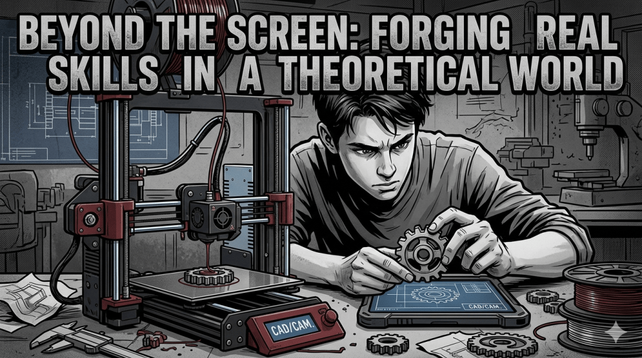
 Houston Public Media
 bellhoss
 Mike Paul