Bouncing Indefinitely

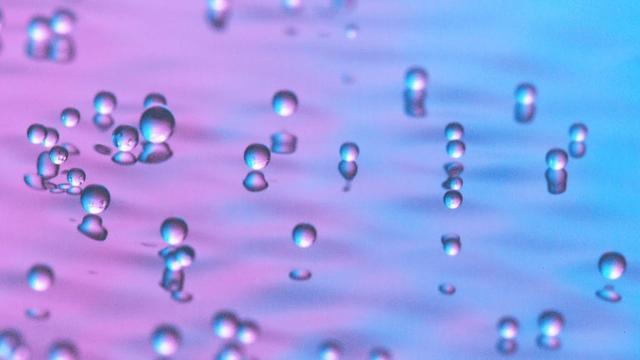
On the surface of a gently vibrating liquid, a droplet can bounce indefinitely without coalescing, kept aloft by an air film too small to see. As long as the droplet lifts off before the air layer drains out from under it, the droplet won’t contact the water below. Now scientists have shown that this is possible with a solid surface, too.

Using an atomically smooth mica plate, researchers were able to bounce a droplet indefinitely without wetting the surface. At higher vibration rates (below), the droplet essentially hovers in place, bouncing so quickly that we simply see its shape vibrating in response to the surface. (Image and research credit: L. Molefe et al.; via APS)

#bouncingDroplets #droplets #fluidDynamics #physics #science #vibration

Hot Droplets Bounce

In the Leidenfrost effect, room-temperature droplets bounce and skitter off a surface much hotter than the drop’s boiling point. With those droplets, a layer of vapor cushions them and insulates them from the hot surface. In today’s study, researchers instead used hot or burning drops (above) and observed how they impact a room-temperature surface. While room-temperature droplets hit and stuck (below), hot and burning droplets bounced (above).

In this case, the cushioning air layer doesn’t come from vaporization. Instead, the bottom of the falling drop cools faster than the rest of it, increasing the local surface tension. That increase in surface tension creates a Marangoni flow that pulls fluid down along the edges of the drop. That flow drags nearby air with it, creating the cushioning layer that lets the drop bounce. In this case, the authors called the phenomenon “self-lubricating bouncing.” (Image and research credit: Y. Liu et al.; via Ars Technica)

#bouncingDroplets #dropletImpact #entrainment #fluidDynamics #marangoniEffect #physics #science