 Speckdäne
Article german: https://www.scinexx.de/news/archaeologie/fossil-enthuellt-gesicht-der-ersten-europaeer/
The earliest human face of Western Europe | Nature
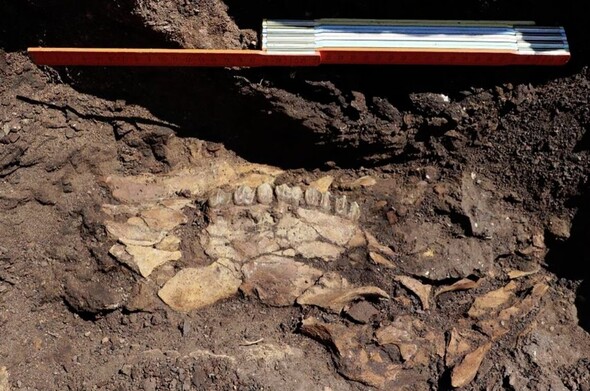
Who the first inhabitants of Western Europe were, what their physical characteristics were, and when and where they lived are some of the pending questions in the study of the settlement of Eurasia during the Early Pleistocene epoch. The available palaeoanthropological information from Western Europe is limited and confined to the Iberian Peninsula1,2. Here we present most of the midface of a hominin found at the TE7 level of the Sima del Elefante site (Sierra de Atapuerca, Spain), dated to between 1.4 million and 1.1 million years ago. This fossil (ATE7-1) represents the earliest human face of Western Europe identified thus far. Most of the morphological features of the midface of this hominin are primitive for the Homo clade and they do not display the modern-like aspect exhibited by Homo antecessor found at the neighbouring Gran Dolina site, also in the Sierra de Atapuerca, and dated to between 900,000 and 800,000 years ago3. Furthermore, ATE7-1 is more derived in the nasoalveolar region than the Dmanisi and other roughly contemporaneous hominins. On the basis of the available evidence, it is reasonable to assign the new human remains from TE7 level to Homo aff. erectus. From the archaeological, palaeontological and palaeoanthropological information obtained in the lower levels of the Sima del Elefante and Gran Dolina sites4–8, we suggest a turnover in the human population in Europe at the end of the Early Pleistocene. A Homo aff. erectus individual dated to 1.4 million to 1.1 million years ago found at Sima del Elefante (Sierra de Atapuerca, Spain) does not display the modern-human-like aspect of Homo antecessor found at the neighbouring Gran Dolina site (900,000–800,000 years ago).
 De Archeoloog