 Tom's Hardware Italia
🧠 "Ever wondered why we see faces everywhere? Science has cracked the code! Excited yet? 🌍 #Pareidolia #AmazingScience"
🔗 https://www.tomshw.it/scienze/il-cervello-vede-volti-ovunque-ecco-perche-2025-07-25
🧠 "Ever wondered why we see faces everywhere? Science has cracked the code! Excited yet? 🌍 #Pareidolia #AmazingScience"
🔗 https://www.tomshw.it/scienze/il-cervello-vede-volti-ovunque-ecco-perche-2025-07-25
Wow!
For years, researchers couldn't identify the source of so much nitrogen (N) in the oceans. It was thought that cyanobacteria were the only organisms capable of fixing nitrogen in marine ecosystems, but their numbers could explain only half of the observed N.
Some years ago, mysterious gene fragments coding for a nitrogenase (the enzyme that fixes nitrogen) were found in seawater samples. These traces were not from cyanobacteria. But then, from who?
A recent study found that the N-fixing bacteria are related to Rhizobia and seem to be symbiotic with diatomees (unicellular algae). Yes, *the rhizobia*. *In a symbiosis*. *with unicellular algae* (= plants)
😃
Rhizobia are the bacteria that fix the Nitrogen in the root nodules of leguminous plants, effectively making the rich terrestrial ecosystems possible.
And their cousins in the sea seem to do the same. The plants provide the bacteria carbohydrates (easy-peasy for photosynthetic organisms, as carbon is not their problem) and shelter, and the bacteria fix nitrogen. Just like this. And everyone benefits, including the surrounding ecosystem.
This is really cool and made my day!
https://www.nature.com/articles/s41586-024-07495-w
#Microbiology #Ecology #Nitrogen #Rhizobia #NitrogenCycle #Oceans #MarineBiology #SciComm
#ScienceIsWonderful #AmazingScience
Nitrogen (N2) fixation in oligotrophic surface waters is the main source of new nitrogen (N) to the ocean1 and plays a key role in fueling the biological carbon pump2. Oceanic N2 fixation is almost exclusively attributed to cyanobacteria, even though genes encoding nitrogenase, the enzyme fixing N2 into ammonia, are widespread among marine bacteria and archaea3-5. Little is known about these non-cyanobacterial N2-fixers and direct proof that they can fix N in the ocean is missing. Here we report the discovery of a non-cyanobacterial N2-fixing symbiont, Candidatus Tectiglobus diatomicola, which provides its diatom host with fixed-N in return for photosynthetic carbon. The N2-fixing symbiont belongs to the order Rhizobiales and its association with a unicellular diatom expands the known hosts for this order beyond the well-known N2-fixing rhizobia-legume symbioses on land6. Our results show that the rhizobia-diatom symbiosis can contribute as much fixed-N as cyanobacterial N2-fixers in the tropical North Atlantic, and that they may be responsible for N2 fixation in the vast regions of the ocean where cyanobacteria are too rare to account for the measured rates.
“Instead of spreading out as one would expect, these superfluid quantum gasses “slosh” heat side to side—it essentially propagates as a wave. Scientists call this behavior a material’s “second sound” (the first being ordinary sound via a density wave).” #amazing #amazingscience #science
Scientists Confirm the Incredible Existence of ‘Second Sound’
https://www.popularmechanics.com/science/a46756715/second-wave-superfluid/
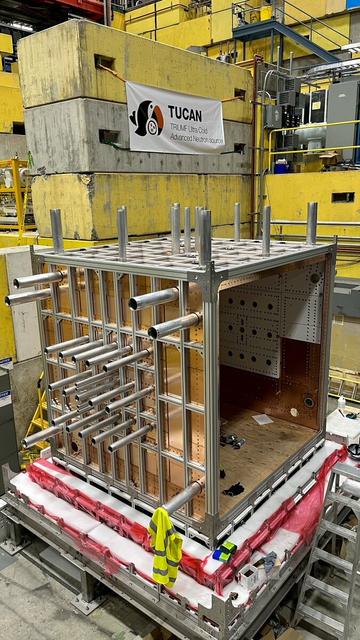
From NigelJTSmith on Twitter: The magnetically shielded room for the Ultra Cold Neutron experiment @TRIUMFLab is making great progress. Either that or a magician is about to put swords through the detector.
#DirectorsWalkthrough
#AmazingScience https://twitter.com/NigelJTSmith/status/1621350231001665537/photo/1
Transplant photosynthetic plant materials into mammalian cells, such that light exposure 👉generate ATP and protect OA cartilage degradation in vivo.
No big deal, really.... 😱😱😱
#amazingscience #Science #ScienceMastodon https://www.nature.com/articles/s41586-022-05499-y

 Earthworm 🐌
 dastelow
 Stephen Sekula
 Gabriele Pollara