Large language models (LLMs) often struggle when performing agentic tasks without substantial tool support, prom-pt engineering, or fine tuning. Despite research showing that domain-dependent, procedural knowledge can dramatically increase planning efficiency, little work evaluates its potential for improving LLM performance on agentic tasks that may require implicit planning. We formalize, implement, and evaluate an agentic LLM workflow that leverages procedural knowledge in the form of a hierarchical task network (HTN). Empirical results of our implementation show that hand-coded HTNs can dramatically improve LLM performance on agentic tasks, and using HTNs can boost a 20b or 70b parameter LLM to outperform a much larger 120b parameter LLM baseline. Furthermore, LLM-created HTNs improve overall performance, though less so. The results suggest that leveraging expertise--from humans, documents, or LLMs--to curate procedural knowledge will become another important tool for improving LLM workflows.

This paper addresses a key limitation in existing counterfactual inference methods for Markov Decision Processes (MDPs). Current approaches assume a specific causal model to make counterfactuals identifiable. However, there are usually many causal models that align with the observational and interventional distributions of an MDP, each yielding different counterfactual distributions, so fixing a particular causal model limits the validity (and usefulness) of counterfactual inference. We propose a novel non-parametric approach that computes tight bounds on counterfactual transition probabilities across all compatible causal models. Unlike previous methods that require solving prohibitively large optimisation problems (with variables that grow exponentially in the size of the MDP), our approach provides closed-form expressions for these bounds, making computation highly efficient and scalable for non-trivial MDPs. Once such an interval counterfactual MDP is constructed, our method identifies robust counterfactual policies that optimise the worst-case reward w.r.t. the uncertain interval MDP probabilities. We evaluate our method on various case studies, demonstrating improved robustness over existing methods.

Autonomous multi-agent systems (MAS) are useful for automating complex tasks but raise trust concerns due to risks such as miscoordination or goal misalignment. Explainability is vital for users' trust calibration, but explainable MAS face challenges due to complex environments, the human factor, and non-standardised evaluation. Leveraging the counterfactual effect size model and LLMs, we propose Agentic eXplanations via Interrogative Simulation (AXIS). AXIS generates human-centred action explanations for multi-agent policies by having an LLM interrogate an environment simulator using prompts like 'whatif' and 'remove' to observe and synthesise counterfactual information over multiple rounds. We evaluate AXIS on autonomous driving across ten scenarios for five LLMs with a comprehensive methodology combining robustness, subjective preference, correctness, and goal/action prediction with an external LLM as evaluator. Compared to baselines, AXIS improves perceived explanation correctness by at least 7.7% across all models and goal prediction accuracy by 23% for four models, with comparable action prediction accuracy, achieving the highest scores overall. Our code is open-sourced at https://github.com/gyevnarb/axis.
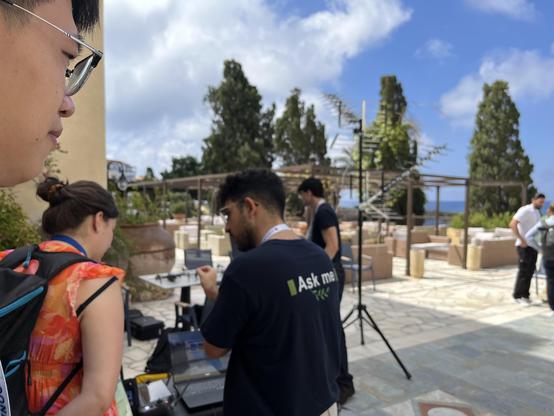
Actually no demo but a great excuse to enjoy the weather. Oh, one‘s flying now.
Sven Koenig
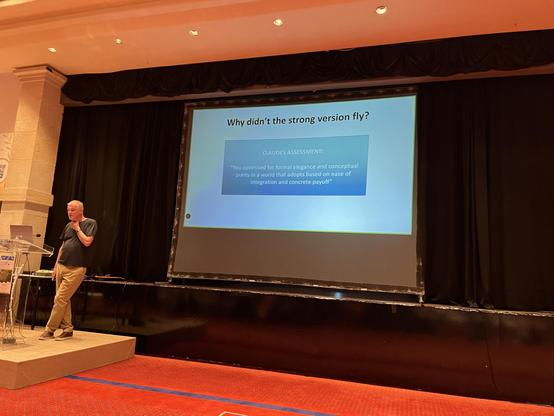
"I only work on cooperative robots because I build them. They have the team in mind. But sometimes we do decentralised"
genau :-) #humanCentring #aamas