 Kirst Mason D'Raven
Steel & Spirits – The Forgotten Folklore of Yorkshire’s Furnaces
Pull up a chair and close your eyes for a moment.
Imagine the sounds. The thunder of machinery. The shriek of metal. The hiss of steam. The roar of furnaces hot enough to melt stone. The glow of molten steel turning night into an artificial dawn. For generations, this was the soundtrack of Yorkshire.
The steel industry shaped towns, communities and families. It built livelihoods and forged identities. It left its mark upon the landscape and upon the people who worked within it. Yet alongside the engineering, economics and industry there existed something else.
Stories.
Like every occupation before it, the steel industry created its own folklore. The men and women who worked amongst the furnaces developed their own superstitions, rituals, warnings and ghost stories. Some were practical. Some were humorous. Some were downright frightening. Many emerged from the simple fact that steelmaking was dangerous work.
Danger breeds folklore. It always has. Long before the first blast furnace, miners carried protective charms underground. Sailors developed rituals for surviving storms. Farmers watched the weather and searched for signs in nature. Steelworkers were no different. The mills and foundries of Yorkshire became fertile ground for stories.
In Sheffield, Rotherham and Stocksbridge, workers often spoke of places within the works that simply felt wrong. Areas where accidents occurred more frequently than statistics might suggest. Corners where machinery seemed prone to failure. Sections of the factory floor where experienced workers preferred not to linger alone during night shifts. Officially these places were no different from any other. Unofficially they had reputations. Every workplace develops them. Sometimes a particular furnace became known as unlucky. Sometimes a workshop acquired a ghost. Sometimes a story emerged to explain a tragedy.
Many tales centred on workers who had died on the job. Industrial accidents were an unfortunate reality throughout much of Britain’s manufacturing history. In an age before modern health and safety regulations, steelmaking could be brutally hazardous. Molten metal. Exploding equipment. Falling loads. Crushing machinery. When accidents occurred, stories often followed.
Across Yorkshire, tales circulated of phantom workers continuing their rounds long after death. Figures glimpsed walking gantries. Shapes observed beside dormant machinery. Voices heard during otherwise empty shifts. Such stories are not unique to steelworks. Similar accounts appear wherever people spend long hours in dangerous environments. Yet they reveal something important about the communities that created them.
Ghost stories often preserve memory. A worker may be forgotten by official records. His colleagues remember him through stories. Folklore becomes a form of remembrance.
The furnaces themselves inspired some of the most striking imagery. To anyone seeing them for the first time, steelworks could appear almost supernatural. Columns of flame erupted into darkness. Sparks cascaded like fiery waterfalls. Molten metal flowed like rivers of liquid sunlight. The Victorian imagination often compared furnaces to the entrance to Hell itself. Visitors described steelworks as infernal landscapes populated by demons and giants – small wonder that workers developed stories of strange presences lurking amongst the fire and smoke. The boundary between industrial reality and supernatural imagination could become surprisingly thin.
Night shifts proved particularly fertile territory. Ask anyone who has worked through the night and they will tell you how different the world feels after midnight. Factories acquire a strange atmosphere. Familiar sounds become unsettling. Shadows move unexpectedly. Fatigue plays tricks on perception.
Steelworkers frequently spoke of seeing movement from the corner of the eye. Figures standing where nobody should be. Shapes disappearing behind machinery. Most can be explained perfectly rationally. Some remain unexplained. All become stories.
Superstitions flourished too. Many workers carried out personal rituals. A particular route through the factory. A lucky coin. A routine performed before starting machinery. An object kept in a locker for years. Such practices rarely appear in official histories, yet they formed part of everyday working life. Ask enough former steelworkers and patterns begin to emerge. People who would laugh at the suggestion of ghosts often maintained surprisingly firm beliefs regarding luck .Dangerous work reminds people how little control they truly possess. Ritual creates an illusion of certainty.
The same phenomenon appears amongst miners, fishermen, soldiers and sailors. Steelworkers simply adapted it to their own environment.
Yorkshire’s industrial communities also produced a rich oral tradition of practical jokes, cautionary tales and workplace legends. The mysterious figure seen on the night shift. The impossible noise heard in an empty building. The worker who supposedly vanished. The apprentice sent searching for fictional tools. Some stories were warnings. Others were entertainment. Many occupied the grey area between fact and fiction where folklore thrives.
One of the most fascinating aspects of industrial folklore is how quickly it disappears. Castles, Churches and Ancient monuments survive. Factories vanish. Steelworks are demolished. Workshops become retail parks. Foundries are replaced by housing estates. When the buildings disappear, their stories often disappear with them – unless somebody records them.This is why industrial folklore matters. It preserves a side of working-class history that rarely appears in textbooks. Not production figures or economic statistics. Human experiences. The stories people told. The fears they shared. The jokes they played.The ghosts they remembered.
Growing up in Yorkshire during the decline of heavy industry, I witnessed communities shaped by mines, steelworks and manufacturing. The closures brought economic consequences that historians continue to debate today. But something else was lost too. The vast body of local knowledge. Thousands of stories vanished when workplaces closed and workers dispersed but traces remain. Speak to former steelworkers and stories still emerge. Ask about strange incidents and superstitions. Ask about the places nobody liked working alone. You may be surprised by what you hear.
Folklore does not belong solely to ancient forests and ruined castles. It belongs wherever people gather. It grows wherever danger exists. It flourishes wherever human beings search for meaning in uncertain circumstances.
The furnaces may have cooled and the mills may have fallen silent. The sparks may no longer light the Yorkshire sky. But the stories remain.
And perhaps, if you listen carefully enough, you can still hear them echoing amongst the steel and shadows.
Further Reading:
Melvyn Jones – The History of the Sheffield Steel Industry
David Hey – A History of Sheffield
George Orwell – The Road to Wigan Pier
Raphael Samuel – Theatres of Memory
Local oral history collections held by Sheffield archives and industrial museums
Copyright Notice:
© 2026 Mysterious Times. All rights reserved.
#BritishFolklore #FactoryGhosts #FoundryFolklore #ghostStories #IndustrialFolkHorror #industrialFolklore #ParanormalYorkshireGhostWorkers #RotherhamHistory #SheffieldHistory #SheffieldSteel #SouthYorkshireHistory #StocksbridgeSteelworks #WorkingClassHistory #YorkshireFolklore #YorkshireSteelIndustry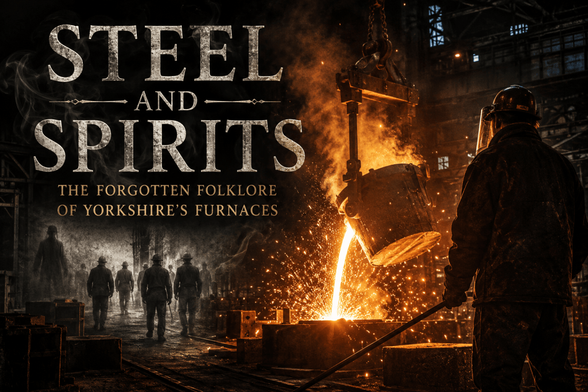

 Folk Horror Magpie