 Kirst Mason D'Raven
The Knockers Beneath The Hill
Stone remembers.
That is perhaps the oldest belief of all.
Long before quarrying became industrial. Long before dynamite split the hillsides of Derbyshire and great clouds of limestone dust drifted across the Peak District, people already believed certain rocks held power.
Standing stones marked sacred places. Ancient burial chambers were raised from carefully chosen slabs. Hills themselves became sleeping giants, petrified witches or gateways to the Otherworld. Across Britain, stone was never simply dead matter. It carried memory, folklore and fear. And when man began cutting deep into the earth for a living, those beliefs did not disappear. They merely changed shape.
Quarry folklore is one of the strangest and least discussed corners of British supernatural tradition. It fits somewhere between mining lore, ghost stories, industrial history and folk horror. Quarrymen worked in landscapes that could kill without warning. Entire hillsides collapsed. Explosions misfired. Hidden shafts opened beneath workers feet. Men drowned in flooded workings or vanished beneath falling rock. In isolated upland regions where mist swallowed sound and strange echoes rolled through the stone, superstition flourished naturally.
And perhaps understandably.
A quarry is an unnatural wound in the landscape. Even today, abandoned workings feel… uncanny. Pools glow with impossible blue-green colours. Cliffs rise in geometric cuts unlike natural valleys. Rusting machinery sits half reclaimed by moss and water. Sounds behave oddly in deep excavations. A single voice can bounce and distort into something that feels distinctly inhuman. For centuries, workers believed these places were inhabited by spirits.
In Cornwall the miners told of Knockers, small subterranean beings who tapped against the rock walls. According to tradition, the Knockers could warn workers of cave-ins if treated respectfully, but could also lure greedy or careless men towards disaster. Welsh miners had similar creatures known as Coblynau. Tiny, goblin-like figures who were said to laugh in the darkness, mimic voices or lead workers astray underground.
Though Derbyshire quarrymen didn’t always use the same name, the beliefs travelled surprisingly far. Stories from limestone workings across the Peak District describe unexplained hammering in abandoned tunnels, phantom footsteps and the sound of picks striking stone long after the workforce had gone home.
Modern geology offers rational explanations for many of these phenomena. Rock shifts under pressure. Underground water systems create echoes and strange acoustics. Limestone cracks loudly as temperatures change. Yet those explanations do little to diminish the atmosphere of such places, especially when experienced alone, by candlelight, hundreds of feet underground.
One particularly old superstition shared by miners and quarrymen held that whistling inside a quarry was bad luck, or dangerous. In some communities it was said to anger spirits dwelling within the stone. In others it was feared because it could mask warning calls before blasting operations. Either way, workers often treated whistling as deeply unlucky.
Another widespread belief involved birds.
If crows gathered unusually near a quarry edge, older workers sometimes interpreted it as a warning of imminent death or collapse. Sudden silence among birds was also considered ominous. In Derbyshire and Yorkshire there are scattered stories of workers refusing to enter or descend after hearing unexplained bird cries from places where no birds should have been able to enter.
Then there were the rituals.
Many workers carried charms. Coins bent into crosses, Religious medals. Fragments of rowan wood. In Northern England, rowan was long associated with protection against evil influences and was sometimes tucked into clothing or hung near dangerous workings.Some quarrymen reportedly spat into the dust before entering new excavations, an act believed to either placate spirits or ensure a safe return.
In parts of Wales and Cornwall, workers would leave tiny offerings. Tobacco, bread, a splash of ale. These gifts were supposedly for the spirits of the earth, though whether workers truly believed in them or simply maintained old traditions ‘Just in case’ is impossible to say.
Britain’s quarry landscapes also became strongly associated with ghosts, and one recurring motif is the ‘phantom worker’.
Across Derbyshire there are stories of solitary figures seen walking ledges at dawn or dusk, sometimes carrying lamps. Witnesses approach, assuming a colleague has remained behind, only for the figure to vanish entirely. In some accounts the apparitions are linked to known industrial accidents.
At Dunsley Quarry, near Whitby, local stories long circulated about a workman crushed in a collapse whose lantern was still occasionally glimpsed moving along the stone faces after dark.Similar tales exist around abandoned slate quarries in Wales where visitors report hearing blasting whistles echoing from empty workings.
Some of the most chilling stories come from flooded quarries. These places are dangerous even in daylight. The water can be lethally cold and deceptively deep, often concealing submerged machinery, sharp drops and hidden currents. Yet abandoned quarries have remained popular swimming spots since the twentieth century, particularly during hot summers. But this popularity comes hand in hand with repeated tragedy.
In Derbyshire, Yorkshire and Cumbria there are numerous local legends surrounding quarry drownings. Some are sadly based on very real events. After fatal accidents, reports often emerge of strange experiences nearby. Voices calling from the water. Figures standing silently at quarry edges before disappearing. Unexplained ripples moving across perfectly still pools.
At the flooded quarry pools around the Peak District, local teenagers for decades swapped stories about ‘the Watcher’, usually described as a dark figure standing motionless on a distant ledge at dusk. Whether these tales were genuine experiences, campfire embellishments or cautionary folklore designed to deter reckless swimming is difficult to untangle. Folklore often develops to warn people away from dangerous places.
The same is true of Britain’s terrifying ‘Bottomless’ quarry and cave legends. Perhaps the most famous near the Peak District is Eldon Hole, near Dove Holes. This vast natural cavern was once believed to descend directly into Hell itself. Early visitors threw stones into the darkness and waited in vain to hear them land.
Seventeenth century philosopher, Thomas Hobbes wrote dramatically about the abyss, helping cement it’s infernal reputation and local folklore around Eldon Hole became wonderfully bizarre. One story claimed a goose thrown into the chasm later emerged from Peak Cavern, it’s feathers blackened by the fires below. Other tales told of strange beings dwelling beneath the hill and phantom lights glimpsed around the edges of the pit at night.
Such stories were not isolated. Throughout Britain, quarries and mines often became associated with gateways to the underworld. Dig too deep and you entered forbidden territory. Ancient spirits. Devils. Hidden kingdoms. Sleeping giants. The symbolism is remarkably ancient. Across many cultures, caves and deep holes represent entrances to realms beneath ordinary reality.
Industrialisation only intensified the eeriness. Victorian quarrying transformed entire landscapes into scarred labyrinths of tunnels, spoil heaps, cranes and abandoned railways. Many workings operated around the clock, their fires and lanterns glowing through misty valleys after dark. Accidents were common and sometimes catastrophic.
One of the worst mining disasters in Derbyshire history occurred at the Hill Carr Sough near Buxton, where flooding trapped workers underground.Though technically linked to mining rather than quarrying, stories afterward described locals hearing cries beneath the earth long after recovery efforts ended.
These tragedies left emotional marks upon communities. Folklore became a way of processing fear and grief. Ghost stories gave shape to danger. Omens created the illusion of warning signs in unpredictable environments.
Even modern paranormal investigators remain fascinated by abandoned quarries. Electronic Voice Phenomena (EVP) recordings frequently capture odd echoes and distorted sounds in stone environments. Investigators report sudden temperature drops, oppressive atmospheres and feelings of being watched. Sceptics point to acoustics, infrasound and environmental psychology. Deep excavations naturally trigger unease in humans. Echoes distort perception. Mist and shadow alter depth awareness.
And that, dear reader, is precisely why quarry and mining folklore persists. The supernatural has always thrived where landscape and emotion intersect, and few places embody that intersection more strongly than a big ‘ole in the ground. Especially in upland regions like the Peak District, where prehistoric ritual sites sit beside Victorian industrial scars, the sense of layered history becomes overwhelming. Ancient henges overlook blasted hillsides. Roman roads vanish into fog above abandoned workings. Beneath the surface lie caves untouched for millennia. It all creates the unsettling feeling the land itself has been disturbed repeatedly across thousands of years.
British folk horror understands this instinctively. Films like Quatermass and the Pit and The Blood on Satan’s Claw revolve around buried things emerging when the ground is broken open. Ancient forces reawakening beneath farmland and villages. Memory trapped in the soil. Quarries embody that idea physically. They are places where humans cut into deep time itself.
Perhaps that is why standing alone beside an open quarry at dusk is so unnerving. The silence is rarely complete. Water drips somewhere out of sight. Stones crack softly in the cooling air. Echoes move strangely among the cliffs. You become aware of the immense weight of the landscape around you, and somewhere… in the back of your mind, ancient instincts whisper that perhaps some places were never meant to be opened at all.
Further Reading
Peak District Mining Museum (https://www.peakdistrictminingmuseum.co.uk)
History of Derbyshire mining, quarrying and underground folklore traditions connected to the Peak District.
The Peak District Mines Historical Society (https://www.pdmhs.co.uk)
Detailed research archive covering historic mines, quarry workings, industrial archaeology and local history.
Atlas Obscura – Eldon Hole (https://www.atlasobscura.com/places/eldon-hole-british-gate-to-hell)
Overview of the legends, folklore and history surrounding Derbyshire’s infamous “bottomless pit”.
Derbyshire Folklore Archive (https://www.derbyshirefolklore.org)
Excellent resource for local legends, ghost stories, customs and strange traditions across Derbyshire.
The National Coal Mining Museum for England (https://www.ncm.org.uk)
Background on mining culture, working traditions, superstitions and industrial heritage in Britain.
Historic England(https://historicengland.org.uk)
Records and research on Britain’s historic industrial landscapes, quarries and mining sites.
The Folklore Society(https://folklore-society.com)
Academic and historical resources covering British supernatural traditions, customs and beliefs.
Suggested Books
The Lore of the Land by Jennifer Westwood and Jacqueline Simpson
The Old Stones by Andy Burnham
Industrial Folklore and Folk Life edited by John Widdowson
Discovering Derbyshire and the Peak District by Neville T. Sharpe
The Living Folklore of Scotland by Margaret Bennett
The British Folklore, Myths and Legends Compendium by Marc Alexander
Copyright © 2026 [Mysterious Times](https://www.mysterioustimes.co.uk). All rights reserved.
This article is the intellectual property of Mysterious Times and the author. No part of this publication may be reproduced, distributed, transmitted, stored in a retrieval system or otherwise used in any form or by any means, electronic, mechanical, photocopying, recording or otherwise, without prior written permission from the publisher, except for brief quotations used in reviews, criticism or educational purposes with appropriate credit.
All images remain the property of their respective creators unless otherwise stated.For permissions, collaborations or enquiries, please contact Mysterious Times via the website.
#abandonedQuarries #BritishFolklore #BritishGhostLore #BritishSupernatural #DerbyshireFolklore #DerbyshireParanormal #DoveHoles #EldonHole #folkHorror #folkloreOfStone #ghostStories #ghostlyLegends #hauntedDerbyshire #hauntedLandscapes #hauntedQuarries #industrialFolklore #limestoneFolklore #miningGhosts #miningSuperstitions #mysteriousPlacesBritain #paranormalBritain #PeakDistrictGhosts #PeakDistrictLegends #PeakDistrictMystery #quarryFolklore #quarryGhosts #quarryLegends #quarrySuperstitions #strangeBritain #undergroundFolklore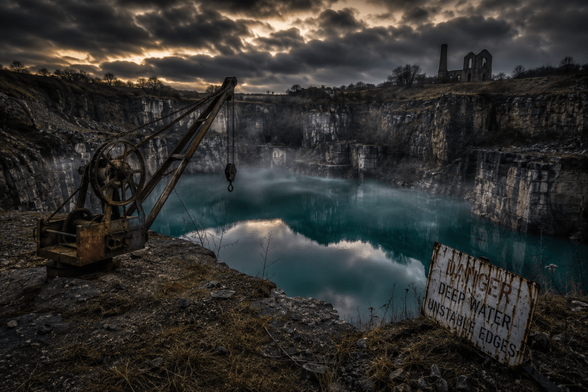
 denicolai_provoost