 Peter Falkingham
FYI for those doing #XROMM, we've now moved everything over to github: https://github.com/XROMMPackages

Excited to say the #XROMM toolkit for #blender (#b3d) is now accepted into the extensions repository. That means it's as easy to install as opening settings, going to addons, typing "xromm", and clicking install:
 UAFunMorph
#WomenAndGirlsInScience SPOTLIGHT DAY 2!
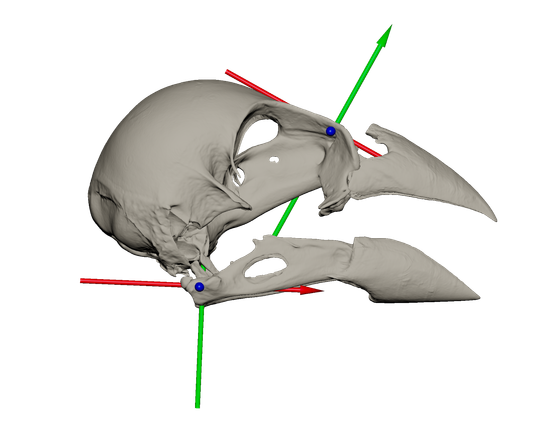
Being in the last year of her PhD, @MajaMielke is currently working through tons of #XROMM data of cute little #birds cracking seeds. She's studying the #biomechanics of beak movement in small songbirds.
When not being busy with experiments and coding, Maja is currently working on her popular science writing skills (http://www.mielke-bio.info/maja/blog/).


 Maja Mielke (she/her)
My research is featured in a new video from @dynxlab from the University of Antwerp! 👇
Thanks to them, I am provided with facilities for x-ray recordings and CT-scanning directly here on campus, which is essential for my #XROMM study on feeding in songbirds! Thanks to @dynxlab for the great collaboration! 💪

XROMM on songbird beaks @ DynXLab
I just discovered that the recording of my talk from the #sebconference has finally been uploaded to the Underline platform. So if you have a conference login and are interested in (re-)watching my #presentation about #feeding #biomechanics and #XROMM in canaries, here is the link:

v0.9 of the #XROMM tools for #Blender is now released on GitHub: https://github.com/pfalkingham/XROMM_BlenderTools
I've implemented everything I initially wanted to, and now all I want before a proper v1.0 release is testing to make sure there's no bugs. If you do XROMM and know blender, give it a try and let me know how it goes.
GitHub page has a wiki for instructions.

My first release of #XROMM toolkit for Blender (#b3d) is now out, v0.1: https://github.com/pfalkingham/XROMM_BlenderTools
Not everything implemented yet, but you can:
import cameras + image planes
Apply rigid body transforms to objects
Create axes w/ locators
Calculate relative motion between objects.
Youtube video run through here: https://youtu.be/zRH4XBChrgA
As I'm in the middle of preparing my talk for #SEBConference2023, I'm getting really excited to finally share my first #XROMM results on #canary #beak movement!
#biomechanics #biology #bird #PhDlife
#biomechanics #biology #bird #PhDlife
New paper on #hominid footprints, limb kinematics, and feet, out now in NatEcolEvo: https://www.nature.com/articles/s41559-022-01929-2
We used #XROMM and #DEM #Simulation to view and model the foot sediment interaction.
The arch in early hominid tracks likely does _not_ reflect anatomy, but does inform about kinematics

Arched footprints preserve the motions of fossil hominin feet - Nature Ecology & Evolution
Combining modelling of living human participants and chimpanzees with analysis of fossil hominin trackways, the authors distinguish between the earliest evidence of modern human-like bipedal kinematics and earlier hominin precursors.