Here is a fin world to play with for #WOTD Merriam-Webster's Word of the Day for Mar 25 is "undulate": www.merriam-webster.com/word-of-the-...
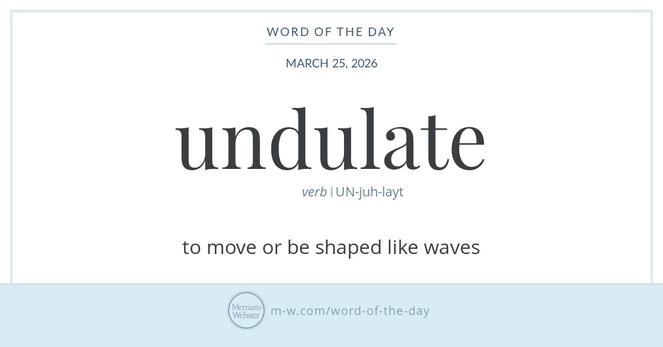
Word of the Day: Undulate

Undulate and inundate (“to cover something with a flood of water”) are word cousins that flow from unda, the Latin word for “wave.” No surprise there. But would you have guessed that abound, surround,

📕 Word of the Day: undulate

undulate • \UN-juh-layt\ • verb

Undulate is a formal word that means “to move or be shaped like waves.”

// On the approach to the tulip festival, visitors are greeted by a large field of the colorful flowers undulating in the wind.

📝 Examples:
“When sufficiently heated, the fresh cheese contracts, sweating whey from the curds that provides liquid to cook the dough, which will plump up and undulate slightly as it expands.” — Karima Moyer-Nocchi, The Epic History of Macaroni and Cheese: From Ancient Rome to Modern America, 2026

📜 Did you know?
Undulate and inundate (“to cover something with a flood of water”) are word cousins that flow from unda, the Latin word for “wave.” No surprise there. But would you have guessed that abound, surround, and redound are also unda offspring? While their modern definitions have nothing to do with waves or water, at some point in their early histories, they all meant “to overflow,” and caught a wave from there.

#English #Vocabulary #wordoftheday #MW #WOTD
burh-āgende, adj: holding a citadel or city; (if read as a noun) ruler of a citadel or city. (BUR’H-AH-yen-duh / ˈbʌrx-ˌaː-jɛn-də)
#OldEnglish #WOTD
#WOTD is Cadence. Merriam-Webster's Word of the Day for Mar 24 is "cadence": www.merriam-webster.com/word-of-the-...
Word of the Day: Cadence

A cadence is a rhythm, or a flow of words or music, in a sequence that is regular (or steady as it were). But lest we be mistaken, cadence also lends its meaning to the sounds of Mother Nature (such

📕 Word of the Day: cadence

cadence • \KAY-dunss\ • noun

Cadence is used to refer to various rhythmic or repeated motions, activities, or patterns of sound, or to the way a person's voice changes by gently rising and falling while they are speaking.

// Ivy relaxed at the beach, listening to the cadence of the surf.

// He speaks with a soft Southern cadence.

📝 Examples:
“Urged by a fast-talking auctioneer and his familiar cadence, paddles shot up as bids climbed into the four- and five-figure range.” — Lily Moayeri, Rolling Stone, 29 Jan. 2026

📜 Did you know?
A cadence is a rhythm, or a flow of words or music, in a sequence that is regular (or steady as it were). But lest we be mistaken, cadence also lends its meaning to the sounds of Mother Nature (such as birdsong) to be sure. Cadence comes from Middle English borrowed from Medieval Latin’s own cadentia, a lovely word that means “rhythm in verse.” (You may also recognize a cadence cousin, sweet cadenza, as a word that is familiar in the opera universe.) And from there our cadence traces just a little further backward to the Latin verb cadere “to sound rhythmically, to fall.” Praise the rising and the falling of the lilting in our language, whether singing songs or rhyming or opining on it all.

#English #Vocabulary #wordoftheday #MW #WOTD

buoptalmon, n.n: ox-eye, chamomile. (BUH-op-tal-mon / ˈbʌ-ɔp-tal-mɔn)
#OldEnglish #WOTD
📕 Word of the Day: frenetic

frenetic • \frih-NET-ik\ • adjective

Something described as frenetic is filled with excitement, activity, or confusion. The word is a synonym of frantic.

// The event was noisy and frenetic, which prompted us to leave early.

📝 Examples:
“As Marty Mauser, a wannabe table tennis champion who dreams and deceives his way through his shamble of a life ... [Timothée Chalamet] injects his scenes with enough nervous energy to fuel a plane. Nowhere will you see a performance more frenetic or impressive.” — Ralph Jones, Vanity Fair, 9 Feb. 2026

📜 Did you know?
In modern use, frenetic can describe a focused and intense effort to meet a deadline, or dancing among a hyped-up crowd, but the word’s Middle English predecessor, frenetik, had a narrower use: it was used to describe those exhibiting a severely disordered state of mind. If you trace frenetic back far enough, you’ll find that it comes from Greek phrenîtis, a term referring to an inflammation of the brain. As for frenzied and frantic, they’re not only synonyms of frenetic but relatives as well. Frantic comes from frenetik, and frenzied traces back to phrenîtis.

#English #Vocabulary #wordoftheday #MW #WOTD

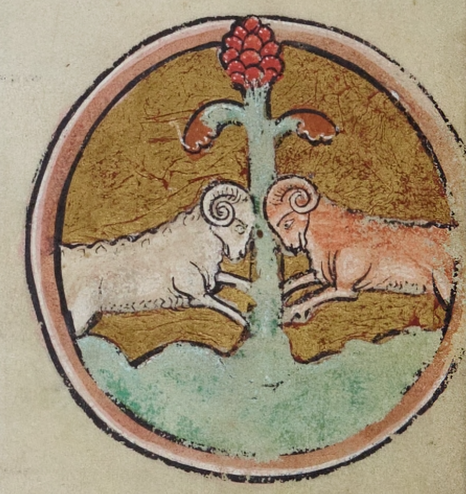
ramm, m.n: a ram (animal); an instrument for pounding or battering. (RAHM / ˈram)
Image: Aries in a Psalter; England, 13th century; Cambridge, Trinity College, B.11.4, d. ii r.
#OldEnglish #WOTD
#WOTD & here it is! Merriam-Webster's Word of the Day for Mar 22 is "apotheosis": www.merriam-webster.com/word-of-the-...
Word of the Day: Apotheosis

Among the ancient Greeks, it was sometimes thought fitting to grant someone “god” status. Hence the word apothéōsis, from the verb apotheóō or apotheoûn, meaning “to deify.” (All are rooted in the