 Peter Cock
RE: https://chaos.social/@sa/116230479201296074
Will this be what takes #VerticalFarming mainstream? 🤣
RE: https://chaos.social/@sa/116230479201296074
Will this be what takes #VerticalFarming mainstream? 🤣

Urban Farming Market Set for Steady Growth 🌱
The global urban farming market is expanding rapidly—rising from $185.7B in 2026 to $242.68B by 2030 at a 6.9% CAGR. Growth is driven by limited farmland, sustainable food systems, and rising adoption of vertical, rooftop, and modular farming technologies.
📄 Free sample:
https://www.thebusinessresearchcompany.com/sample.aspx?id=13750&type=smp
#UrbanFarming #AgriTech #SustainableFood #VerticalFarming #MarketResearch
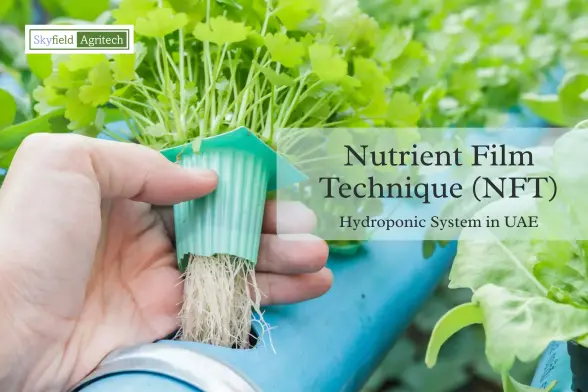
Nutrient Film Technique (NFT) Hydroponic System in UAE 🌱
Farming in the UAE isn’t easy, but NFT hydroponics makes it possible to grow fresh leafy greens and herbs using less water and zero soil. Learn how the Nutrient Film Technique works, which crops suit it best, its advantages, limitations, and how it compares with other hydroponic systems in UAE conditions.
Read the full blog 👉 https://skyfieldagritech.com/nutrient-film-technique-nft-hydroponic-system-uae/
#NFTHydroponics #HydroponicFarmingUAE #HydroponicsInUAE #VerticalFarming
SkyHarvest: How China’s AI-Powered Vertical Farms are Reshaping Global Food Security
From the outskirts of Chengdu to the deserts of the Middle East, China’s “SkyHarvest” vertical farming towers use robotics, AI, and climate control to produce food with 95% less water and 100 times the yield per square meter, offering a high-tech solution to a looming global crisis.
In a nondescript industrial park in Chengdu, the future of food is growing in sterile, silent rooms bathed in a surreal magenta glow. Rows of leafy greens—lettuce, kale, bok choy—rise in perfect, stacked layers, their roots misted with a nutrient-rich solution, their growth meticulously orchestrated not by seasons, but by algorithms. There is no soil, no pesticide, and no weather. This is a SkyHarvest facility, part of a wave of Chinese controlled environment agriculture (CEA) that is redefining the limits of farming. As climate change disrupts traditional agriculture and global populations concentrate in cities, the ancient challenge of food security is meeting a 21st-century response. China, with its historical imperative to feed nearly 20% of humanity with only 9% of the world’s arable land, has become an unlikely but powerful pioneer in this space. By integrating advanced hydroponics, AI-driven climate management, and industrial robotics, companies like SananBio and XAG are constructing vertical farms that boast staggering efficiency: using 95% less water, zero chemical pesticides, and producing 100 times more yield per square meter than traditional fields. These high-tech food factories are no longer just experiments; they are operational centers supplying fresh produce to urban supermarkets and are now a key component of China’s technology export portfolio, offering a blueprint for nations facing water scarcity and food import dependence.
The drive for vertical farming in China is rooted in stark necessity. Rapid urbanization has consumed vast tracts of farmland, while industrial pollution has degraded soil and water quality in some regions. Simultaneously, a growing middle class demands safer, higher-quality, and traceable produce. The government’s “No. 1 Central Document” annually emphasizes food security, and the latest Five-Year Plans have explicitly prioritized agricultural technology as a strategic sector. This has unleashed both public research funding and private venture capital. The result is a fusion of China’s strengths in manufacturing, construction speed, and digital technology. A SkyHarvest tower can be erected in months within a city, slashing “food miles” from thousands to just tens. The core innovation, however, lies in the software. An AI “brain” continuously analyzes millions of data points from sensors monitoring light spectrum, humidity, CO2 levels, and plant physiology. It then adjusts the environment in real-time to optimize for taste, texture, growth speed, and nutritional content, creating what engineers call “recipe-driven agriculture.” This move from an open-loop, nature-dependent system to a closed-loop, digitally-manufactured one represents a Copernican shift in our relationship with food, with China aggressively steering the wheel.
Inside the Tower: The Technology Stack of Precision Farming
A visit to a SkyHarvest facility feels more like touring a semiconductor cleanroom than a farm. The process begins in a lab where plant scientists select and germinate seeds under microscopes. The seedlings are then transferred to growing trays that enter a multi-story vertical growing carousel.
The output is consistent, high-quality, and hyper-local. A single urban tower can produce over 1,000 tons of greens annually, supplying tens of thousands of citizens with daily fresh salads, year-round, irrespective of droughts or floods outside.
From Domestic Security to Global Export
China’s vertical farming ambition has a clear dual track: first, secure its own urban food supply, particularly for high-value vegetables; second, become the global supplier of the technology to do so. Domestically, major cities like Beijing, Shanghai, and Chengdu now host commercial-scale farms. The produce often carries a premium but appeals to consumers wary of pesticide residues and eager for local branding.
The more strategically significant move is the export of the entire SkyHarvest model as a turnkey solution. This aligns perfectly with China’s Belt and Road Initiative, which seeks to build infrastructure and create new markets. Chinese companies are building massive vertical farms in water-stressed but capital-rich nations like Kuwait, Qatar, and the United Arab Emirates, where desert agriculture is nearly impossible. In Southeast Asia, where arable land is pressured by urbanization, these farms offer a way to boost local production. The package includes not just hardware but also the AI software, training, and ongoing technical support, creating deep, long-term dependencies. For recipient countries, it’s an attractive proposition: it reduces reliance on fragile global food supply chains, conserves precious water, and provides a symbol of national modernity. For China, it establishes its technological leadership in a sector critical to human survival, generates lucrative export revenue for its high-tech manufacturing sector, and builds geopolitical goodwill through tangible contributions to food security.
The Limits and the Horizon
Despite its promise, the SkyHarvest model is not a panacea. Its economics currently work best for high-value, fast-growing leafy greens and herbs. Staple crops like wheat, rice, and corn, which provide the bulk of human calories, are not yet viable due to their space and energy requirements for growth. The energy footprint, primarily for lighting and climate control, remains a significant challenge, though it is being mitigated by pairing farms with renewable energy sources and advances in ultra-efficient LEDs.
Furthermore, the social impact on traditional farming communities could be disruptive, though Chinese policy frames it as complementary—freeing up rural land for staple grain production while letting vertical farms handle perishable vegetables in cities. The ultimate horizon, however, is breathtaking. Research is advancing on growing strawberries, tomatoes, and even dwarf fruit trees in vertical systems. The integration of these farms with urban waste streams—using captured CO2 from city air to boost plant growth, or filtering greywater—points to a vision of the “circular city.” In this vision, SkyHarvest towers are not just food producers but vital organs in a sustainable urban metabolism, pioneered in China and replicated worldwide.
A Harvest of Bytes, Not Just Bushels
The rise of SkyHarvest vertical farming is a powerful testament to how necessity, when met with technological capability and state support, can breed radical innovation. China has taken a technology pioneered in Japan, the Netherlands, and the United States and scaled it with a speed and industrial pragmatism that is reshaping the field. It demonstrates a shift from seeing agriculture as a purely biological and land-based endeavor to viewing it as a form of precision manufacturing.
The implications are global. As climate volatility increases, the ability to grow food in climate-resilient, location-independent factories will become a strategic asset. China’s early-mover advantage in perfecting and exporting this model positions it not just as the “world’s factory” for gadgets, but potentially as a key architect of future global food systems. The story of SkyHarvest is ultimately about control: over the environment, over the supply chain, and over the geopolitical leverage that comes with securing one of humanity’s most fundamental needs. The crops harvested from these towers are not just lettuce and basil; they are data points, energy efficiency metrics, and diplomatic capital, grown in the magenta glow of a hungry, inventive future.
👉 Share your thoughts in the comments, and explore more insights on our Journal and Magazine. Please consider becoming a subscriber, thank you: https://borealtimes.org/subscriptions – Follow The Boreal Times on social media. Join the Oslo Meet by connecting experiences and uniting solutions: https://oslomeet.org
References

Innovative farm in Virginia can grow 4 million pounds of strawberries on less than an acre

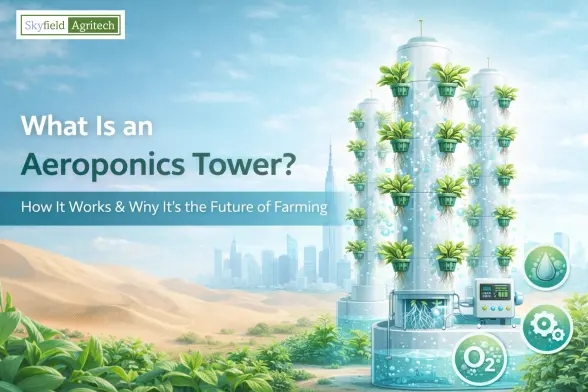
Aeroponics towers are transforming modern farming with soil-less, water-efficient technology. Built for vertical farming and indoor aeroponics systems, they deliver faster growth, higher yields, and sustainable food production—ideal for regions like the UAE.
Read more 👉 https://skyfieldagritech.com/aeroponics-tower-future-farming/
#AeroponicsTower #AeroponicsFarming #VerticalFarming #IndoorFarming #SoillessFarming

Goldenberries taste like a cross between pineapple and mango, pack the nutritional punch of a superfood, and are increasingly popular in U.S. grocery stores. But the plants that produce these bright yellow-orange fruits grow wild and unruly—reaching heights that make large-scale farming impractical.
 Reel Tubes
 anwar_tbrc
 Skyfield Agritech
 Boreal Times Newsroom
 Front Page
 Units of Measurement
 Jack C.M