It seems like the basic building blocks of a topological quantum computer were demonstrated experimentally for the first time.

https://arxiv.org/abs/2601.20956

The promise of topological quantum computer – which would be resistant to errors because it would encode quantum information using trajectories of weird “quasiparticles” called anyons – is one of the main motivations why people investigate topological orders like fractional quantum Hall effect or spin liquids. The catch about this study is that, as far as I understand, it lacks the required stability, which arises from the fact that the topological order is exhibited by the ground state of the system (lowest energy), and the anyons are lowest excitations (lowest energies above the ground state). Here, as far as I understand, the topologically ordered state was created inside a quantum computer, with no reference to energy. Still, this is one step closer to realizing topological quantum computation. Also, the study uses quantum gates based both on anyon braiding – “winding” their trajectories around each other – and “fusion”, i.e. merging anyons with each other. I was not aware you can use fusion in this way.

#science #physics #quantum #CondensedMatter #CondMat #QuantumComputing #TopologicalOrder #anyons

Universal Topological Gates from Braiding and Fusing Anyons on Quantum Hardware

Topological quantum computation encodes quantum information in the internal fusion space of non-Abelian anyonic quasiparticles, whose braiding implements logical gates. This goes beyond Abelian topological order (TO) such as the toric code, as its anyons lack internal structure. However, the simplest non-Abelian generalizations of the toric code do not support universality via braiding alone. Here we demonstrate that such minimally non-Abelian TOs can be made universal by treating anyon fusion as a computational primitive. We prepare a 54-qubit TO wavefunction associated with the smallest non-Abelian group, $S_3$, on Quantinuum's H2 quantum processor. This phase of matter exhibits cyclic anyon fusion rules, known to underpin universality, which we evidence by trapping a single non-Abelian anyon on the torus. We encode logical qutrits in the nonlocal fusion space of non-Abelian fluxes and, by combining an entangling braiding operation with anyon charge measurements, realize a universal topological gate set and read-out, which we further demonstrate by topologically preparing a magic state. This work establishes $S_3$ TO as simple enough to be prepared efficiently, yet rich enough to enable universal topological quantum computation.

arXiv.org

Fractional quantum Hall states in atom arrays

Our second approach to create a topological order in atom arrays is to focus on a different kind of topological order: fractional quantum Hall (FQH) states. These were first discovered in condensed matter. It is possible to confine electrons to move in two-dimensions only (such as in the 2D material graphene or in so-called metal-oxide-semiconductor transistors) and then put them in a strong perpendicular magnetic fields. The electrons then move in circles (so-called “cyclotron motion”), but since they are quantum objects, only some values of radius are allowed. Thus, the energy can only take certain fixed values (we call them “Landau levels”). There are however different possibilities of an electron having the same energy, because the center of the orbit can be located in different places – we say that Landau levels are “degenerate”. And when there is degeneracy, the interaction between electrons becomes very important. Without interactions, there are many possible ways of arranging electrons within a Landau level, all with the same energy. In the presence of interactions, some arrangements become preferred – and it turns out those correspond to topological orders known as the FQH states. Such systems host anyons which look like fractions of an electron – like somehow the electron split into several parts.

[1/2]

#Physics #science #TopologicalOrder #Quantum #QuantumOptics #CondensedMatter #CondMat #cond_mat #QuantumHall

Spin liquids in Rydberg atom arrays in cavities

What is our proposal for the realization of spin liquid?

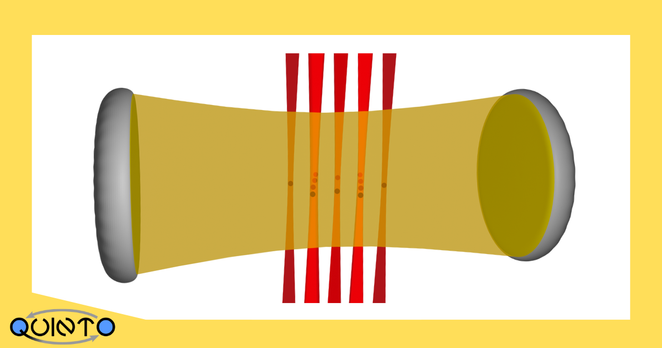
We consider an atom array held by optical tweezers and placed in an optical cavity. The cavity consists of two mirrors placed on the opposite sides of the system. The photons which normally would escape the system (at least some of them) will bounce back and forth between the mirrors. In such a configuration, the distance between atoms becomes irrelevant and the probability of an excitation hopping between any two atoms becomes the same.

The second ingredient is that the excited state of the atoms would be a Rydberg state – a very high-energy state where the electron is far away from the nucleus. The atoms in Rydberg states interact strongly by van der Waals forces. In our case it would mean that two excitations will have much higher energy when they are at nearest-neighboring atoms than if they are far away.

This setting seems much different from usual crystals. In the typical material, the electrons are much more likely to hop between nearest-neighboring atoms than far-away ones, while in our case they would be able hop arbitrarily far with the same probability. But it turns out that there is in equivalence between such “infinite-range hopping + Rydberg” model and the Heisenberg model, commonly used to describe magnets, including the frustrated ones.
[1/2]
#Physics #Quantum #TopologicalOrder #CondMat #CondensedMatter #QuantumOptics #Science

#Microsoft has announced that they created topological qubits.

The perspective of creating such qubits is one of the main reasons why scientists are interested in topological orders. A topological qubit will be based on the operations of braiding anyons (see my post about anyons here: https://fediscience.org/@quinto/113284395842516473). Such operations will be naturally protected from noise, as the exact trajectory on which the anyons move does not matter. It only matters which anyon encircles which. Adding some random noise to the trajectory would not change that.

There are, however, some reasons to be skeptical about Microsoft's claims - see here: https://www.nature.com/articles/d41586-025-00527-z

#QuantumComputing #Quantum #physics #TopologicalOrder #qubits

QUINTO project (@[email protected])

Attached: 1 image Anyons and two-dimensional physics So, what are these “anyons” I mentioned last time? Surprisingly, this is related to a fundamental aspect of elementary particles: the fact that they can be divided into two classes: bosons and fermions. The distinction arises from the fact that quantum particles of the same kind (e.g. two electrons) are indistinguishable. There is no way to tell if electron 1 is at point A and electron 2 at point B, or is it other way around. #physics #quantum #science [1/6]

FediScience.org

Quantum simulation of topological orders

In the previous posts, I was talking a lot about complex quantum states that we aim to study in the QUINTO project: topological orders, in particular spin liquids. Now, let us see how quantum optics can help us in this endeavour.

Topological orders can be hard to find. Not all of them – one particular class, “fractional quantum Hall states”, can be created in the lab by applying very strong magnetic field to electrons confined in two dimensions. But others, such as spin liquids, remain elusive, even though scientists proposed some materials in which spin liquids might occur.

Moreover, with solid-state materials, we don’t usually have enough control to manipulate individual anyons as precisely as we would want (even though impressive experiments were performed with tiny anyon colliders and anyon interferometers in the quantum Hall systems).

An alternative is to assemble a quantum system – a “quantum simulator” from scratch, piece by piece, precisely controlling its parameters. For example, it is possible to “catch” a single atom with a laser beam – a so-called “optical tweezer”. The radiation pressure of the beam “traps” the atom in the point where the light is strongest, i.e. where the beam is focused. Such atoms can then be arranged in arrays resembling crystals.

[1/2]
#TopologicalOrder #Physics #Science #Quantum #QuantumSimulation #QuantumPhysics #QuantumOptics

Anyons in spin liquids

To see how anyons can arise in topological orders, one can look again on the simplified picture of the Z2 spin liquid (see the previous post: https://fediscience.org/@quinto/113465683021157305). Anyons can be created on the top of the spin liquid by altering the singlet pattern.

First, we can break one singlet bond into two spins, one up and one down, which can move freely throughout the pattern by rearranging the singlets. The two spins can be thought of as (quasi)particles called spinons.

By the way, spinons can also be created by flipping a spin. In a spin liquid ground state, we have as many up spins as down spins, so all of them can be paired into singlets. But if we flip one of, say, down spins, we have *two* up spins that cannot be paired – two spinons. One flipped spin somehow turns into two quasiparticles. This is known as “fractionalization”.

Secondly, we can do something more complicated. We can draw a line intersecting some bonds. Then, in the sum over all singlet configurations, we put a plus if the line intersect an even number of singlets and minus if this number is odd. The ends of the line are quasiparticles called visons. It does not matter how we draw the line – it only matters where it starts and ends.
[1/2]
#physics #science #CondensedMatter #CondMat #TopologicalOrder #Anyons

QUINTO project (@[email protected])

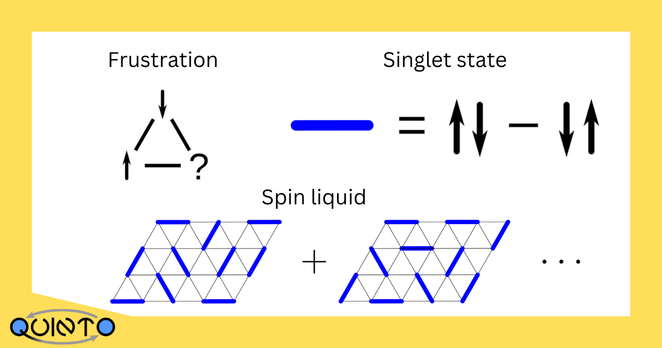
Attached: 1 image Spin liquid As an example of how a topological order can look like, one can look at simplified picture of so-called Z2 spin liquid. This type of topological order is postulated to occur in some “frustrated magnets”. #physics #TopologicalOrder #science #CondensedMatter #CondMat [1/6]

FediScience.org

Yesterday Charlie-Ray Mann gave a talk as a part of the "Many-Body Quantum Optics" program at KITP. Charlie is a postdoc working in the same group as me. Part of presented work (2D numerics which is not directly referenced) was done by me within the QUINTO project. You can listen to the recording of the talk here: https://online.kitp.ucsb.edu/online/mbqoptics24/mann/

#CondensedMatter #condMat #Cond_mat #TopologicalOrder #SpinLiquid #QuantumOptics #Optics #Physics #ColdAtoms #Science

Spin liquid

As an example of how a topological order can look like, one can look at simplified picture of so-called Z2 spin liquid. This type of topological order is postulated to occur in some “frustrated magnets”.
#physics #TopologicalOrder #science #CondensedMatter #CondMat
[1/6]

Hi!
We are conducting a research project on the intersection of quantum optics and condensed matter. We study what happens if an ordered array of atoms absorbs many photons, thus becoming a complex system of many interacting particles. We want to find and exploit analogies between such systems and so-called topological orders, and build a “bridge” between the two fields of physics.
#introduction #Physics #CondensedMatter #CondMat #QuantumOptics #TopologicalOrder #ManyBody #ColdAtoms

[1/2]