 Karsten Schmidt
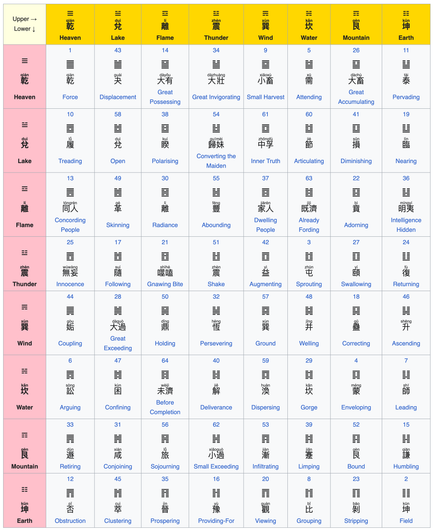
Another workshop done and glad I got a chance to introduce colleagues to the I Ching hexagrams as an example for #BottomUpDesign and as system for constructing/composing higher level concepts/meanings from just a small set of fundamental archetypes (in the I Ching there're only 8 fundamental trigrams)... It's been hugely influential and a guiding principle for my own work & design philosophy (incl. for most of my #OpenSource projects) and I keep finding ever new uses for applying this approach, here to devise a composable classification system, eventually allowing us to define more complex concepts... In world defined by #TopDownThinking, going the opposite way and showing people the benefits/flexibility is sometimes/oftentimes _very_ hard, but to me unquestionably more powerful...
Ps. Also reminded again of the whole Seed technology and essence/function (aka "ti-yong") contrast/discussion/subplots in Stephenson's Diamond Age... Yong is the outer manifestation of something. Ti is the underlying essence...

 James Kemp