 Royce Williams
For North America folks interested in low-maintenance, accurate atomic/radio clocks, but live outside the expected WWVB range¹ :
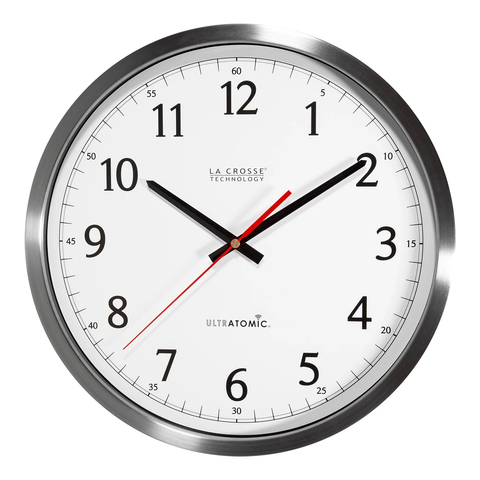
The La Crosse UltrAtomic large wall clock has a semi-novel internal two-antenna design that allows the WWVB signal to be picked up at greater distances (such as southcentral Alaska) when conditions are favorable (especially at night).
And since the modern WWVB signal² embeds DST/ leap seconds / etc well in advance of actual changes, and since the oscillator is relatively low drift ... the time accuracy window is pretty robust.
It takes either two or four D batteries. Four will get you around four years of life in ANC (in my experience).
So between the self-setting and the long battery life .... you can put a visible, affordable, low-maintenance clock in a hard-to-reach place, even in Alaska.
And here's a great teardown for the geeks:
http://leapsecond.com/pages/ultratomic/
(not affiliated or compensated, just a fan!)
¹https://tf.nist.gov/stations/wwvbcoverage.htm
²https://www.nist.gov/publications/wwvb-time-signal-broadcast-new-enhanced-broadcast-format-and-multi-mode-receiver
 Josef 'Jeff' Sipek
 Måns Nilsson