Chupacabra Rises and Evolves

Cryptids don’t become popular without important context and cultural influences that lift them up for all to see, and hold them there. The chupacabra (first known as El Chupacabras) is a complex mystery creature that has evolved and expanding in scope in response to social needs and cultural feedback. It has an amazing history that is still being written today.

The rise of El Chupacabras

Officially, the first cryptid that evolved on the Internet, the stories of El Chupacabras began in Puerto Rico in March 1995, when farmers noticed dead livestock, particularly chickens and goats. The prey was dead, apparently via neck bites, but were not consumed, leading to the idea that some vampiric beast had drained their blood. A previous vampire legend, known as the Moca Vampire, was prevalent in 1975. The same idea was applied to the new crisis, as blood sucking fiends were a cultural touchstone that people understood.

From the San Juan (Puerto Rico) Star (1996)

A couple of decade ago, the Moca monster was sucking blood of assorted animals around that small mountain town, while the garadiablo was a devilish looking creepy crawly from the lagoon seen in local swamplands. “This seems to be a very Caribbean phenomenon, especially of the Spanish-speaking islands,” said [Marvette Perez, curator of Hispanic history at the Smithsonian Institution’s American History Museum]. “It’s part of our folklore. It’s interesting that the chupacabras has not been found on the English-speaking islands, but has migrated only in places where people speak Spanish.

As with the Moca vampire, the subsequent El Chupacabras (or goat-sucker) beast was associated with alleged UFO sightings. The early speculation on the origins of the creature was not zoological, but supernatural, conspiratorial, cultural, and media-driven. The less dramatic and more likely explanation (that was put forward at the time, but ignored) was that the livestock was killed by feral dogs. The blood coagulates and pools inside the carcasses, leading people to think it was drained of blood. No mammal can suck blood. But the facts didn’t stand in the way of the evolution of a great story.

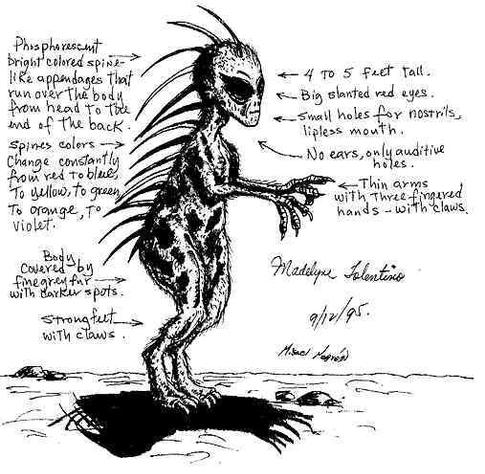
Things REALLY ramped up in Puerto Rico in August of 1995 when witness, Madelyne Tolentino said she saw a bizarre, reptilian, bipedal animal with spiky protrusions on its back, and big eyes. The account was linked to the livestock deaths and the “chupacabras” label, resulting in local panic and an explosion in media coverage. In January 1996, the story of the sightings was covered in the New York Times, kicking off chupa-mania.

Toletino’s original description of the creature.

The beast jumps to the mainland and changes form

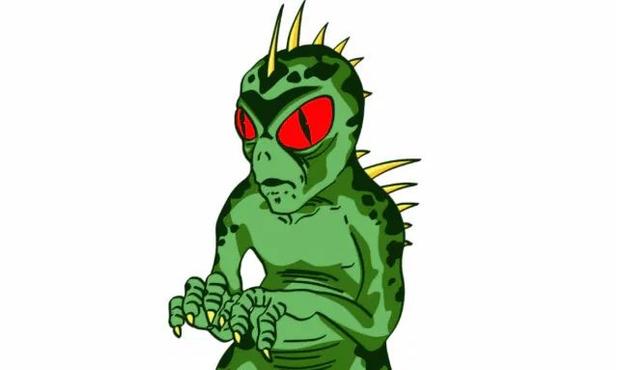
Reports of strange animals surfaced in Mexico, Texas, and Florida – areas with Latino populations that had knowledge of the modern legend. Some cattle deaths that were previously linked to UFOs shifted to being ascribed to the mystery killer. But the move of the chupacabra (now with the shortened name) into the US also came with a change in its description. The original demonic, kangaroo-like, hopping, two legged monster (Type 1) transformed into “any weird strange looking animal”, most often a hairless quadruped (dog, coyote, raccoon, etc.) (Type 2). Over the next several years in the Fortean-zoology community, Type 2 creatures became known as the Texas Blue Dogs based on speculation that these animals may represent a hybrid or new species of canid.

It’s fitting that the original livestock deaths were attributed to dogs, and then the alien-like El Chupacabras description morphed into a strange-looking dog. Shortly, the Type 2 chupa provided something extremely rare in cryptozoology – actual specimens. Ranchers were able to spot and/or kill several of these animals, providing evidence as to what they actually were. The following are some of the most famous incidents:

  • 2004. Elmendorf Beast. Caught in Elmendorf Texas by D. McAnally, the skin of the animal was bluish gray, hairless, and it had a severe overbite. Conclusion: a canid with mange, either a dog or coyote – the DNA was too degraded to be conclusive.
  • 2006. Blanco Chupacabra. The unusual-looking animal shot in Blanco, Texas was taxidermied. It also had hairless dark gray skin. The mount later was displayed in oddities museums, including a Creationist museum for a while. DNA test results were not revealed, suggesting it likely came back as coyote, as expected.
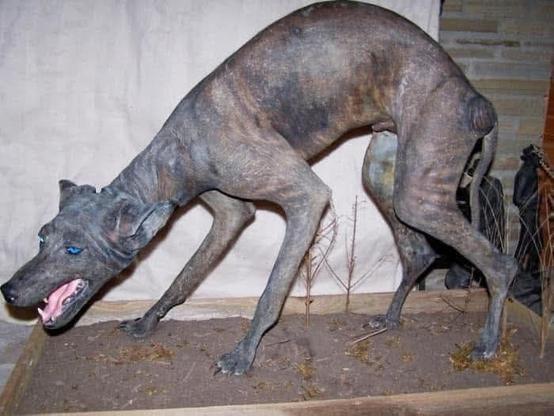
  • 2007. Cuero beast. Phyllis Canion had seen the live animal that later turned up dead near her property. She had it taxidermied and the DNA tested, twice. The first results showed it was a coyote but she did not agree. The second test also returned “coyote” but with a possible trace of Mexican red wolf. Focusing on that hybridity, she still calls it a “chupacabras” and points out its strange tail glands and other odd features.
  • 2008. The Sheriff in Dewitt County, Texas shot a dashcam video of a hairless, gray canid running on road. The animal has a severe overbite and it didn’t look like a usual coyote. This led to news media promoting the animal in terms of the chupacabras legend.
  • 2015. The Rockdale, Texas creature was killed by Philip Oliveira’s dogs. The verdict was mangey coyote. The pattern was now well established.

The non-controversial zoological explanation is that these animals are coyotes or coy-dog hybrids, maybe some are Mexican hairless dogs. The hairlessness in many cases is caused by mange. Note the overbite mentioned frequently. This is a genetic defect of the jaw, making the snout look abnormal and resulting in the unfortunate animals having a harder time killing and consuming prey. Ultimately, this would lead to its weakened state, with the animal more susceptible to disease (mange), and perhaps a penchant to go for livestock as an easier meal.

Canion’s Cuero beast.

Pop culture chupacabra

There is complex cultural context to the rise and evolution of the chupacabra. The definitive book on the subject is Benjamin Radford’s Tracking the Chupacabra (2010). But since that book was written, the cryptid has increased in popularity to a greater degree and their form and description continues to transform and expand.

The horror movies began in 1996 and have continued, depicting the creature mostly as a bloodthirsty monster. But not always. More importantly, the word “chupacabra” became the top catch-all cryptid. Any weird creature that wasn’t immediately identifiable was labeled “chupacabra” no matter what animal family it resembled. The media reporting was credulous, not investigative, and simply repeated the tropes.

Meanwhile, the original outbreak in Puerto Rico was its own study in the effects of cultural influences. Wild explanations circulated about the Type 1 hairless hopping demon version.

  • A biomedical lab experiment that escaped
  • Alien, alien hybrid, or alien pet (recall the UFO associations)
  • Created by the FBI or CIA as a hybrid human-dog or human-monkey
    (Rhesus monkeys did escape from US bio-med labs from the 1950s)
  • A metaphor for US capitalistic policies sucking their “blood”
  • A reflection of the HIV/AIDS problem, that the cynical believed was created to kill minorities.

However, the first visual of the monster, from Tolentino, whose sighting set off the local panic, was discredited. Radford’s field work in the country and, particularly, his interview with Tolentino, conclusively showed that she was heavily influenced by the movie Species in describing what she said she saw prowling her street. The image and stories that circulated were so novel and interesting that people remembered it and it stuck. But it was imaginary.

Many people connected the legend of the Moca vampire to the chupacabra 20 years later. The difference in names strongly suggests this is not the same phenomenon, though it has some similarities. There is no mention of “El Chupacabras” prior to 1995 so we can consider it its own cultural phenomenon. Perhaps the two incidents had the same source – feral dogs killing the livestock combined with cultural priming.

The term “goat sucker” was associated in medieval times to the myth of nightjars (whip-poor-will) that described the birds’ behavior of flying into goat pens at night to suck milk from goats, leaving them dry and blind. This was untrue, but still a fun fact of etymological history.

The move from “El Chupacabras” as the cryptid label to “chupacabra” annoyed some early cryptid commentators as incorrect grammar. Attempts to gatekeep language most often fails in cryptozoology, as words and creature labels develop and change in response to a social need. When a creature is never found but still “seen”, the descriptions and meaning will drift with each telling. When the stories of the Puerto Rican monster went international, the label transitioned into a word that everyone adopted and ultimately understood.

The chupa was “cutified” and sanitized for a young audience.

As with other cryptids, the chupacabra was used to cast doubt on the scientific community and their credibility. John Adolfi exhibited the Blanco beast as an example of the fallibility of science. His Lost World Museum featured exhibits that aimed to show what he believed is proof that scientists don’t have all the answers. Adolfi is a Young Earth Creationist who irrationally thinks that by showing that scientists haven’t figured out the chupacabra, they could also be wrong about evolution and the age of the Earth. This simply doesn’t logically follow, but the same idea turns up with other cryptid themes.

Spirit of Halloween chupacabra

We have our answer

Many still wish to believe that the chupacabra is something more mysterious than a social panic from Puerto Rico, or diseased canids in North America, even though we have strong evidence to explain most incidents. Weird animals were seen, identified, killed and tested. We have our answer. But the answer is not really what the audience wanted. The legendary themes hint at an underlying and more tricky sociocultural problem – loss of livestock and economic hardships, cultural fear of vampires, a precarious sense of the future, and distrust in authority that leads to conspiracy ideas.

In conclusion, the chupacabra has a fascinating history that is only mildly zoological and heavily cultural. The legend was super-charged by the rising World Wide Web, our ever-decreasing familiarity with nature, sensationalist media coverage, and a need for dramatic story-telling in a frightening world. Yet, there still remains some scientific questions as to why we are seeing “blue dogs”. And, there is a recent discovery of the genetic history of the “weird looking” Galveston coyotes. In these ways and more, the chupacabra chronicles lead us out of the mysterious and towards discovery.

This post is part 1 of the 12 days of Cryptids.

#12DaysOfCryptids #chupacabra #cryptid #Cryptozoology #elChupacabras #MocaVampire #paraCryptid #TexasBlueDogs
Lost Monster Files – Carolina Chupacabra review

The Discovery Channel’s new series “Lost Monster Files” (LMF) is promoted as a cryptozoology program that uses a team of experts that consult the archives of “founder of cryptozoology”, Ivan T. Sanderson, in their investigations of modern claims of unclassified animals. The first episode, titled Carolina Chupacabra, aired on 9 October 2024. Here is my review about the content and conclusions.

Not a promising start

There is not a lot of reliable background information on this show on the web. There was a press release and that’s about it. The episodes listed in various places are jumbled and they are not yet airing on the usual streaming services (that is, it’s not on Discovery +). Here is the official blurb for the first episode:

In the premiere episode, the group investigates a series of strange livestock mutilations in the Smoky Mountains that locals fear could be tied to the infamous Chupacabra, which has terrorized the Southwest for decades. Using journals and evidence from Sanderson’s archive, the team investigates a rash of deadly encounters in North Carolina to try and document this killer canine…and the possibility that the creature could be migrating east.

Interestingly, I also found this alternate wording on another TV listing site that was more or less the same except for this part:

…the team attempts to uncover the identity of this killer canine and whether or not it could be part of a secret government testing program.

Right from the start, with the intro (“A horrifying, blood-sucking beast is terrorizing Appalachia…”), and the hint of conspiracy mongering from what might have been an earlier draft blurb, we’re in outlandish BS paranormal territory. The episode ends up NOT going there, at least, but I can’t help wonder if that was an editing decision. Before we get to the content, let’s check out the show’s “experts.”

A Team of “Experts”

From the press release:

The team includes field scientist and tech expert Charlie Mewshaw, cryptozoologist Brittany Barbieri, predator experts and wildlife trackers Troy Lillie and Justin Igualada, and former CIA officer and FBI agent Tracy Walder. Following evidence and theories buried away for decades and chasing up-to-the-minute encounters, they aim to bring fact to fiction by documenting one of these legendary creatures for the first time.

In the intro, we also are told that all of these people are “experts”. Obviously, we are meant to find them credible and experienced in investigating mystery animal claims. Mewshaw says he has several degrees,

  • Barbieri is listed as a “cryptozoologist”, and the others are touted for their experience and knowledge. My idea of experts must be different than the producers as none are zoologists or biologists. Barbieri, is known as a paranormal researcher who has interest in UFOlogy. She has given herself the title of cryptozoologist like many others in that field. But her IMDB bio states Actress, Writer and Producer.
  • Charlie Mewshaw is an author, podcaster, and artist (and now “program host”) who cites his “natural resource science” background. It’s unclear what that means but it that is not “biology” or “zoology”.
  • Troy Lillie is Brittany’s brother. His job, according to Facebook, is Co-Owner of Crocstar clothing and produces crocodile-related conservation media content.
  • Justin Igualada is a wildlife handler and alligator wrestler.
  • I don’t doubt that CIA/FBI person Tracy Walder was what she said but it doesn’t actually have any value to a show about mysterious animals unless they are going to focus on eyewitness accounts (which seems like the way it’s going to go) or government secrets (which also might be the direction they are headed).

So, from my point of view, this is a team of people who call themselves experts but they haven’t done much, if any, scientific research, published papers, and undergone peer review for their work. Discovery producers can call them “experts” and won’t get in trouble for it. I’ll drop in here a reminder that Sanderson himself had a degree in Zoology. Calling oneself an “expert” is usual for paranormal content, so this flummery is almost expected.

If I’m wrong about any of these assertions, feel free to let me know. The reason I’m irked by this use of “expert” in a presumably zoological show is because, if you are going to do animal investigations regarding interpretation, conclusions, etc., that is framed as scientific, you had better have some legit cred and know how science actually works. None of these people have that, though it will not be obvious to the casual viewer. This is a Monster Quest-style show where people are pretending to do science and look very serious-minded, but their conclusions mean little because the results are contrived without peer review and critique. Scientific discoveries aren’t legitimized via TV show.

Oh dear, I’ve shown all my cards already. But it’s no surprise that I deeply despise this ‘I play a scientist/researcher on TV’ gambit. It is how many nonfiction mystery docu-shows are formatted, which is, unfortunately, promoting misinformation to the audience. My choice would have actual scientists talking about this stuff, but, I’d bet they are busy creating actual knowledge.

At least LMF does not appear to be manufactured fiction like previous Discovery Network shows. And, it is possible that the content could be informative. Plus, we all know that Monster Quest was useful in getting people interested in animals. Some of those people undoubtedly realized that the MQ content was not altogether reliable; that it was solely entertainment, not scholarship.

Episode 1: A tale of two chupacabras

I’ll hit the few points that stuck out to me in this episode.

Sanderson is emphasized as “the” founder of cryptozoology.

I’m going to assume that the people reading this have some background in the history of cryptozoology. The program uses Ivan T. Sanderson’s ideas as a foundation, and maybe nothing more than a plot device. I’m a bit concerned about that. Sanderson was problematic but I enjoy his writing without taking it too seriously. The narration tells us Sanderson was “the” founder of cryptozoology. The press release says “a” founder of cryptozoology, which is more correct. There is no mention of Bernard Heuvelmans (“father of cryptozoology”) so far, but they do head to Minnesota…

Where is the archive from?

The archive of recordings, papers, binders, casts and animal remains are said to have been “lost” for 50 years and that this team got access to it in Kalamazoo, Michigan. I don’t know the background for this. Sanderson’s paper are known to be in the archives of the American Philosophical Society in Philadelphia. I do not know the difference between the collections. Could this content be some of the material taken from his Society for the Investigation of the Unexplained (SITU) headquarters in New Jersey? It was known that after his death people made off with stuff from the headquarters. The origin story of the archives is not addressed in the first episode.

Hybrid canids and the chupacabra

For this episode, the link to Sanderson, who wrote back in the 1950s and 60s, is that he considered that hybrid wolf-like canids could account for mystery animals in the US. This is the show’s jumping off point to discuss livestock deaths by mystery canids in both North Carolina and Texas. Brittany, Troy and Justin visit farmers in Appalachian North Carolina who report seeing a large canid and experiencing livestock deaths. Notably, the creature is said to be bigger than a coyote with some reporting “glowing green eyes”.

Meanwhile, Charlie and Tracy pay a visit to Phyllis Canion, owner of the iconic “chupacabra” that was killed and taxidermied in Cuero, Texas. Canion’s DNA test showed that the strange animal was a coyote with a mix of Mexican red wolf. However, it is notable that the “wolf” portion could have been introduced generations ago, according to information from UC Davis. In LMF, however, the DNA result is said to include a “unknown” portion as well. Much is made of this “mystery” as I will circle back to in a bit.

Phyllis Canion with the mounted version of the hairless animal killed near her Cuero, Texas ranch.

In North Carolina, a stake out by the crew with a live goat as bait resulted in a brief glimpse on infrared video of a canid shape racing through the area. Almost unbelievably, the animal ran into a pole they placed in the ground to act as a hair trap, dislodging it. It left not hair, but skin. The skin sample was sent for DNA testing and the result was said to be exactly the same as Canion’s result, leading to the team to conclude that it’s the same species of animal.

Blood-sucking beast

The history of the cryptid called a “chupacabra” is socially complex and rather confusing. If you know, you know. Throughout the episode, the cast states that it would be awesome to finally get proof of whatever the “chupacabra” is. However, not only is Canion’s animal referred to as a “chupacabra” (so we already know that, in this four-legged chupa-form, it’s a coyote), but the legend of other sightings are assumed to be factual, as if this is all one-in-the-same “new” species of animal that “drains the blood” of livestock. At no point is there ever mention of the fact that canids do not and cannot “suck” blood. Dead animals don’t bleed because blood quickly coagulates. If the carcass is “mutilated” by scavengers after it is deceased, there will not be blood everywhere. The cast appears to be egregiously ignorant of how biology works. Or the whole vampire angle is emphasized for creepy effect.

Ridiculous conclusion

A trendy idea by non-scientists in the fantastical cryptid scene is that dire wolves are still living out there. There is zero scientific evidence for this, not even a hint that they exist, with the youngest remains dated at about 10,000 years ago. LMF suggests that the “unknown” portion of the two DNA results could represent dire wolf, vindicating Sanderson’s hybrid idea. However, we do have DNA from extinct dire wolfs and it shows they diverged from other wolf lines nearly 6 million years ago. The animals in question are not part dire wolf. The real conclusion, no matter if you believe or not, is that these animals are weird looking coyotes. Wolf-like canids readily hybridize. The DNA mix appears to not be unusual as it is common for southern coyotes to have red wolf DNA, but, here, the gaps are exploited as “mysterious” for dramatic effect (and as misinformation).

Barbieri and Mewshaw casually decide, on the basis of dubious reports and DNA conjecture, that both animals belong to a new species that they call “Lykos sphinx” – and inappropriate and nonsensical name. Zoological names must be based on specimens, and be published, not a hot take from a TV show. This is undoubtedly the stupidest part of the show, even outdoing the gross sibling jibes (which are sort of realistic and funny) and gratuitous sexist reference about Brittany asking to talk to other witnesses.

I’m not buying much of the “evidence” in this presentation. The premise of a blood sucking, green eyed, ravenous beast is supported. Coyotes, and many other things, kill livestock and there are several explanations for why a body remained uneaten. I’m not even convinced by the bite marks on the dead pig shown. Too many questions remain unanswered and the anecdotes are also unconvincing. LMF appears to be another in a very long parade of samey pseudoscience paranormal shows. The scientifical cast appears to want to use the gimmick that Sanderson was prescient in thinking about cryptids decades ago. I feel this is reaching, and it doesn’t land well. I will watch a few more episodes to see.

Real mystery animal out there?

I don’t want to end on that note – there is something interesting to me going on with animals like the one Phyllis Canion found and I would like to know more from actual experts. The Cuero specimen has some unique characteristics, and I wonder if more than one animal like this has been documented. In a way, these pseudo-chupacabra animals are cryptids in that the legend is growing and outpacing the ability of scientific information to reach the public.

Sometimes called “Texas blue dogs” for their hairless, blue-skinned appearance, some show hairlessness beyond typical patterns of sarcoptic mange, and have unusual jaws, eye color, leg length, etc. I cannot find that there was ever a published article on these specimens, if they fall within the range of morphology for coyotes, and if this ties into the claims about these hybrid animals as a population or an anomaly. It would make an actual good show to hear more about this and see what’s real and what has been exaggerated.

For more info on the history of the chupacabra, check out Benjamin Radford’s Tracking the Chupacabra (2011)

More: Episode 2, ABSM and the origin of the files and Episode 3, Pennsylvania Thunderbird

#chupacabra #coyote #cryptid #Cryptozoology #direWolf #DNA #IvanSanderson #LostMonsterFiles #MonsterQuest #paranormalTV #PhyllisCanion #ReviewOfLostMonsterFiles #science #sciencey #Scientifical #TexasBlueDogs #TVShow

https://sharonahill.com/?p=8791