 Khurram Wadee ✅
Caught in the Web: #Visualization of a #BlackHoleMerger in the #TarantulaNebula
#Astronomy #Picture of the Day
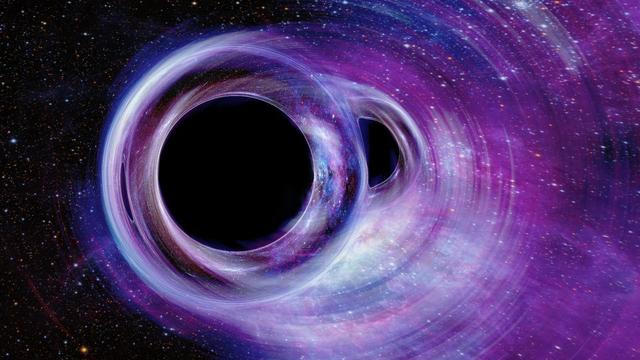
Caught in the Web: #Visualization of a #BlackHoleMerger in the #TarantulaNebula
#Astronomy #Picture of the Day
Last night was surprisingly successful for #astrophotography. I shot five targets, and got good results for three of them. The fifth ... I'll add its data to my previous sessions later.
First up was the #Moon. At about 3/4 full, it is now a major issue for many targets, but makes for a great image itself, as the surface is mostly visible, but still has the sun hitting at an angle, so we get great shadows.
Second was the #TarantulaNebula , aka #C103 or #NGC2070 .
Next up was a bit of an experiment - #Orion 's Belt. This was a roughly 1 hour mosaic, and I am pretty pleased with how it has come out.
Last for the evening was the #BeehiveCluster or #M44. I don't often shoot clusters, but I thought this was in a good position. Sadly there is no nebulosity associated with it. Despite this, it has come up looking very pretty.
Here is a little collage of the evenings shots.
#astronomy #Astrodon #backyardAstronomy #southernhemisphere #Dwarf3 #Snapseed

This cosmic spider resides in the Large Magellanic Cloud, a dwarf galaxy located about 160,000 light-years away in the constellations Dorado and Mensa. The Tarantula Nebula is the largest and brightest star-forming region, not just in the Large Magellanic Cloud, but in the entire group of nearby galaxies to which the Milky Way belongs. It's also home to the most massive stars known, some roughly 200 times as massive as our Sun.
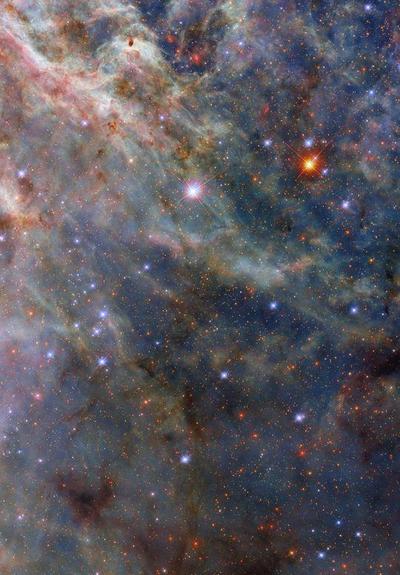
Last night was an interesting one for astrophotography. According to the forecasts, we were to expect about 2 hours of clear skies, and right on schedule, a mass of cloud came in from the North-West. Unexpectedly, it then slid off to the South-West, and vanished. We then spent the rest night nervously picking new targets and waiting for the cloud to return. Which it did at about 4AM.
So this was one night where having the ability to schedule our shoots was utterly useless to us.
That said, we are in Bortle 2/3 skies here, and with a new moon we had a chance to go for some things that lose a lot of detail in the suburbs, even with a smart telescope.
One of those for me was the Tarantula Nebula, aka 30 Doradus in the Large Magellanic Cloud.
This is a truly massive star forming region - don't forget that the LMC is a companion galaxy to ours - so it is really far away compared to other similar objects we can discern. As it is, it is 2/3 degree by 1/2 degree in size for us, making it a massive 200-570 parsecs across at the estimated distance of 49 Kpc .
It is also insanely bright - if it was the same distance as the Orion Nebula, it would be as bright as a full moon!
Anyways, I got 83 minutes with the Ha/OIII filter on the Dwarf3, post processed in Stellar Studio and Snapseed.
#Astrophotography #Astronomy #Astrodon #LMC #TarantulaNebula #Dwarf3 #SmartTelescope #Snapseed #NGC2052

So, knowing I had a fixation on the #TarantulaNebula, #BernieReim let me turn in a painting of the nebula as my final project! I incorporated a lot of what I learned about telescopes and refraction (the cross shaped light patterns), and also how one can perceive every color EXCEPT green! (Including some spots that appear brown to the human eye). He really appreciated my level of detail, even if my painting skills weren't the best (and my canvas was a paper box cover)...

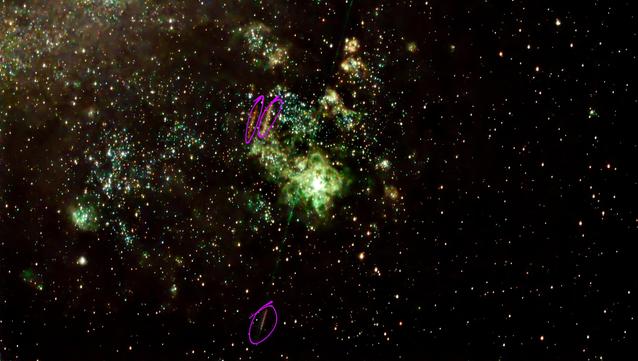
Early this morning I took this shot of the Tarantula Nebula.
56x60s@80 on my Dwarf3.
I only stopped because of something weird.
The green line is clearly a satellite - not a problem. Annoying, but not a problem.
The question is "What are those broad red streaks?" They seem to have appeared in a single frame, and so were less than 60s in duration, but they are very broad. If all three were aligned, I'd say it was a passing jet, but the bottom one does not line up. Despite that they all parallel to each other. And to the satellite path.
Does anyone have any ideas?
#dwarf3 #tarantulaNebula #Astrodon #Astronomy #astrophotography
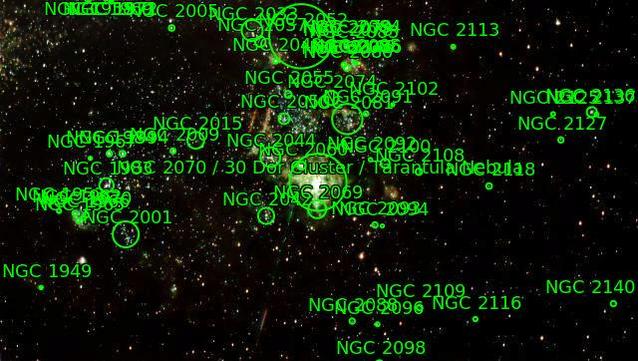
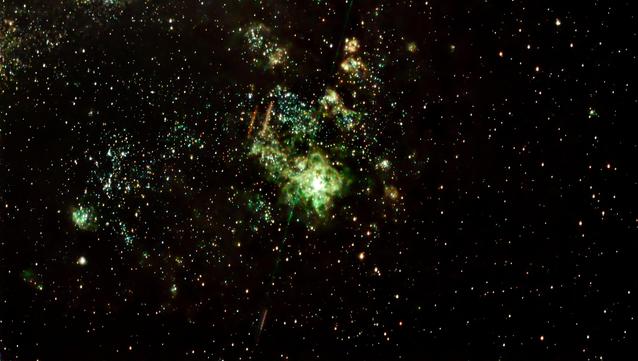

This is the #TarantulaNebula! It’s near the south celestial pole.
About 6 hours of integration time. 3 hours of Ha, 3 hours of Sii.
Not much more to say about this one. Enjoy!
#Astrodon #Astro #Astrophotography #Nebula #ED80 #SkyWatcher
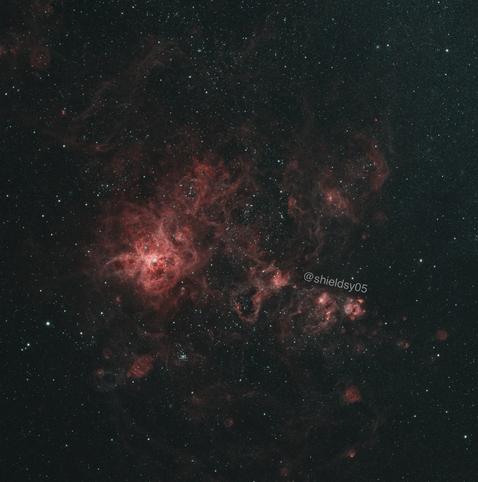
Referenced link: https://phys.org/news/2023-06-tarantula-nebula-shouldnt-stars.html
Discuss on https://discu.eu/q/https://phys.org/news/2023-06-tarantula-nebula-shouldnt-stars.html
Originally posted by Phys.org / @physorg_com: http://nitter.platypush.tech/physorg_com/status/1668656127028985856#m
The #TarantulaNebula shouldn't be forming stars. What's going on? @universetoday @AAS_Publishing https://hcvalidate.perfdrive.com/fb803c746e9148689b3984a31fccd902// https://phys.org/news/2023-06-tarantula-nebula-shouldnt-stars.html

The Tarantula Nebula is a star formation region in the Large Magellanic Cloud (LMC). Tarantula is about 160,000 light-years away and is highly luminous for a non-stellar object. It's the brightest and largest star formation region in the entire Local Group of galaxies.
 rdm
rdm earthling
 DoomsdaysCW
 Mary McIntyre Astronomy
 David
David Phys.org
 John Pork