 Dr. Juande Santander-Vela
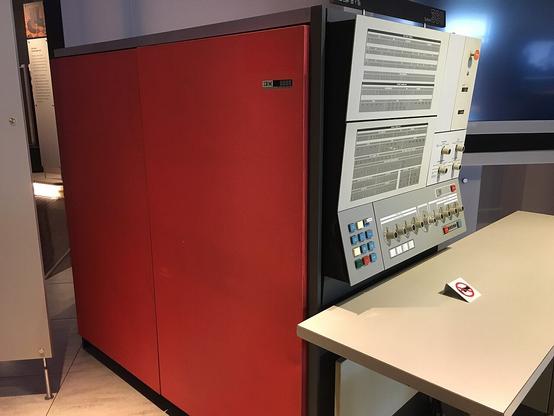
System/360 was quite an engineering feat, with an architecture developed first which supported different implementations, including using microcode or not being part of the implementation details.
From the Wikipedia entry on the generic System/360 [1]:
«System/360's chief architect was Gene Amdahl and the project was managed by Fred Brooks, responsible to Chairman Thomas J. Watson Jr.»
Gene Amdahl [2] formulated the eponymous scaling law [3], while Fred Brooks [4] was the author of “The Mythical Man Month” [5], and Thomas J. Watson Jr. [6] was IBM’s second president, who managed the mainframe era of IBM. Watson, the expert system supercomputer that beat Jeopardy! in 2011 [7] was named after his father, IBM’s original founder.
[1]: https://en.wikipedia.org/wiki/IBM_System/360
[2]: https://en.wikipedia.org/wiki/Gene_Amdahl
[3]: https://en.wikipedia.org/wiki/Amdahl's_law
[4]: https://en.wikipedia.org/wiki/Fred_Brooks
[5]: https://en.wikipedia.org/wiki/The_Mythical_Man-Month
[6]: https://en.wikipedia.org/wiki/Thomas_J._Watson_Jr.
[7]: https://en.wikipedia.org/wiki/IBM_Watson
https://stefanbohacek.online/@discontinued/115797198191231974
#retrocomputing #IBM #SystemScaling #Scalability #ComputerArchitecture #System360 #IBMSystem360
 CrateDB