Weekly Update from the Open Journal of Astrophysics – 10/01/2026

Welcome to the first proper update for 2026 from the Open Journal of Astrophysics. The New Year brings us to Volume 9. In many countries, especially in Europe, Christmas is celebrated on January 6th so this week was also affected by the holiday season. Nevertheless, since the last update we have published four papers, bringing the number in Volume 9 (2026) to 4 and the total so far published by OJAp up to 452.

The first paper this week (and of course the first of 2026) is “A targeted, parallax-based search for Planet Nine” by Hector Socas-Navarro and Ignacio Trujillo (both of the Instituto de Astrofísica de Canaria, Spain). This article describes a targeted search for the hypothesized Planet Nine in the outer solar system, using parallax position shifts. No credible candidates were found within the observed field. It was published on Tuesday January 6th in the folder Earth and Planetary Astrophysics. The overlay is here:

You can find the officially accepted version on arXiv here and the announcement on Fediverse here:

https://fediscience.org/@OJ_Astro/115847068676034973

The second paper is “Going beyond S8: fast inference of the matter power spectrum from weak-lensing surveys” by Cyrille Doux (Université Grenoble Alpes, France) and Tanvi Karwal (U. Chicago, USA). This was published on Wednesday January 7th in the folder Cosmology and Nongalactic Astrophysics and it presents a new framework to extract the scale-dependent matter power spectrum from cosmic shear and CMB lensing measurements, revealing a consistent suppression in the matter power spectrum in galaxy-lensing. The overlay is here:

The official version of the paper can be found on arXiv here and the Fediverse announcement here:

https://fediscience.org/@OJ_Astro/115853112748106265

Next we have “Constraining the Stellar-to-Halo Mass Relation with Galaxy Clustering and Weak Lensing from DES Year 3 Data” which is led by G. Zacharegkas et al. (Argonne National Laboratory, USA) and has 102 other authors too numerous to list by name from many institutions around the world again too numerous to list by name. It presents a framework to analyze the relationship between a galaxy’s stellar mass and its dark matter halo mass, using data from the Dark Energy Survey. The findings align with previous results. This paper was published on Thursday January 8th in the folder Astrophysics of Galaxies. The overlay is here:

The official version can be found on arXiv here and the Fediverse announcement is here:

https://fediscience.org/@OJ_Astro/115858972601709198

Finally for this week we have “Distance measurements from the internal dynamics of globular clusters: Application to the Sombrero galaxy (M 104)” by Katja Fahrion (University of Vienna, Austria) and 9 others based in Spain, Australia, UK, USA, Brazil, Germany and Switzerland. This was published on Friday 9th January (yesterday) in the folder Astrophysics of Galaxies. This study uses the globular cluster velocity dispersion method to measure the distance to the Sombrero galaxy, finding it to be approximately 9.0 Mpc away. The overlay is here:

The officially accepted version can be found on arXiv here and the Fediverse announcement here:

https://fediscience.org/@OJ_Astro/115864438724623861

That concludes the update for this week. I will do another next Saturday.

#arXiv250405473v2 #arXiv250616434v3 #arXiv250622367v3 #AstrophysicsOfGalaxies #CosmologyAndNonGalacticAstrophysics #DarkEnergySurvey #DES #DiamondOpenAccess #DiamondOpenAccessPublishing #EarthAndPlanetaryAstrophysics #galaxyClustering #galaxyHalo #OpenAccess #OpenAccessPublishing #OpenJournalOfAstrophysics #Planet9 #PowerSpectrum #StellarMass #TheOpenJournalOfAstrophysics #weakGravitationalLensing

Some more #art. Loose marker sketches on Reracks from #Stellarmass. I'm planning to change them around a bit cause they haven't been updated since 2019. But yeah, a friend asked if they could be pastel colored so I doodled up some variations the species can have.

Color is sex-linked, so natal males will have wild, bold, and bright colors while natal females will have dull, speckled colors with paler brighter color accents. These accents are there as an identifier for individuals.

As we all know, however, genetics aren't always binary and things can get weird fast. Some individuals are intersex or chimeras and will have color patterns that split down the middle (which can happens irl to birds!) or muddle together into blotches.

Pastels come about from a dilute gene and it completely washes out their colors. It can occur in any sex. Sometimes pastels are prone to health problems, especially in their eyes, but it's not always the case.

Some rough #art from me. Haven't drawn any of my aliens from my speculative biology/sandbox scifi universe, #Stellarmass in a long....long time. :x

Just some Reracks, a dude and a gal respectively. I remember I did a rework of the species to fit how birds function, with the females being big and dull colored with the males being smaller, brighter colored, and flamboyant as fuck. Someone told me it should be the other way around and clearly it meant they never observed actual living birds before, lol.

Its so nice to let lose with pens and markers and just be sloppy. The toddler like the sketch so I call it a win.

Second-biggest #blackhole in the #MilkyWay found
As far as black holes go, there are two categories: #supermassive that live at center of #galaxies (and we're unsure about how they got there) and stellar mass ones formed through #supernovae that end lives of massive stars. Although #stellarmass #blackholes are several times the mass of the Sun, they aren't really all that heavy in the grand scheme of things, and the on in our galaxy is close, 2,000 light-years distant.
https://arstechnica.com/science/2024/04/second-biggest-black-hole-in-the-milky-way-found/
Second-biggest black hole in the Milky Way found

May help explain why we see so many of these monsters colliding.

Ars Technica

www.sciencedaily.com/releases/2022/11/221104113504.htm

#Gemini #North #telescope on #Hawaii reveals #first #dormant, #stellarmass #blackhole in our #cosmic #backyard.

#Astronomers have discovered the #closest known black hole to #Earth. This is the first unambiguous detection of a dormant stellar-mass black hole in the #MilkyWay. Its close proximity to Earth, a mere #1600 #lightyears away, offers an intriguing target of study to advance our understanding of the evolution of #binary systems

Working on the Atagi sheet for #stellarmass

There's three kinds of Atagi. Soldiers, Workers, and Queens. What they do is obvious. Technically all of them are female and reproduce via thelytoky parthenogenesis. I imagine they evolved that way as the scrub-lands (in which they mostly live) got bigger and bigger and drones had problems finding queens so...why not just not rely on drones anymore?

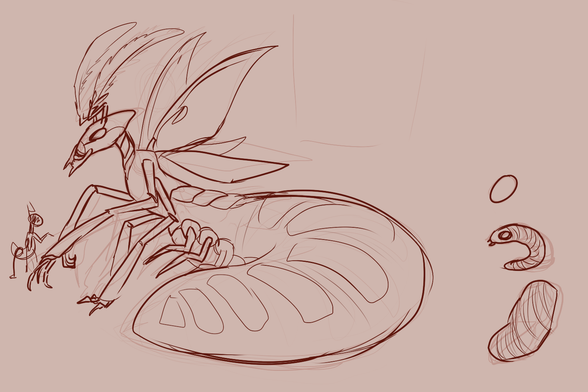
HW asked his patreon reward drawing to be an Anansi from my #stellarmass universe showing off a beautiful blanket she wove! It also needed to include constellations, so this particular one to them is 'the great dragon', which is pretty much a gigantic predatory non-sapient dragonfly type invertebrate that inhabits their planet.

#art #mastoart

Another #stellarmass #alien for you guys! It's my favorite thing in the world, science fiction and westerns, combined into one...the #Springer !

Full writeup is on my FA -> https://www.furaffinity.net/view/33034955

#art #mastoart

Stellarmass - Springers by KeetahSpacecat

Now for SPACE COWBOYS. These are the second species I ever created and it was over 15 years ago wowie. Springers are a bipedal mammal ...

Got another #stellarmass #alien for you guys! The first species I made up and one that's very popular cause of FLOOF and CUTE....the #zuraki !!!

Full writeup is on my FA -> https://www.furaffinity.net/view/33034512/

#art #mastoart

Stellarmass - Zuraki by KeetahSpacecat

And now, perhaps the most popular species of this universe, the cuddly Zuraki! Zuraki are a quadrupedal mammal race from a planet ...

Hey yo it's a brand new #stellarmass species! They Sycrine!

Write up here ->https://www.furaffinity.net/view/31805750/

Eventually im going to make a wiki for all of this.

#art #mastoart

Stellarmass - Sycrine by KeetahSpacecat

Here's a Stellarmass species that you aren't allowed to talk to yet, just in case an introduced virus could make them all sick. Be caref ...