 Filosofía en Abierto (SdFA)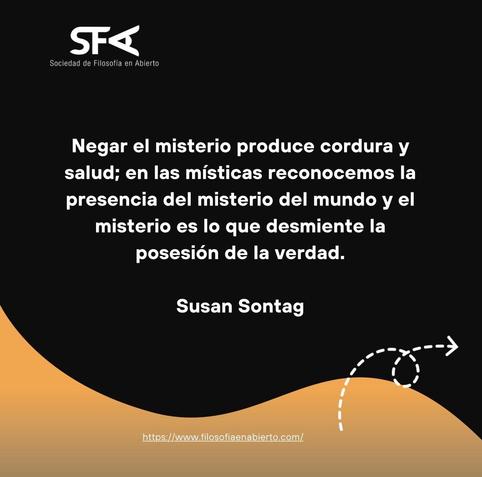
 David Boles
Sontag’s Two Doors, Campbell’s Underworld
In a television interview that has circulated for years, Susan Sontag offers a small theory of storytelling. She points out that the English word “story” carries a double valence. We say “tell me the real story” to demand truth, and we say “that’s only a story” to dismiss invention. Stories, she argues, face two directions at once, toward fact and toward fantasy, and this doubleness sits at the center of what stories do.
The observation is correct as far as it travels, and the format of a televised exchange does not give a thinker of Sontag’s caliber room to develop the qualifications she would have written into print. Sontag is reliable on the surface phenomena. The deathbed scene she describes, where family secrets surface around mortality, is psychologically accurate. Her returning voyager who brings news from elsewhere is one of the oldest functions of narrative, traceable from Odysseus through Marco Polo and Mary Kingsley to the embedded war correspondent. We are also gripped, as Sontag says, by stories precisely because they describe what cannot happen. Readers of Kafka know Gregor Samsa did not wake as an insect, and that knowledge intensifies the story’s force.
Where Sontag falters is in locating this doubleness at “the very center of the whole enterprise of storytelling.” The tension she identifies is a feature of post-Enlightenment English usage. Other languages partition the territory differently. German separates Geschichte from Erzählung, the chronicle from the tale. Ancient Greek separates mythos from logos and historia. Sanskrit holds itihasa, the account of what happened, distinct from purana, the ancient telling. Yoruba oral tradition separates itan, the sacred and ancestral narrative, from àló, the entertaining household tale. The ambiguity Sontag treats as constitutive is partly an artifact of English vocabulary collapsing distinctions that other tongues hold apart. To say storytelling faces two directions, truth and lie, is to inherit a Cartesian frame that pre-modern peoples would have found alien to the question.
This is exactly where Joseph Campbell would intervene. For Campbell, the truth-versus-fiction axis was a symptom of modern literalism, useful for tracking what one cultural moment had lost but useless for explaining how myth operates. Drawing on Jung and on comparative anthropology, he argued that stories carry psychological reality independent of historical reality. The hero’s descent to the underworld, the dying and rising god, the trickster who exposes the king, these belong to a third register that Sontag’s binary cannot accommodate. They register as neither historical claim nor fantasy opposed to fact. As Campbell argued throughout his career, mythology is what we call other people’s religion, and he was pointing at the failure of the truth/lie axis to capture what religious narrative does for those who live inside it.
Campbell would likely call Sontag’s voyager model one motif among several, including myths of descent, metamorphosis, cosmogony, and trickster disruption, while also insisting that the voyager holds special centrality because it externalizes the interior process by which the soul ventures into the unconscious and returns with knowledge. He traced this structure from the shamanic vision quest through Joyce’s Ulysses into the popular cinema of his late life, and his reading of Star Wars as a contemporary monomyth was either his most generous gift to popular culture or his most embarrassing capitulation to it, depending on which scholar you read. Maureen Murdock’s challenge to the male hero’s quest, developed in The Heroine’s Journey in 1990, sharpened the critique that Campbell’s pattern was less universal than his rhetoric implied. Robert Ellwood in The Politics of Myth and Brendan Gill in The New York Review of Books raised harder questions about Campbell’s politics and his unguarded private writings, and those critiques have not been resolved by his admirers so much as set aside.
Even granting those qualifications, Campbell’s instinct about register stands. He saw that stories carry meaning along a vertical axis, downward into the unconscious and upward into shared cultural reference, and the truth/lie binary slices that axis horizontally and loses the depth.
Saul Kripke offers a second escape from Sontag’s binary, arriving from a tradition Campbell never engaged. In his John Locke Lectures delivered at Oxford in 1973 and published as Reference and Existence in 2013, Kripke extended the rigid-designator theory of his Naming and Necessity to fictional and mythological names, arguing that such names refer to abstract objects brought into existence by the storytelling act itself. The name “Odysseus” refers, in Kripke’s account, to a fictional character: an abstract artifact created by Homeric composition and sustained by every subsequent reader and translator who has carried that reference forward. Kripke gives storytelling a creative-ontological power Sontag’s truth/fiction frame cannot register. Two traditions sharing almost no methodological vocabulary, depth psychology and analytic philosophy of language, arrive at the same conclusion: the truth/lie axis fails because storytelling produces a third class of object the axis cannot measure.
There is a temperamental and political difference between Sontag and Campbell worth naming directly. Sontag wrote in the long aftermath of the Holocaust and the Cold War, suspicious of any totalizing narrative. She had watched fascism weaponize national myth in Germany and Italy, and her caution reflects that experience honestly. Campbell was an American comparativist working in the wake of Frazer and Jung, drawn to pattern across cultures, and his posthumously published journals raised real questions about his political instincts. Sontag’s suspicion functions as a corrective against political weaponization. Campbell’s pattern recognition functions as recognition of common structure across cultures that have never met. The disagreement between them is genuine and should not be smoothed over for the comfort of synthesis.
My position is partial agreement with Sontag and deeper agreement with the Campbell answer she did not stay alive long enough to receive. The truth/fiction ambiguity she describes belongs to modern Western reading habits and shows up wherever those habits travel. The deeper question of what narrative does across cultures requires a different lens. Campbell goes closer to the bone when he asks what stories do across human societies, treating function as the proper unit of analysis, which lets him see patterns Sontag’s frame keeps hidden. Stories organize experience, transmit pattern across generations, rehearse mortality, model possible selves, and bind communities through shared reference. Whether the events “really happened” is a question that stories themselves typically dissolve, which is why we still read Homer and the Book of Job long after their cosmologies have been falsified.
The synthesis Sontag misses, Campbell only gestures toward, and Kripke names from a third direction is that stories operate at multiple registers simultaneously: as durable structures of consciousness, as historically situated cultural artifacts, and as creators of abstract reference objects that take on real life within communities who carry the names forward. The Odyssey is psychologically accurate about return and recognition, it is a specific Bronze Age Greek text carrying specific class and gender assumptions, and it brought “Odysseus” into existence as a name that refers to something real, even if not historical. Collapsing any of these registers into another impoverishes the reading. Sontag’s caution prevents the first kind of collapse, where myth becomes a timeless template that erases the particular hands that made the particular text. Campbell’s depth prevents the second kind of collapse, where a poem becomes a museum object emptied of the psychological force it still exerts on readers who pick it up. Kripke prevents a third collapse altogether, the one in which storytelling is denied its world-making authority and reduced to description of things that already exist. None of the three alone reaches the full target.
What Sontag could not see from the angle of her camera is that the voyager she names as one model among many is the externalization of the tension she places at the center of storytelling. The voyager who returns with news is also the dreamer who returns from the underworld. The bringer of facts and the bringer of vision occupy the same archetypal position, which is why storytelling moves along a single descending axis with truth and invention braided together at the bottom of the well. Sontag stopped at the doorway. Campbell walked down the stairs.
#books #campbell #comparision #culture #knowing #kripke #lies #meaning #myth #naming #sontag #stories #storytelling #truthtelling #voyager
 the woman who fell to earth a.k.a. nauseatingly miserable beyond repair
 Mark
Mark Urban Camera
 (((Cindy Weinstein)))
 Simon Taylor