 Vicky Veritas
Gravitational Lensing
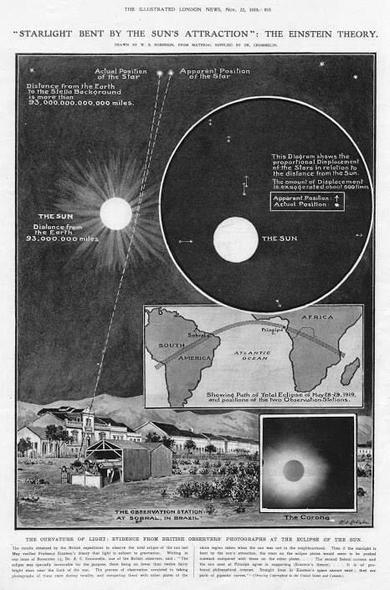
Einstein's Theory of Relativity predicted that the path of light should bend slightly when influenced by an object's gravitational field, but how to prove it?
Sir Frank Watson Dyson, Britain's Astronomer Royal, conceived the perfect experiment to test the theory by using the upcoming total solar eclipse of May 29, 1919. The sun would cross the path of the bright Hyades star cluster and the light from the cluster would have to pass through the sun's gravitational field on its way to Earth. The eclipsing of the sun's normally blinding light by the moon would make it darker and easier to measure any slight shift in the faint light from the cluster.
Sir Arthur Eddington, British Astronomer, mathematician and physicist, led the experiment making precise measurements of the positions of the stars prior to the eclipse. During the eclipse astronomers took pictures from several locations on Earth during the six minutes of total eclipse and Eddington compiled these data. When Eddington announced the results confirming Einstein's predictions on November 6th, 1919, Einstein became a celebrity overnight.
The bending of light around massive objects is now known as "gravitational lensing" and is used in astronomy to try to understand dark matter and the expansion of the universe, and to find exoplanets.
More at: https://www.zmescience.com/science/physics/what-is-gravitational-lensing-astronomers/
More on gravitational lensing here: https://www.cfa.harvard.edu/research/topic/gravitational-lensing
#GravitationalLensing #Einstein #SirFrankWatsonDyson #SirArthurEddington #SolarEclipseMay291919 #BendingLight