 ZiClaud
What happened to the Socratic Method?
 Duncan Stephen
From answer engines to learning engines — Why fast answers are like fast food
People crave fast answers. But the purpose of information systems is to help people gain knowledge. So we should seek better questions.
 (Roughly) Daily
“I cannot teach anybody anything. I can only make them think.”*…
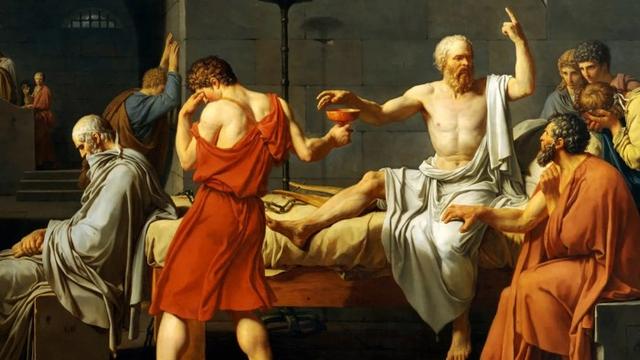
Death of Socrates, Jacques-Louis David (source)Benjamin Ross Hoffman puts “the Socratic Method” into context– important, timely context…
There is a scene in Plato that contains, in miniature, the catastrophe of Athenian public life. Two men meet at a courthouse. One is there to prosecute his own father for the death of a slave. The other is there to be indicted for indecency. [or impiety– see here] The prosecutor, Euthyphro, is certain he understands what decency requires. The accused, Socrates, is not certain of anything, and says so. They talk.
Euthyphro’s confidence is striking. His own family thinks it is indecent for a son to prosecute his father; Euthyphro insists that true decency demands it, that he understands what the gods require better than his relatives do. Socrates, who is about to be tried for teaching indecency toward the gods, asks Euthyphro to explain what decency actually is, since Euthyphro claims to know, and Socrates will need such knowledge for his own defense.
Euthyphro’s first answer is: decency is what I am doing right now, prosecuting wrongdoers regardless of kinship. Socrates points out that this is an example, not a definition. There are many decent acts; what makes them all decent?
Euthyphro tries again: decency is what the gods love. But the gods disagree among themselves, Socrates observes, so by this definition the same act could be both decent and indecent. Euthyphro refines: decency is what all the gods love. And here Socrates asks a question Euthyphro cannot answer: do the gods love decent things because they are decent, or are things decent because the gods love them?
If decent things are decent because the gods love them, then decency is arbitrary, a matter of divine whim. Socrates is too polite to say so, but the implication is: if decency is defined by the arbitrary whim of our betters, who are you to prosecute your father?
If the gods love decent things because they are decent, then however we know this, we already know the standard for decency ourselves and can cut out the middleman. But then Euthyphro should be able to explain the standard. He can’t.
Euthyphro tries a few more times, suggesting that decency is a kind of service to the gods, a kind of trade with the gods. Each time Socrates gently follows the definition to its consequences, and each time it collapses. Eventually Euthyphro leaves, saying he is in a hurry. Socrates’ last words are a lament: you have abandoned me without the understanding I needed for my own defense.
This is usually read as a proto-academic dialogue about definitions. It is a scene from a civilization in crisis. A man is about to use the legal system to destroy his own father on the basis of a concept he cannot define, in a courthouse where another man is about to be destroyed by the same concept. And the man who cannot define it is not unusual. He is representative.
The indecency for which Socrates was being prosecuted seems to have consisted of asking just the sort of questions Socrates posed to Euthyphro…
[Hoffman sketches the culture and politics of Athens in the late fifth century, the role of the Sophists, and the (radical) role that Socrates played…]
… Plato also responded to his beloved mentor’s death by founding the Academy, a great house in Athens where philosophical reasoning was taught methodically. We still have our Academics.
Agnes Callard, in her recent book Open Socrates, wants Socrates to be timeless. She strips out the historical situation, strips out the aliveness that preceded the method, and ends up defending a method that’s obviously inapplicable in many of the cases where she claims it applies. Aristarchus did not need his assumptions questioned at random. He needed someone who could ask probing questions about his actual problem, from a perspective that didn’t share his assumptions about what was and wasn’t possible.
Zvi Mowshowitz, in his review of Callard’s book (part 1, part 2), argues at considerable length that the decontextualized version is bad. He is right. Cached beliefs are usually fine. Destabilizing them is usually harmful. Most people do not want to spend their lives in Socratic questioning, and they are right.
But Zvi has written a long polemic in two installments on the winning side of an incredibly lame debate about whether we should anxiously doubt ourselves all the time, responding to Callard’s decontextualized Socrates, not the real one. The real one did not devise a method and then apply it. He had a quality, something the oracle reached for the language of the tragedians to describe. And what was memorialized as a “method” was what happened when that quality met a city where every other participant in public life had stopped being alive.
Socrates invokes timeless considerations like logical coherence, and committing (even provisionally) to specific claims; these are very natural things to try to appeal to when people are being squirmy, dramatic, hard to pin down, and fleeing to abstractions that resist falsification.
Spinoza, in the Theologico-Political Treatise, similarly resituated the teachings of Jesus of Nazareth in their proper context. The political teachings of the Gospels to turn the other cheek, forgive debts, and render unto Caesar what is due to him, are instructions for people living under a hostile and extractive system of domination. Citizens of a free republic have entirely different duties. They have an affirmative obligation to hold each other accountable, to sue people who have wronged them, to participate in collective self-governance. The teachings are not wrong. They are addressed to a specific situation, and become wrong when mechanically transplanted into an inappropriate context.
The reason to recover the historical Socrates is not only accuracy about the distant past; it is that by seeing this relevant aspect of the past more clearly, we might see more clearly what we are up against now.
Socratic cross-examination requires an interlocutor who at least would feel ashamed not to put on a show of accountability. The people Socrates questioned were performing wisdom, but they were performing it because the culture still demanded that leaders seem accountable. They would sit for the examination, because refusing would be disgraceful, like breaking formation in a hoplite phalanx. Their scripts collapsed because the scripts were designed to look like real accountability, and real accountability is what Socrates brought.
There is a useful framework for understanding how public discourse degrades, which distinguishes between guilt, shame, and depravity. A guilty person has violated a norm and intends to repair the breach by owning up and making amends. An ashamed person intends to conceal the violation, which means deflecting investigation. A depraved person has generalized the intent to conceal into a coalitional strategy: I will cover for you if you cover for me, and together we will derail any investigation that threatens either of us.
The leaders Socrates questioned were, at worst, ashamed. They had taken on roles they couldn’t account for, and they wanted to hide that fact, but they still felt the force of the demand for accountability. When Socrates pressed them, they squirmed, they went in circles, they eventually fled. But they engaged. They felt they had to engage. The culture of Athens, even in its degraded state, still held that a man who refused to give an account of his claims was disgraced.
Depravity is a further stage, and Sartre described it precisely in his book Anti-Semite and Jew:
Never believe that anti-Semites are completely unaware of the absurdity of their replies. They know that their remarks are frivolous, open to challenge. But they are amusing themselves, for it is their adversary who is obliged to use words responsibly, since he believes in words. The anti-Semites have the right to play. They even like to play with discourse for, by giving ridiculous reasons, they discredit the seriousness of their interlocutors. They delight in acting in bad faith, since they seek not to persuade by sound argument but to intimidate and disconcert. If you press them too closely, they will abruptly fall silent, loftily indicating by some phrase that the time for argument is past.
The depraved person does not perform accountability. He plays with the forms of accountability to exhaust and humiliate the person who still takes them seriously. He is not running a script that is trying to pass as a perspective, collapsing only under the kind of questioning we still call Socratic. He is amusing himself at the expense of the questioner. Cross-examination does not expose him, because he was never trying to seem consistent. He was trying to demonstrate that consistency is for suckers. The Socratic method will not help him.
The Socratic method, if we can rightly call it that, was forged by the pressures confronted by a living mind in a city of the ashamed, people who still cared enough about accountability to fake it. It has nothing to say to the depraved themselves, who have dispensed with the pretense, though in a transitional period might expose them to the judgment of the naïve.
But the quality that preceded the method is something else.
What the oracle recognized in Socrates was not the ability to cross-examine. It was something closer to what it recognized in Euripides: the capacity to be present to what is happening, to see the person in front of you rather than the drama you are supposed to enact with them, to respond to the situation rather than to your script about the situation. To be alive.
We do not need a new method. Methods are what you formalize after you understand the problem, and we are not there yet. What might still help us is the quality that precedes method: the willingness to see what is in front of us, to say the obvious thing that everyone embedded in the performance is too scripted to see, and to keep reaching out to others even when the response is usually not even embarrassment but indifference, not even a failed defense but a smirk.
The oracle didn’t say Socrates had the best method. It said he was the wisest man, in a society oriented against wisdom. The “method” was just how aliveness was memorialized by a city that still cared enough to be ashamed of being dead.
The question for us is what aliveness looks like in a city beyond shame…
Eminently worth reading in full.
The Socratic Method and the importance of recognizing and responding to the times in which we live: “Socrates is Mortal“
See also: “The real reason Socrates was given the death sentence– humiliating powerful people was not a key to success“
Apposite: “What Separates The Great From The Petty In History” (“embracing the relentless ally of reality makes all the difference”)
* Socrates
###
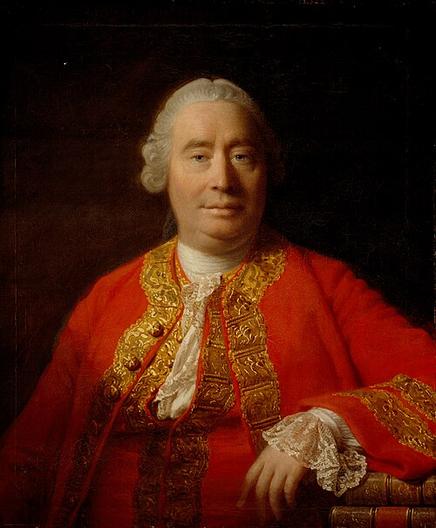
As we inhabit our moment, we might send thoughtful birthday greetings to David Hume; he was born on this date in 1711. A philosopher, historian, economist, and essayist, he developed a highly-influential system of empiricism, philosophical scepticism, and metaphysical naturalism.
Hume strove to create a naturalistic science of man that examined the psychological basis of human nature. Hume followed John Locke in rejecting the existence of innate ideas, concluding that all human knowledge derives solely from experience; this places him amongst such empiricists as Francis Bacon, Thomas Hobbes, Locke, and George Berkeley.
Hume argued that inductive reasoning and belief in causality cannot be justified empirically; instead, they result from custom and mental habit. People never actually perceive that one event causes another but experience only the “constant conjunction” of events. This problem of induction means that to draw any causal inferences from past experience, it is necessary to presuppose that the future will resemble the past; this metaphysical presupposition cannot itself be grounded in prior experience.
An opponent of philosophical rationalists, Hume held that passions rather than reason govern human behaviour, proclaiming that “Reason is, and ought only to be the slave of the passions.” Hume was also a sentimentalist who held that ethics are based on emotion or sentiment rather than abstract moral principle. He maintained an early commitment to naturalistic explanations of moral phenomena and is usually accepted by historians of European philosophy to have first clearly expounded the is–ought problem, or the idea that a statement of fact alone can never give rise to a normative conclusion of what ought to be done.
Hume denied that people have an actual conception of the self, positing that they experience only a bundle of sensations and that the self is nothing more than this bundle of perceptions connected by an association of ideas. Hume’s compatibilist theory of free will takes causal determinism as fully compatible with human freedom. His philosophy of religion, including his rejection of miracles and critique of the argument from design, was especially controversial. Hume left a legacy that affected utilitarianism, logical positivism, the philosophy of science, early analytic philosophy, cognitive science, theology and many other fields and thinkers. Immanuel Kant credited Hume as the inspiration that had awakened him from his “dogmatic slumbers.”
– source
Apropos the piece featured above, see Peter Kreeft‘s Socrates Meets Hume- The Father of Philosophy Meets
The Father of Modern Skepticism (“A Socratic Examination of [Hume’s] An Enquiry Concerning Human Understanding“)
 Know Thyself
“I will go wherever my argument leads me”
This quote, often phrased as “Follow the argument wherever it leads” or “We must follow the argument wherever, like a wind, it may lead us”, comes from Plato’s Republic (394d) and represents the core of the Socratic method.
It embodies the philosophical commitment to pursuing truth through logic and rational dialogue, regardless of where that conclusion takes you or whether it contradicts your initial beliefs.
Here is a breakdown of the significance of this principle:
- Intellectual Honesty: Socrates believed that one should not be afraid of challenging ideas, even if those ideas are commonly accepted or comfortable.
- Rationality Over Bias: The approach urges individuals to abandon preconceived biases or emotional limitations in favor of objective reasoning.
- The Pursuit of Truth: It assumes that through reasoned dialogue (dialectic), one can arrive at a valid conclusion, and that this conclusion is more valuable than maintaining a mistaken belief.
- Socratic Dialogue: In practice, this meant questioning interlocutors until they saw that their own arguments led to contradictions (the elenchus), forcing them to abandon their false initial positions.
This commitment to truth over reputation or comfortable belief is what ultimately led to Socrates’ trial, as he refused to stop questioning the leaders and citizens of Athens.
#AncientGreekPhilosophy #CriticalThinking #Dialectic #Ethics #IntellectualHonesty #LifelongLearning #Logic #Philosophy #Plato #Rationalism #Socrates #SocraticMethod #TheRepublic #Truth #WesternPhilosophy CTNET
CTNETLevel 2: Socratic Interrogation - where AI becomes a thinking partner.
The workflow:
1. Develop thinking independently
2. Ask AI to challenge assumptions
3. Ask AI to identify gaps
4. Ask AI for alternative perspectives
5. Synthesise back into your framework
AI input is the start of deeper thinking, never the end.
#CriticalThinking #PKM #AILiteracy #Zettelkasten #SocraticMethod
 Becca
BeccaRepeated, deliberate engagement of the part of your brain that causes you to stop and question assumptions is highly recommended.
There's opportunity aplenty these days 😁
 Aneesh Sathe
Problems are Places, Questions are Spaces
Last year, while regrouping myself and rebuilding my old curious ways, I had a thought. The common words “spaces” and “places” pass through our minds, fingers, and lips but they deserve a second thought. Unsurprisingly, I wasn’t the first one to consider this and the wealth of reading material helped me write We Need Homes in the Delta Quadrant. Spaces and places have been an enjoyable lens to look through.
Recently, through Agnes Callard’s Open Socrates, I was introduced to the Socratic concepts of questions and problems. Initially I thought of it as a newish way to look at things, but I’m converging toward the idea that problems are places and questions are spaces. A quick exploration below as to why.
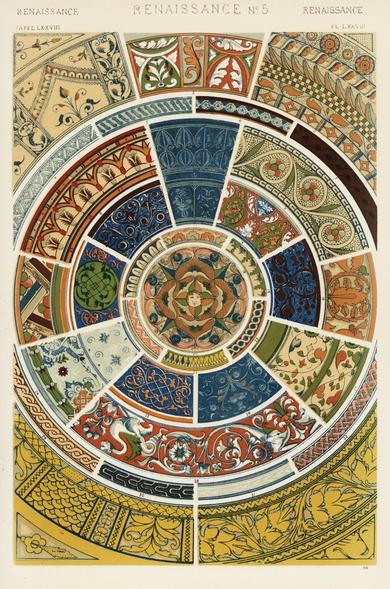
Vintage pattern illustration. Digitally enhanced from our own 19th Century Grammar of Ornament book by Owen Jones.Problems impede your quest and solving them makes them disappear. There are established ways of solving problems—recipes, algorithms, or rituals that nudge the obstacle aside so the original activity may continue unabated. Essentially, problems are tractable.
Places are tractable too as “an ordered worlds of meaning.” Place-making, like problem-solving, begins by drawing a boundary and then treating that encapsulation as a building black, whatever its inner workings. The moment you can stand somewhere and say “here” you have marked out a place; the moment you can name a difficulty and say “do this” you have packaged a problem.
The Socratic question, by contrast, is a quest. It is a hunt whose solution is unknown. Questions do not disappear when solved, instead they are additive and leave you with something, i.e. the solution. A real question insists on orientation before action: you must find north in the wilderness before plotting any march. And yet, along the path to an answer, you inevitably solve problems. Those problems are the markers that help you orient and keep you moving. A previous “solution” to a question can be used as a new place to further explore and prod at the question. In that sense, a question is like the horizon you constantly seek.
Spaces feel exactly like that horizon. Spaces are pure potential to be explored by the places that demarcate the space. Identity, orientation, and even memory of a space are created by and stored in the places that surround it. To explore a space you must create stable places around it
While the new way of thinking about Questions and Problems is great, I still prefer the lens of Spaces and Places. Q&P seem too narrow a set of lenses limited to the human mind. S&P expand that stage and allow us to think of more in that context. What I like even more is that spaces can also be places assuming we allow a boundary to be drawn around the fuzzy nature of a space. As a scientist, this feels a bit more satisfying because it allows you to explore and experiment even when the knowledge isn’t properly tied down by facts.
#AgnesCallard #cognitiveFrameworks #conceptualMetaphors #curiosity #epistemology #knowledgeExploration #philosophy #placeTheory #placemaking #questionsAndProblems #scientificInquiry #socraticMethod #spaceAndPlace #systemsThinking #yiFuTuan
Thinking with places
“A farmer has to cut down trees to create space for his farmstead and fields. Yet once the farm is established it becomes an ordered world of meaning—a place—and beyond it is the forest and space.” — Yi-Fu Tuan
Thinking itself is place-making: the act of converting undifferentiated possibility into navigable meaning.
A place comes into being the moment we interrupt undifferentiated space. Place-making is fundamentally an act of interruption. Space is thought of as possibility but is unavailable without the signposts of place. When a place is created we impose a way of looking, being, and acting on the space of choice. The place you pick to navigate your space defines the identity you will inhabit during your quest. Every tool is a micro-place: it frames what can be thought and forecloses alternative moves. They enforce the kind of thoughts that can be had, the type of exploration that can be done, and configures space in an opinionated way.
Two-masted Schooner with Dory (1894) by Winslow Homer. Original from The Smithsonian. Digitally enhanced by rawpixel.Picking a tool commits us to a world view. Consider the space of ‘good TV shows’. Family, friends and culture have made the choice of what good means. When Netflix suggests shows it uses your watching history as a probe to create place so that every individual is always watching ‘good’ shows. The pure possibility space of the search bar is disrupted by the suggestions provided.
Like algorithmic curation, Socratic dialogue also interrupts space, it is interrogation as cartography. Socratic thinking is also an act of interruption and making concrete what was nebulous. It’s asking us to specify which show, if we claim to love TV. Socratic thinking (henceforth referred to as just thinking) starts by probing that which does not need questioning, the answers that are obvious the ones that everyone knows. This may seem foreign at first glance but we do this all the time, say we make a list of our favorite TV shows, someone always says you are missing this or that show and that this list is completely wrong. This kind of disagreement leads to the shared quest of answering the question, ‘What is it to be entertained?’.
Thinking pursues knowledge through the act of stabilizing answers to such questions by creating places in those unexamined areas. Discussion allows us to map. There is usually no well defined answer for such questions, if there were, they would simply be problems that we could solve with a google search. The quest stops when the parties involved are satisfied that they have arrived at an answer. Thinking is the act of place-making by taking something that was ungraspable and tying it down with knowledge. Place is, after all, an “ordered world of meaning” and we can use these places to create home bases from which to explore.
Even without other people simply engaging with the reality of the universe is sufficient for thought. Places are stable systems which provide a surface on which your thoughts and hypothesis can be tested. Even if there is no other person around and you’re simply engaged with looking at the world can uncover a new truth tied down by knowledge.
Thinking is the process of updating beliefs based on the mini places that make up the space that you’re interrogating. Each place is a noisy pointer to the underlying truth, and each updating of belief allows you to get closer to the knowledge you seek.
#algorithmicCuration #cognitiveScience #criticalThinking #epistemology #mentalModels #philosophy #senseMaking #socraticMethod #spaceAndPlace #toolUse #worldview #yiFuTuan

 Illuminated
Socratic Method Explained: From Debate Tactic to Path of Truth
https://youtu.be/zGiIDlnjtoI
#SocraticMethod #PhilosophyOfTruth #Socrates #Nonduality #LivingPhilosophy
https://youtu.be/zGiIDlnjtoI
#SocraticMethod #PhilosophyOfTruth #Socrates #Nonduality #LivingPhilosophy

Socratic Method Explained: From Debate Tactic to Path of Truth
 N-gated Hacker News
🎨🖊️ Ah, the age-old mystery of asking questions that even Socrates couldn't solve, brought to you by someone who just rediscovered their 2 pencil. Maybe AI can answer, "What's the point of this article?" 🤔🔍
https://newsletter.dancohen.org/archive/asking-good-questions-is-harder-than-giving-great-answers/ #mysteryofquestions #AIinsights #Socraticmethod #rediscovery #creativity #HackerNews #ngated
https://newsletter.dancohen.org/archive/asking-good-questions-is-harder-than-giving-great-answers/ #mysteryofquestions #AIinsights #Socraticmethod #rediscovery #creativity #HackerNews #ngated
