
To start the new year, I wrote a summary of what I did as a researcher in computer science and professor in 2025. FWIW.

https://people.irisa.fr/Martin.Quinson/blog/251231/Status_update:_2025

I speak of #SimGrid, software model-checking and exhaustive testing of digital infrastructures, #csUnplugged, #SmolPhone, #FrugalComputing and #DeuxFleurs among other things.
Status update: 2025

@max_power Here you are for a report on the #SmolPhone project: https://people.irisa.fr/Martin.Quinson/blog/251231/Status_update:_2025/#SmolPhone Thanks for your interest 😊
Status update: 2025

J'ai mis à jour mon billet de blog #SmolPhone au sujet du hackathon des élèves de l'institut supérieur du design de St Malo pour ajouter les productions des élèves en bas de la page. Illes ont super bien bossé, on est ravis.

https://people.irisa.fr/Martin.Quinson/blog/250623/Smolphone-Institut-Design/

SmolPhone @ Institut Design

(english below)
Lundi, j'étais à l'Institut Design de St Malo pour parler du #SmolPhone. J'ai fait un ptit résumé en ligne pour présenter le contexte, mon ressenti de la présentation et vous partager les slides. Vivement vendredi pour la restitution du hackathon.

https://people.irisa.fr/Martin.Quinson/blog/250623/Smolphone-Institut-Design/

I did yet another presentation about the SmolPhone, in a school of design. The above blog post is in French because the presentation was, sorry about that.

SmolPhone @ Institut Design

And now, the keyboard works completely with the little UI of the #SmolPhone. So does the battery (not charging the battery, but powering the board from a battery) and the little touchpad of the blackberry keyboard.

Not impressive for now, I agree, but I'm still super happy of these tiny improvements.

@bonkers The HW engineer told us that we cannot go much further with a RP2040 because our devboard has not enough pins for all the devices I'd want on a #SmolPhone, so we will use a RP2350 instead, which has twice the amount of pins.

Since we braced for of the RP2040, the new MCU seems incredible. 520kb SRAM and dual M33 cores on the chip, that's already great. But the devboard has 48 pins, a SD card reader and even 8Mb of on board RAM! That's almost too much, I'm curious about the power draw.

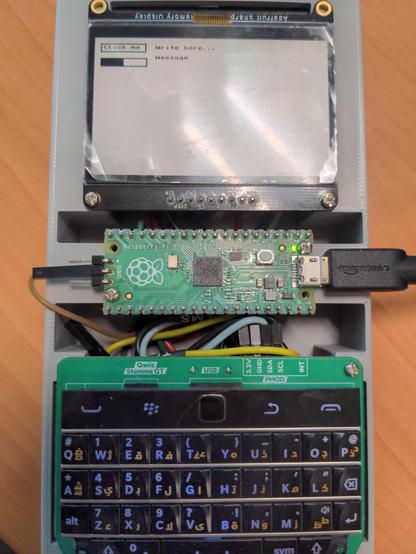
And now, our software boots up on our hardware prototype of the #SmolPhone The keyboard kinda works, too. More work in the future but OK for now.

The substrate is able to display a "modern" UI with buttons, text areas, labels, checkbox and such under the RP2040 constraints (about 200k of RAM but rather OK compute power).

The goal is to allow users to build apps with lua scripts, as in #Scrappy https://jrcpl.us/contrib/2025/Scrappy Maybe before the end of the year, if we're lucky.

#LowNum #FrugalComputing

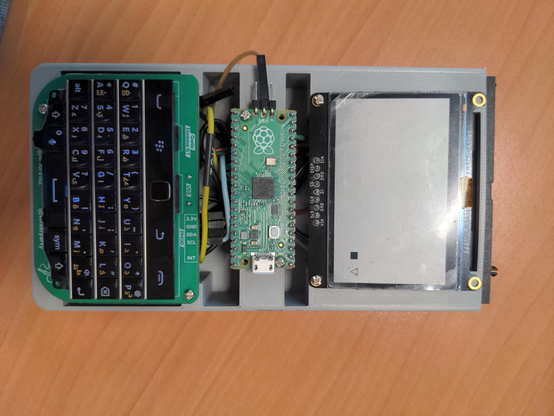
First prototype of the #SmolPhone, with a screen, a keyboard and a RP2040 as main compute unit. The 4G and wifi modems will be for a future iteration.

Don't expect it to be functional yet. It's assembled in a rush since 2 days: the keyboard is connected but not recognized by the program loaded on the 2040. Only the screen is used for now, to move a little black square and its friend the white triangle around the screen.

More to come :)

New blog post about the #SmolPhone (our take on #FrugalComputing): I gave a short talk about it, and decided to write the things I usually say. It's here: https://people.irisa.fr/Martin.Quinson/blog/250528/Smolphone-Magellan/

I think that the result is a nice introduction to the project. Please comment and tell us what you think of it!

SmolPhone @ Magellan

I just gave another presentation about the #SmolPhone project (a #lownum smartphone) at the Eco-ICT fall school. It went smothly, as presented on this page: https://people.irisa.fr/Martin.Quinson/blog/241011/Smolphone-EcoICT/

I'm really eager to see this project really starting, in December I think

SmolPhone @ Beg Meil