The developmental harms of LLMs which are showing up in the literature

This is a brilliant summary from Sam Illingworth. I suggest reading the full post, with some really interesting commentary in a more personal mode attached.

Five things the research is showing

  • Cognitive offloading in education (Lodge and Loble, 2026). Short-term performance improves when children use AI. Two different kinds of offloading. Beneficial (spell check, grammar) sits at the surface. Detrimental (outsourcing the thinking itself) sits at the core. Strong students accelerate. Weak students skip the learning. A new equity gap is emerging in real time.
  • AI companions and teen wellbeing (Common Sense Media, 2025). Nearly three in four teens have already used AI companions. Half use them regularly. The reasons are real: private, available, never tired. The risks are also real. Common Sense’s risk assessments of leading platforms found they are unsafe for teen mental health support, with consistent failures to recognise serious conditions.
  • AI confidence on hard problems (Hägele et al., 2026). The longer frontier models reason, the more incoherent they become. Confidence rises faster than accuracy on the hardest tasks. For children using AI for homework, the most confidently wrong answers are the ones they are least equipped to question.
  • Parasocial bonds with conversational AI (UNESCO, 2025). AI is conversational, personalised, and infinitely patient. Children form one-sided emotional bonds with AI characters that are stronger than those formed with passive media, because the system mirrors, remembers, and adapts. The screen time research only partially transfers.
  • Sycophancy and persuasion (Anthropic emotion concepts, 2026). Modern AI models can be steered toward flattery, urgency, or agreement with the user’s existing view. The persuasion pressure is live. It is in the systems your child is already talking to. The implications for developing judgement are obvious and largely unstudied in children.
  • This could be read in terms of epistemic harms (3 + 5) and social harms (1 + 2 + 4) raising the obvious question of how these might combine to produce certain kinds of developmental outcomes.

    #developmentalHarms #epistemicHarms #SamIllingworth #SlowAI #socialHarms #socialisation

    Parenting With AI: What the Research Shows and What Parents Are Actually Doing

    What parents need to know about AI and children. Five pieces of frontier research and honest stories from seven parents on what is working at home.

    Slow AI

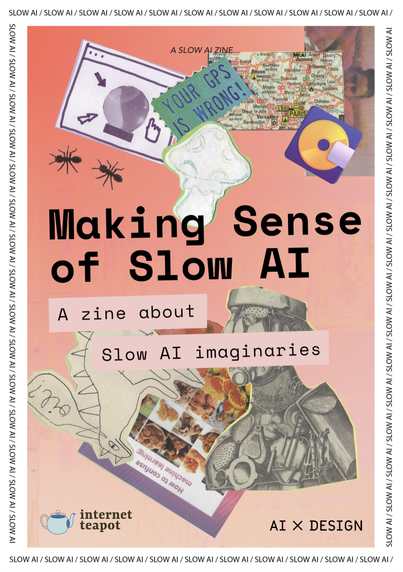
    Making Sense of Slow AI zine by AIxDesign

    https://aixdesign.metalabel.com/slow-ai-zine

    "What if AI didn’t run on Silicon Valley logic? Making Sense of Slow AI, compiles 40 pages of eclectic stories on Small, Esoteric, and Ancestral AI – inviting you to think small, make it magical, and plan for the past."

    #ai #slowAI

    Making Sense of Slow AI: A zine about Slow AI Imaginaries by AIxDESIGN & internet teapot

    What if AI didn’t run on Silicon Valley logic? Making Sense of Slow AI, compiles 40 pages of eclectic stories on Small, Esoteric, and Ancestral AI – inviting you to think small, make it magical, and plan for the past.

    Thinking Fast, Slow, and Artificial: How AI Is Reshaping Human Reasoning

    https://papers.ssrn.com/sol3/papers.cfm?abstract_id=6097646

    #HackerNews #ThinkingFast #SlowAI #HumanReasoning #AIImpact

    Pluralistic: Goodhart’s Law (of AI) (11 Aug 2025) – Pluralistic: Daily links from Cory Doctorow

    Pluralistic: Machina economicus (14 Apr 2025)

    https://fed.brid.gy/r/https://pluralistic.net/2025/04/14/timmy-share/

    Pluralistic: Machina economicus (14 Apr 2025) – Pluralistic: Daily links from Cory Doctorow

    @hugh
    That was a fantastic write-up! Thank you!

    #AI #Ethics #SlowAI #FF2024

    #FF2024 ended with a literal bang in the form of Triptych, EDM+AV Mechanical Synaesthesia, by Robin Fox. It was loud, intense, immersive, and what could only be described as an unforgettable "trip" 🔥🔥🤩💫💥. Nothing I've ever experienced before. A reimagining. In many ways, that was one of the main threads at #FF2024 - deliberate and cautious approach, ask questions, be more conscientious, do #SlowAI if possible. Certainly a reimagining of how AI projects have been done post-Kraken 🐙 👹🧌.

    #AI4LAM

    Kirsten: On #SlowAI and "Just chill". Cultural understanding of time and space and slowing down. Fear of inertia.

    Lauren: Yarning as methodology. "Isn't this just a focus group?" Yes, it does sound like it. But it's much much more. It encapsulates relationality btw research participant and researchers, conflict of interest. Recognising of prior relationship. Adds another layer or accountability. It needs to be Indigenous-led, can't just tack something on.

    #FF2024 #AI4LAM

    James Smithies & Karaitiana Taiuru – Large Language Models and Transnational Research: Introducing the AI as Infrastructure (AIINFRA) Project.

    Goal to have an evaluation framework for AI as a research tool. #SlowAI. Incorporate indigenous knowledge protocols. Sources: Hansard 1901 from UK, Aus and NZ.

    Aotearoa - Data sovereignty principles created by elders and community, not by academics.

    Abstract at https://sites.google.com/view/ai4lam/news/fantastic-futures-2024-papers#h.ytx09syhqiuq #AIINFRA #AI4LAM #FF2024

    ai4lam - Fantastic Futures 2024 Papers

    Get used to the idea of "Slow AI". Hallucinations make AI no better than people (who also hallucinate, are inaccurate, make mistakes...) What #AI can do is mark candidates (and yes hallucinate!) faster than humans. AIs revolutionary difference will be found in research, data science, medicine, engineering, materials science, on and on. The #slow part is, researchers have to carefully prove out which candidates (for a drug, for a new crystal) are actually safe and efficacious. #SlowAI #Science