🎮 Shigeru Miyamoto confirmed in an interview that the many callbacks to classic Nintendo games in The Super Mario Galaxy Movie were not created or directed by Nintendo.

The easter eggs and nostalgic winks were choices made by the filmmakers themselves, Miyamoto said, so don't blame Nintendo for every little wink and nod in the film

#SteamAndEpic #Nintendo #Miyamoto #Shigeru #Galaxy #Super

.
"Cyborg" (manga by Shigeru Mizuki, 1960)

#figures #action figures #shigeru mizuki

Miyagawa says the studies collectively provide increasingly converging evidence about when these geographic splits started taking place.

The first survey of this type was performed by other scholars in 2017,
but they had fewer existing genetic studies to draw upon.

Now, there are much more published data available, which when considered together point to 135,000 years ago as the likely time of the first split.

The new meta-analysis was possible because “quantity-wise we have more studies,
and quality-wise, it’s a narrower window [of time],”
says Miyagawa, who also holds an appointment at the University of São Paolo.

Like many linguists, Miyagawa believes all human languages are demonstrably related to each other,
something he has examined in his own work.

For instance, in his 2010 book,
“Why Agree? Why Move?”
he analyzed previously unexplored similarities between English, Japanese, and some of the Bantu languages.

There are more than 7,000 identified human languages around the globe.

Some scholars have proposed that language capacity dates back a couple of million years, based on the physiological characteristics of other primates.

But to Miyagawa, the question is not when primates could utter certain sounds;
-- it is when humans had the cognitive ability to develop language as we know it,
combining vocabulary and grammar into a system generating an infinite amount of rules-based expression.

“Human language is qualitatively different because there are two things,
words and syntax,
working together to create this very complex system,”
Miyagawa says.

“No other animal has a parallel structure in their communication system.
And that gives us the ability to generate very sophisticated thoughts and to communicate them to others.”

This conception of human language origins also holds that humans had the cognitive capacity for language for some period of time before we constructed our first languages.

“Language is both a cognitive system and a communication system,”
Miyagawa says.

“My guess is prior to 135,000 years ago, it did start out as a private cognitive system,
but relatively quickly that turned into a communications system.”

So, how can we know when distinctively human language was first used?

The archaeological record is invaluable in this regard.

Roughly 100,000 years ago, the evidence shows, there was a widespread appearance of symbolic activity,
from meaningful markings on objects to the use of fire to produce ochre, a decorative red color.

Like our complex, highly generative language, these symbolic activities are engaged in by people, and no other creatures.

As the paper notes, “behaviors compatible with language and the consistent exercise of symbolic thinking are detectable only in the archaeological record of H. sapiens.”

Among the co-authors, #Tattersall has most prominently propounded the view that language served as a kind of ignition for symbolic thinking and other organized activities.

“Language was the trigger for modern human behavior,” Miyagawa says.

“Somehow it stimulated human thinking and helped create these kinds of behaviors. If we are right,
people were learning from each other [due to language] and encouraging innovations of the types we saw 100,000 years ago.”

To be sure, as the authors acknowledge in the paper, other scholars believe there was a more incremental and broad-based development of new activities around 100,000 years ago,
involving materials, tools, and social coordination,
with language playing a role in this, but not necessarily being the central force.

For his part, Miyagawa recognizes that there is considerable room for further progress in this area of research,
but thinks efforts like the current paper are at least steps toward filling out a more detailed picture of language’s emergence.

“Our approach is very empirically based, grounded in the latest genetic understanding of early homo sapiens,” Miyagawa says.

“I think we are on a good research arc, and I hope this will encourage people to look more at human language and evolution.”

This research was, in part, supported by the São Paolo Excellence Chair awarded to Miyagawa by the São Paolo Research Foundation.

#Shigeru #Miyagawa

https://www.frontiersin.org/journals/psychology/articles/10.3389/fpsyg.2025.1503900/full

Frontiers | Linguistic capacity was present in the Homo sapiens population 135 thousand years ago

Recent genome-level studies on the divergence of early Homo sapiens, based on single nucleotide polymorphisms, suggest that the initial population division w...

Frontiers

It is a deep question, from deep in our history:
When did human language as we know it emerge?

A new survey of genomic evidence suggests our unique language capacity was present at least 135,000 years ago.

Subsequently, language might have entered social use 100,000 years ago.

Our species, Homo sapiens, is about 230,000 years old. 

Estimates of when language originated vary widely, based on different forms of evidence, from fossils to cultural artifacts.

The authors of the new analysis took a different approach
-- They reasoned that since all human languages likely have a common origin
— as the researchers strongly think
— the key question is how far back in time regional groups began spreading around the world.

“The logic is very simple,” says #Shigeru #Miyagawa,
an MIT professor and co-author of a new paper summarizing the results.

“Every population branching across the globe has human language,
and all languages are related.”

Based on what the genomics data indicate about the geographic divergence of early human populations, he adds,

“I think we can say with a fair amount of certainty that the first split occurred about 135,000 years ago,
so human language capacity must have been present by then, or before.”

The paper,
👉“Linguistic capacity was present in the Homo sapiens population 135 thousand years ago,”
appears in Frontiers in Psychology.

The co-authors are Miyagawa, who is a professor emeritus of linguistics and the Kochi-Manjiro Professor of Japanese Language and Culture at MIT;
Rob DeSalle, a principal investigator at the American Museum of Natural History’s Institute for Comparative Genomics; 
Vitor Augusto Nóbrega, a faculty member in linguistics at the University of São Paolo;
Remo Nitschke, of the University of Zurich, who worked on the project while at the University of Arizona linguistics department;
Mercedes Okumura of the Department of Genetics and Evolutionary Biology at the University of São Paulo;
and Ian Tattersall, curator emeritus of human origins at the American Museum of Natural History.

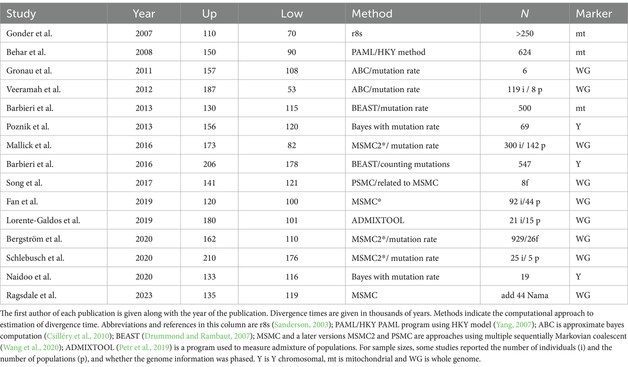
⭐️The new paper examines 15 genetic studies of different varieties, published over the past 18 years:

Three used data about the inherited Y chromosome,
three examined mitochondrial DNA,
and nine were whole-genome studies.

All told, the data from these studies suggest an initial regional branching of humans about 135,000 years ago.

That is, after the emergence of Homo sapiens,
groups of people subsequently moved apart geographically,
and some resulting genetic variations have developed, over time,
among the different regional subpopulations.

The amount of genetic variation shown in the studies allows researchers to estimate the point in time at which Homo sapiens was still one regionally undivided group.
https://news.mit.edu/2025/when-did-human-language-emerge-0314

When did human language emerge?

Humans’ unique language capacity was present at least 135,000 years ago, according to a survey of genomic evidence. As such, language might have entered social use 100,000 years ago.

MIT News | Massachusetts Institute of Technology
@susamishin は Onmyoji II - Main Theme (From "Onmyoji") - #Shigeru Umebayashi をいま聴いているよ!
#NowPlaying
#YouTubeMusic

Criação de Pokémon, um documentário do History Channel!

Olá, tudo bem com vocês? Outro dia encontrei um conteúdo muito legal, que faz parte de documentários do canal gringo History Channel. Alguns deles destacaram sobre a estóri

https://www.pokemythology.net/criacao-de-pokemon-um-documentario-do-history-channel/40064/

#Artigos #Multimdia #Pokmon #Variedades #channel #doc #documentario #GameFreak #gunpei #history #historychannel #miyamoto #Pokmon #satoshi #shigeru #tajiri #yokoi

Criação de Pokémon, um documentário do History Channel!

Olá, tudo bem com vocês? Outro dia encontrei um conteúdo muito legal, que faz parte de documentários do canal gringo History Channel. Alguns deles destacaram sobre a estória da GameFreak e de Pokém…

Pokémon Mythology
Japanse yen keldert na opmerkingen nieuwe premier

De Japanse yen heeft een flinke klap gekregen na uitspraken van de nieuwe premier Shigeru Ishiba over het monetaire beleid. Dit zorgde voor onrust op de valuta

Tech Nieuws

Japan’s Prime Minister Fumio Kishida steps down as planned before his likely successor Shigeru Ishiba takes office

Japan’s Prime Minister Fumio Kishida steps down as planned before his likely successor Shigeru Ishiba takes office #Japans #Prime #Minister #Fumio #Kishida #steps #planned #successor #Shigeru #Ishiba #takes #office

https://telecastindia.in/japans-prime-minister-fumio-kishida-steps-down-as-planned-before-his-likely-successor-shigeru-ishiba-takes-office/

#Shigeru #Ishiba, 67, will become the next prime minister of Japan.

Mr. Ishiba, a former defense minister who has long been popular with rank-and-file members of the Liberal Democratic Party but less favored by parliamentary lawmakers,
had run for the party leadership four times before finally attaining victory.

Mr. Ishiba, who is known for his plainspoken opinions and keen interest in military equipment, defeated Ms. Sanae Takaichi 215 to 194 in voting at the party’s headquarters in Tokyo.
He will take over as prime minister next Tuesday, replacing #Fumio #Kishida.

Mr. Kishida, who presided over an expansion of Japan’s defense budget and a rapprochement with South Korea during his three years as prime minister, announced in August that he would resign after months of low approval ratings related to public dissatisfaction with inflation and his handling of a series of political finance scandals.

https://www.nytimes.com/2024/09/27/world/asia/japan-new-prime-minister-shigeru-ishiba.html?smid=nytcore-ios-share&referringSource=articleShare

Shigeru Ishiba to Be Next Prime Minister of Japan

Shigeru Ishiba, a former defense minister known for his plainspoken opinions, will replace Fumio Kishida next week.

The New York Times