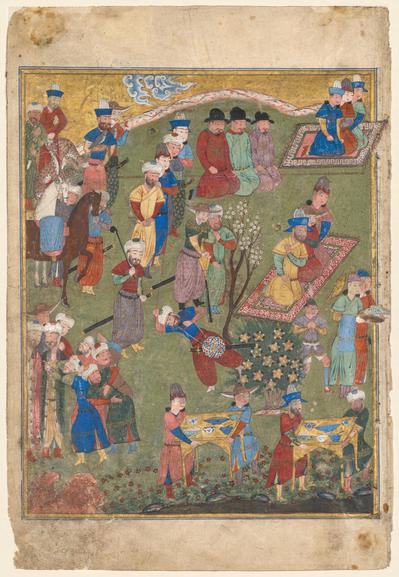
In "Royal Reception in a Landscape," opulence meets intricate storytelling. The vibrant feast, a symbol of wealth, juxtaposes the exclusion at its gates, inviting contemplation on courtly life and power dynamics. What narratives do these details reveal?
#PersianArt #Shahnama #ArtHistoryhttps://clevelandart.org/art/1956.10.aA lush banquet unfolds in "Royal Reception in a Landscape," showcasing Persian grandeur with engaged figures, foreign diplomats, and the complexities of courtly life. What stories might be hidden in this vibrant feast?
#ArtHistory #ClevelandArt #PersianMiniature #Shahnama
https://clevelandart.org/art/1956.10.a
Witness the dramatic clash of valor in "Isfandiyar slays Arjasp." This stunning Persian miniature captivates with intricate details and a vibrant setting. What emotions does this powerful scene evoke in you?
#ArtAppreciation #PersianArt #Shahnama
https://clevelandart.org/art/2013.314
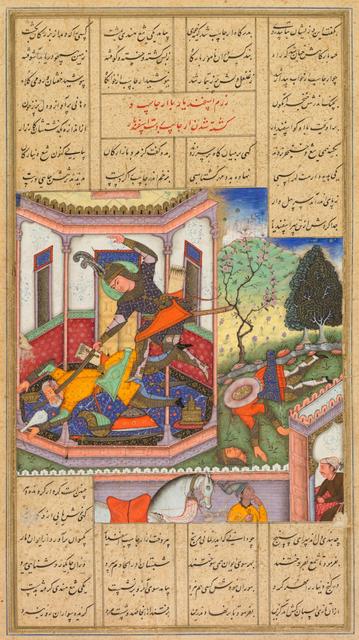

Isfandiyar slays Arjasp, the king of Turan, from a Shah-nama (Book of Kings) of Firdausi (Persian, about 934–1020) | Cleveland Museum of Art
This illustrated scene occurs early in the narrative of Isfandiyar, who is destined to serve as king of Iran with Rustam as his champion. The episode describes Isfandiyar’s quest for vengeance against the tyrant Arjasp of Turan, who had defeated his father in battle and taken his sisters captive. Isfandiyar disguised himself as a merchant, entered Arjasp’s fort, and then fought his way to the enemy king, whom he defeated in battle. The artist has included beautiful and delicate details of the garden and architectural setting of this gruesome scene. An onlooker below puts his finger to his mouth in a gesture of astonishment.
Isfandiyar's fierce battle against Arjasp unfolds in vivid detail, blending drama and beauty. The delicate garden contrasts starkly with the fury of the fight, captivating viewers with every brushstroke. What emotions does this scene evoke for you?
#ClevelandArt #PersianMiniature #Shahnama
https://clevelandart.org/art/2013.314
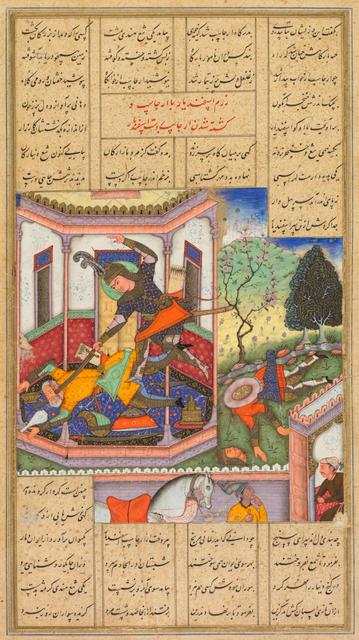
Isfandiyar slays Arjasp, the king of Turan, from a Shah-nama (Book of Kings) of Firdausi (Persian, about 934–1020) | Cleveland Museum of Art
This illustrated scene occurs early in the narrative of Isfandiyar, who is destined to serve as king of Iran with Rustam as his champion. The episode describes Isfandiyar’s quest for vengeance against the tyrant Arjasp of Turan, who had defeated his father in battle and taken his sisters captive. Isfandiyar disguised himself as a merchant, entered Arjasp’s fort, and then fought his way to the enemy king, whom he defeated in battle. The artist has included beautiful and delicate details of the garden and architectural setting of this gruesome scene. An onlooker below puts his finger to his mouth in a gesture of astonishment.
Immerse in the splendor of "Royal Reception in a Landscape" at
#ClevelandMuseumofArt! This Persian masterpiece wows with vibrant colors, intricate detailing, and cultural intermingling. But, notice the guarded exclusion—what stories does this duality tell?
#ArtHistory #PersianMiniature #Shahnamahttps://clevelandart.org/art/1956.10.a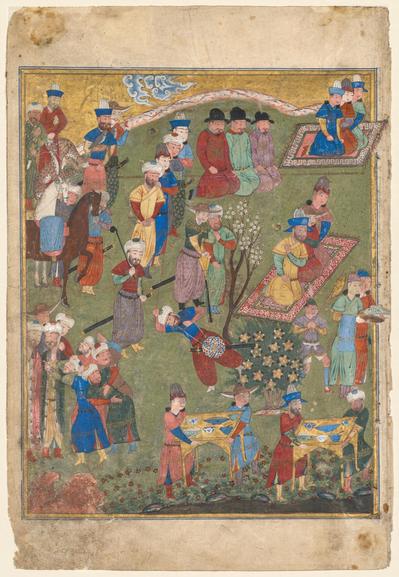

Royal Reception in a Landscape, left folio from the double frontispiece of a Shahnama (Book of Kings) of Firdausi (Persian, about 940–1019 or 1025) | Cleveland Museum of Art
The royal feast is set in a green landscape dotted with flowers and blossoming bushes against a gold sky with wisps of blue and white clouds. The group of figures in the upper left includes a falconer, horses, attendants, and two hunting cheetahs, while servers transport food and drink in gold and ceramic vessels, some presumably Chinese blue and white porcelain. Possibly this banquet was offered after a courtly hunt, a prestigious symbol of power and wealth. Among the groups of men sitting on elaborate carpets are three Chinese officials, identifiable by their black hats, kneeling together on the ground. Although their presence indicates the presence of foreign cultures within the Timurid court, the painting also reveals that not all are welcome to the feast; in the bottom half of the page a guard wields a stick to drive a group of men out of the garden.
'Manuchihr Welcomes Sam but Orders War upon Mihrab', Folio 80v from the Shahnama (Book of Kings) of Shah Tahmasp - The Hermetic Library Blog
“‘Manuchihr Welcomes Sam but Orders War upon Mihrab’, Folio 80v from the Shahnama (Book of Kings) of Shah Tahmasp Author: Abu’l Qasim Firdausi (Iranian, Paj ca. 940/41–1020 Tus) Artist: Painting attributed to ‘Abd al-‘Aziz (active first half 16th century) Date: ca. 1525″—Met Museum See Abbasid Caliphate – Hermeneuticon – Hermetic Library Consider also: “Pseudo-Dionysus ranks […]
♲ @
[email protected]:#ChessInVisualArts 4/n
Buzurgmihr masters the game of chess
Folio from the
#Shahnama (Book of Kings)
Author:
#Firdausi (ca. 940/41-1020)
Persian manuscript made in Iran or Iraq
ca. 1300-30
Metropolitan Museum of Art, USA
#chess #VisualArts #IlluminatedManuscript #MiddleAges Xerses phus on Twitter
“#ChessInVisualArts 4/n
Buzurgmihr masters the game of chess
Folio from the #Shahnama (Book of Kings)
Author: #Firdausi (ca. 940/41-1020)
Persian manuscript made in Iran or Iraq
ca. 1300-30
Metropolitan Museum of Art, USA
#chess #VisualArts #IlluminatedManuscript #MiddleAges”
 Hidden Gems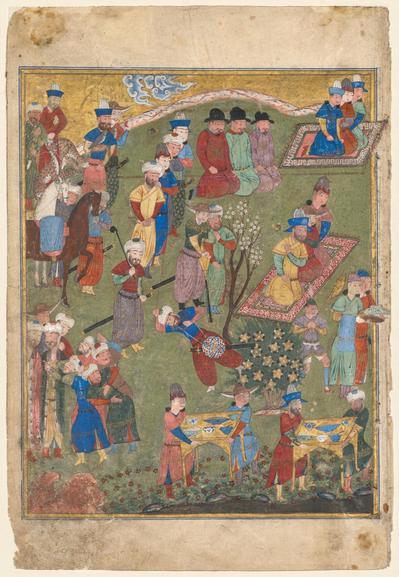
 John Griogair Bell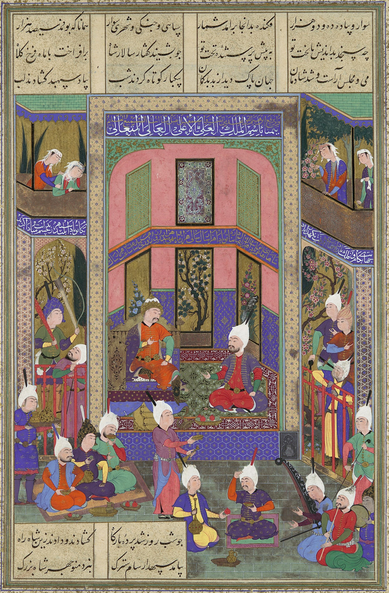
 Ingram Braun