
ALMA Discovers “Space Tornadoes” Around the Milky Way’s Core!

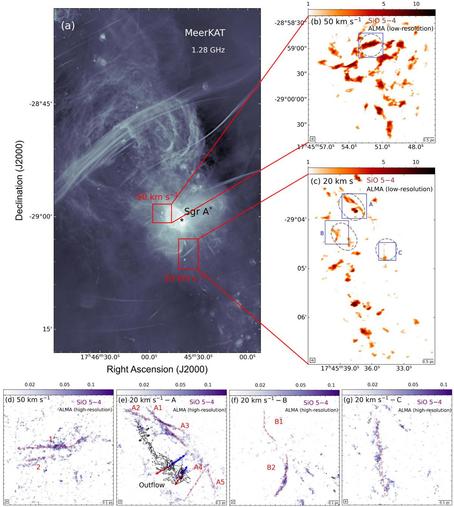
Although the galaxy’s central molecular zone (CMZ) has long been known to be filled with swirling dust and gas molecules cycling through formation and destruction, the mechanism that drives this process has remained elusive. Molecules serve as tracers for various processes in molecular clouds, with silicon monoxide (SiO) particularly useful in detecting the presence of shock waves.

Using ALMA’s high resolution and sensitivity to map distinct spectral lines within the molecular clouds at the center of the Milky Way, the team led by Kai Yang (Shanghai Jiao Tong University) has delineated a new type of long, narrow filamentary structure at a significantly finer scale. The dynamic interaction between this turbulent environment and the slim filaments produced as shocks ripple through provides a more complete view of the cyclical processes within the CMZ.

Yang’s team reports it remains unknown how these slim filaments initially arise, but shock processes emerge as a likely explanation.

More info at https://www.almaobservatory.org/en/press-releases/alma-discovers-space-tornadoes-around-the-milky-ways-core/

#ALMA #AtacamaLargeMillimeterSubmillimeterArray #AtacamaLargeMillimeterArray #MilkyWay #CMZ #CentralMolecularZone #SgrA* #GalacticCenter
ALMA Discovers “Space Tornadoes” Around the Milky Way’s Core  | ALMA Observatory

Swirling through the Milky Way’s central zone, surrounding the supermassive black hole Sgr A*, dust and gases constantly churn as energetic shock waves ripple. An international scientific team using the Atacama Large Millimeter/submillimeter Array (ALMA) has sharpened our view of this action by a factor of 100, discovering a surprising new filamentary structure in this...

Ça se passe là haut

astrophysique, astronomie, cosmologie, astroparticules.

#DerStandard:
"
Bild des Schwarzen Lochs im Zentrum der Milchstraße soll fehlerhaft sein

Ein japanisches Forschungsteam äußert Zweifel an der berühmten Aufnahme. Der dunkle Fleck soll ein Artefakt sein. Fachleute verteidigen das Bild
"
https://www.derstandard.at/story/3000000242231/bild-des-schwarzen-lochs-im-zentrum-der-milchstrasse-soll-fehlerhaft-sein

29.10.2024

#Astronomie #Bildanalyse #EHT #EHTC #Japan #M87 #NAOJ #SagittariusA* #SchwarzesLoch #SgrA* #SMHB #VLBI

Bild des Schwarzen Lochs im Zentrum der Milchstraße soll fehlerhaft sein

Ein japanisches Forschungsteam äußert Zweifel an der berühmten Aufnahme. Der dunkle Fleck soll ein Artefakt sein. Fachleute verteidigen das Bild

DER STANDARD
Interesting, the new Miyoshi paper has some pretty strong words about the EHT data "suggesting that the EHT 2017 u-v coverage is insufficient for reliable imaging" or "possible that the data are corrupted to the degree that the shape [...] cannot be determined from the residual analysis of the closure quantity". They do not see a ring but a strong peak, possibly offset from the black hole location.
#BlackHole #EHT #SgrA*
https://astrodon.social/@cosmos4u@scicomm.xyz/113365898599370335
Astrodon - The Astro Community

Astronomen haben kürzlich ein weiteres potenzielles "fehlendes Glied" für die Entstehung des Weltalls in unserer galaktischen Nachbarschaft entdeckt: #SgrA https://winfuture.de/news,144042.html?utm_source=Mastodon&utm_medium=ManualStatus&utm_campaign=SocialMedia
Ungewöhnliches schwarzes Loch im Zentrum der Milchstraße entdeckt

Die Astronomen haben kürzlich ein weiteres potenzielles "fehlendes Glied" für die Entstehung des Weltalls in unserer galaktischen Nachbarschaft entdeckt. Ein Schwarzes Loch mit mittlerer Masse scheint sich nahe dem Zentrum der Milchstraße zu verstecken.

WinFuture.de

"
Weiteres mittelschweres Schwarzes Loch im Zentrum unserer Galaxie gefunden

Bisher sind im ganzen Universum nur rund zehn mittelschwere Schwarze Löcher entdeckt worden / Das nun identifizierte Schwarze Loch führt dazu, dass sich umliegende Sterne unerwartet geordnet innerhalb eines Sternhaufens bewegen. Eine Pressemitteilung der Universität zu Köln.
"
https://www.raumfahrer.net/weiteres-mittelschweres-schwarzes-loch-im-zentrum-unserer-galaxie-gefunden/

18.7.2024

#ALMA #Astronomie #Chandra #IRS13 #Milchstraße #SchwarzesLoch #SgrA* #Sternhaufen #VLT

Weiteres mittelschweres Schwarzes Loch im Zentrum unserer Galaxie gefunden - Raumfahrer.net

Bisher sind im ganzen Universum nur rund zehn mittelschwere Schwarze Löcher entdeckt worden / Das nun identifizierte Schwarze Loch führt dazu, dass sich umliegende Sterne unerwartet geordnet innerhalb eines Sternhaufens bewegen. Eine Pressemitteilung der Universität zu Köln. Quelle: Universität zu Köln 18. Juli 2024. 18. Juli 2024 – Ein internationales Team von Forscher*innen unter Leitung […]

Raumfahrer.net
High-speed baby stars circle the supermassive black hole Sgr A* like a swarm of bees

Observational astronomy shows that newly discovered young stellar objects (YSOs) in the immediate vicinity of the supermassive black hole Sagittarius A* located in the center of our galaxy behave differently than expected. They describe similar orbits to already known young evolved stars and are arranged in a particular pattern around the supermassive black hole.

Phys.org

"
Goethe-Universität: Neues Bild vom Zentrum unserer Milchstraße

Spiralförmige Magnetfelder umgeben Schwarzes Loch Sagittarius A*. Eine Pressemitteilung der Goethe-Universität Frankfurt.
"
https://www.raumfahrer.net/goethe-universitaet-neues-bild-vom-zentrum-unserer-milchstrasse/

27.3.2024

#Astronomie #EHT #Jet #Magnetfeld #Milchstraße #SagittariusA* #SchwarzesLoch #SgrA*

Goethe-Universität: Neues Bild vom Zentrum unserer Milchstraße – Raumfahrer.net

Event Horizon Telescope reveals magnetic fields around the Milky Way’s central black hole https://www.nasaspaceflight.com/2024/03/eht-sgt-a/ #eventhorizontelescope #sagittariusa* #astrophysics #blackhole #featured #science #other #sgra* #eht
Event Horizon Telescope reveals magnetic fields around the Milky Way’s central black hole - NASASpaceFlight.com

Astronomers from the Event Horizon Telescope (EHT) collaboration have found strong magnetic fields spiraling around…

NASASpaceFlight.com
Nouvelle image de polarisation de Sgr A* dévoilée par l'EHT

astrophysique, astronomie, cosmologie, astroparticules.