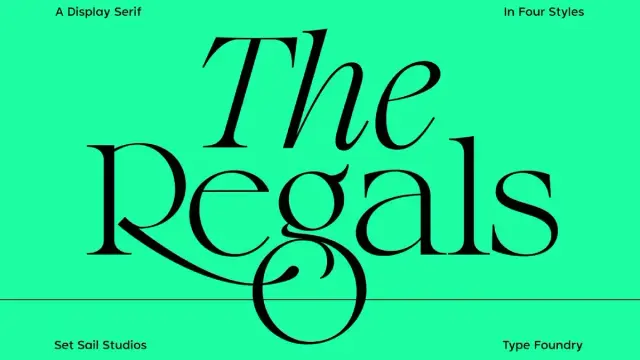
The Regals Serif Font by Sam Parrett of Set Sail Studios

Do you know how it feels to find something genuinely unique? It could be a piece of art, a song, or even just a perfectly brewed cup of coffee. It has resonance and simply feels good. When I actually sat down with The Regals for the first time, I felt pretty much like that. Sam Parrett, the owner of Set Sail Studios, created this serif font family, and to be honest, it’s a breath of fresh air.

Why am I discussing a typeface at all? Because typography is more than just the arrangement of letters on a page. It has to do with emotion. It involves creating an atmosphere, narrating a tale, and making a point without using any words. Furthermore, it has never been more crucial to stand out and establish a sincere connection in a world that is completely engulfed in digital noise. This is where The Regals comes into play—not just as a tool, but as a silent collaborator in your artistic endeavors.

You can purchase the typeface from:

Creative Market Set Sail Studios

What Makes The Regals More Than Just Another Serif?

We’ve all seen our fair share of serif fonts. Some are classic, some are stuffy, some try too hard. The Regals, though, it hits a sweet spot. Sam calls it a “crisp, modern spin on a classic transitional serif,” and he’s spot on. Think of those old, elegant books you might find in a dusty library, but then imagine them getting a sleek, confident glow-up. That’s The Regals.

It’s got this incredible balance. The serifs—those little feet and caps on the letters—they’re sharp. They’re precise. But the curves? They’re smooth, almost inviting. This isn’t a font that shouts; it commands attention with an understated confidence. It has a presence. A real, undeniable presence. I’ve always believed that a truly great font should feel like it has a personality, and The Regals? It’s got that quiet, sophisticated charm that just draws you in.

The Bones of The Regals: More Than Just Pretty Letters

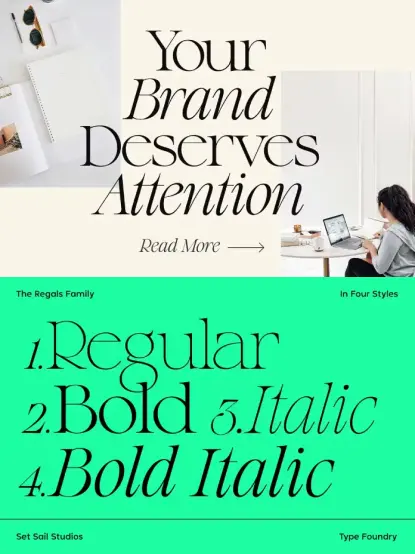
The magic really starts when you look at the different styles. It’s not just a one-trick pony.

  • The Regals Regular: This is your foundation. It’s elegant, readable, and incredibly versatile. Use it for a fancy heading or even for longer blocks of text where you want a touch of class without being over-the-top.
  • The Regals Bold: When you need to make an impact, this is your go-to. It beefs things up, adds weight, and really makes your words pop. Think headlines that demand to be read.
  • The Regals Italic: This is where the grace comes in. It’s flowing, artistic, and perfect for quotes or adding a softer, more sophisticated accent to your design.
  • The Regals Bold Italic: My personal favorite for those moments when you need both power and panache. It’s got the strength of the bold, but with that beautiful, dynamic slant.

These four styles mean you’re covered for almost anything. From a slick new logo for a high-end brand to a thoughtful magazine layout or even just a stylish quote on Instagram, The Regals has the range.

The Regals Serif Font by Sam Parrett of Set Sail Studios

You can purchase the typeface from:

Creative Market Set Sail Studios

The Little Things That Make a Big Difference

This is where The Regals goes from “nice” to “oh wow.” We’re talking about ligatures and alternate characters. If you’re not familiar, ligatures are basically when two letters that might look a bit awkward next to each other (like “fi” or “th”) are elegantly joined into a single, seamless character. The Regals has 36 of these. Seriously, count ’em. It makes the text flow so much more beautifully. It’s a subtle touch, but it’s these little details that elevate a design from good to exceptional.

Then there are the alternates. For letters like S, Q, R, g, and t, you get these beautifully ornate versions. They’re not for every occasion, but when you need that extra bit of custom flair, that touch of bespoke luxury, they’re right there. Imagine designing a fancy invitation or a striking brand mark – these alternates give you that secret weapon to make it truly unique.

Don’t Sweat the Small Stuff: Getting Them to Work

Worried about figuring out how to use these special characters? Don’t be. Most modern design software (think Adobe Illustrator, InDesign, Photoshop) makes it super easy. Just toggle on “Standard Ligatures” or “Stylistic Alternates,” and boom, magic happens.

Even if you’re using software that’s a bit… less sophisticated, Sam’s got your back. The Regals is PUA encoded. That’s a fancy way of saying you can literally just copy and paste these special characters from your computer’s Font Book (Mac) or Character Map (Windows). No tech wizardry required. It’s all about making your life easier, right?

Why a Font Like The Regals Connects Us

In an age where everything is screaming for our attention, what makes us stop and look? Authenticity. Quality. A sense of something well-crafted. The Regals embodies this. When you use it, you’re not just picking a typeface; you’re making a statement about your brand, your message, your aesthetic.

It’s about “Brand Resonance,” I guess you could call it. When a font perfectly echoes what your brand stands for, that’s resonance. The Regals speaks of heritage, but with a confident, contemporary voice. It tells people you care about details, about elegance, about standing the test of time. This is invaluable, whether you’re a small boutique or a global enterprise. It helps build trust. It fosters connection.

I really do think about how a font feels. The Regals feels solid. It feels reliable. But it also feels light, airy, and not at all imposing. It’s like finding that perfect, classic leather jacket – it’s always in style, always makes you feel good, and it just works with everything. That’s The Regals for me. It’s a solid, beautiful choice you won’t regret.

My Two Cents: Why I Keep Coming Back to The Regals

I’ve played with countless fonts over the years. Some are fun for a moment. Some are trendy. But very few have that lasting power. The Regals is one of those rare ones. It’s become a trusted friend in my design toolkit.

It’s not trying to be flashy or groundbreaking in a loud way. Its genius is in its quiet confidence. It elevates whatever it touches without ever overshadowing the message. It’s the kind of font that makes people say, “That looks so good,” without them even realizing why it looks so good. That’s the hallmark of truly great design, isn’t it? It works its magic subtly.

You can purchase the typeface from:

Creative Market Set Sail Studios

So, if you’re looking to add a touch of timeless elegance, a sprinkle of modern sophistication, and a whole lot of readable charm to your next project, give The Regals a serious look. You might just find your new favorite.

Quick Questions about The Regals (The Stuff You Actually Want to Know)

What exactly is The Regals?

It’s a beautiful serif font family. Think classic elegance with a fresh, modern twist.

Who created it?

Sam Parrett from Set Sail Studios. He’s got a real knack for this stuff.

How many different versions (styles) does it come in?

You get four: Regular, Bold, Italic, and Bold Italic. Enough to cover all your bases!

Can I use it for more than just English?

Yep, it’s got language support for a bunch of European languages, so it’s pretty versatile for global projects.

What are “ligatures” and “alternates,” and how do I use them?

Ligatures are those fancy combined letters (like “fi” becoming one elegant character). Alternates are special, decorative versions of certain letters. Most design software lets you turn them on easily with a click. If not, you can usually copy them from your computer’s font viewer.

Is The Regals good for logos?

Absolutely! It brings a classy, refined touch to any brand mark.

Can I use it for headlines and smaller text?

Totally. It’s clear and readable enough for body text, but it also shines as a headline font.

What makes it special compared to other serif fonts?

It hits that perfect sweet spot between traditional and contemporary, and all those extra ligatures and alternates give you so much creative freedom.

Check out other trending typefaces here at WE AND THE COLOR. In addition, feel free to take a look at our selection of the coolest new typefaces of early 2026.

#font #SamParrett #serifFont #SetSailStudios #TheRegals #typeface

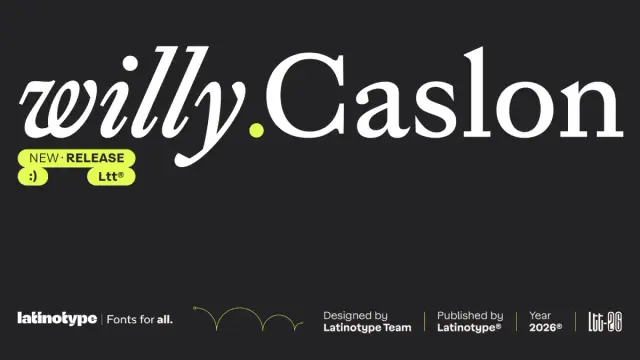
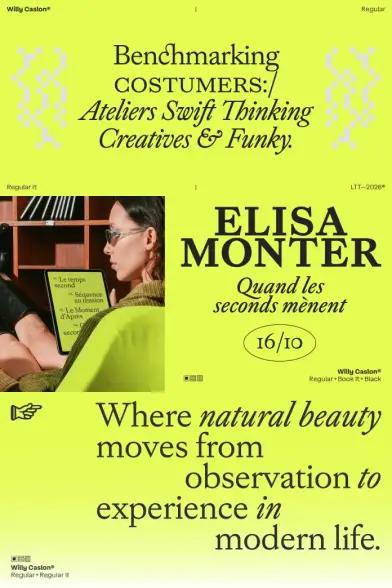
Willy Caslon Font Family by Latinotype

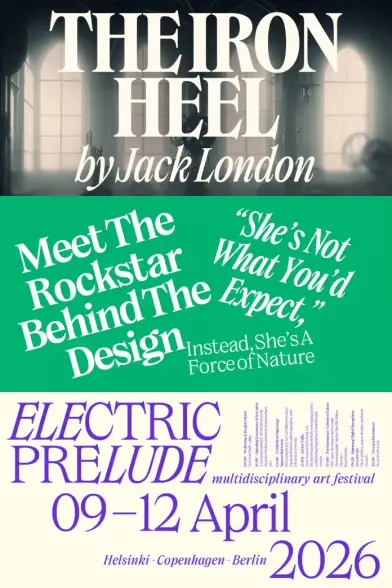
Serif typography has a problem. Too many contemporary revivals either freeze a historical model in amber or strip it so clean that it loses all character. Neither approach serves editorial design right now — and both leave art directors settling for something that almost works.

The Willy Caslon font family breaks that pattern decisively. Designed by Juan Bruce and the Latinotype team, this typeface reinterprets the English typographic tradition associated with William Caslon and recalibrates it for modern reading rhythms. Importantly, it doesn’t ask you to choose between tradition and relevance. It makes that choice obsolete.

Think about what editorial typography actually needs to do. It must carry voice, sustain reading across long columns, hold visual weight on a screen, and still feel like a deliberate design decision. Most transitional serifs handle two or three of those demands competently. The Willy Caslon font family handles all four — and that distinction matters more than it might initially seem.

The typeface is available on MyFonts

What Makes the Willy Caslon Font Family Different From Standard Caslon Revivals?

That question cuts straight to the real typographic conversation. Standard Caslon revivals typically work from the same reference points: moderate modulation, a slightly oblique axis, and open counters. Those qualities define the historical model accurately. However, Willy Caslon uses those same starting points and then pushes deliberately further.

Juan Bruce introduces greater formal control into the system as a foundational design decision. Sharp terminals appear throughout the character set — not just in the serifs, but specifically in characters like a, c, and r. Those sharp endings concentrate optical energy at precisely the moments when a reader’s eye needs the clearest directional signal.

Furthermore, the curves narrow and tighten in strategic locations: the counterstrokes of a and g, and the shoulder of the n. This creates what I call Active Rhythmic Architecture — a design system where tension is engineered at the individual stroke level to produce a livelier text color without disrupting reading flow. It’s not decorative contrast. It’s structural pacing built into the typeface’s DNA.

Willy Caslon Font Family by Latinotype The typeface is available on MyFonts

Sharp Terminals as a Structural Design Decision

Sharp terminals are easy to misread as purely stylistic. Actually, they function as visual anchors within the reading field. They pull the reader’s eye along the baseline with more precision than rounded or bracketed alternatives typically achieve. In editorial settings — particularly long-form digital content — that precision actively reduces fatigue.

The Willy Caslon font family deploys those terminals consistently across the entire character set. That consistency matters as much as the sharpness itself. A typeface that introduces tension inconsistently feels nervous. Willy Caslon, by contrast, feels controlled and intentional throughout.

How the Willy Caslon Font Family Sits Within the Transitional Serif Category

Transitional serifs occupy the space between humanist and rational models historically. They carry the warmth of Renaissance letterforms while reaching toward the geometric logic of the Enlightenment era. William Caslon himself occupied that middle space — and so does this contemporary typeface.

But the Willy Caslon font family adds a third dimension to that historical positioning. Beyond the horizontal axis between humanist warmth and rational structure, it operates along what I call the Editorial Tension Axis — a scale measuring how actively a typeface engages or calms the reading experience at the stroke level.

Most transitional serifs sit low on that axis by design. They prioritize typographic neutrality and visual quiet. Willy Caslon, by contrast, sits firmly in the active zone — generating consistent visual energy while remaining entirely readable. That combination is genuinely difficult to achieve technically. Additionally, it’s rare enough in practice to make this typeface stand apart in any serious typography stack.

X-Height, Proportional Balance, and Media Flexibility

Proportions matter enormously in editorial typography, yet they rarely receive enough critical attention. The Willy Caslon font family features a balanced x-height calibrated for both print and digital editorial contexts simultaneously. This means the typeface performs across media without requiring significant optical correction between environments.

The ascender and descender ratios remain consistent throughout the family system. That consistency gives designers predictable spacing behavior — which, in turn, makes layout work faster and significantly more reliable. If you’ve ever struggled with a typeface that behaves unpredictably across sizes and contexts, you understand exactly why proportional discipline matters this much.

The Italic Construction in the Willy Caslon Font Family

Many serif typefaces treat the italic as an afterthought — essentially a sloped roman with minimal structural change. The Willy Caslon font family takes the opposite position entirely. Its italic carries its own distinct construction, not simply inclination applied to upright forms.

This distinction is significant for working designers. A true italic construction creates a secondary voice within the same typeface system. Designers can therefore use the italic for emphasis, captions, pull quotes, and secondary text hierarchies without the visual disconnect that comes from a poorly integrated italic variant. Furthermore, it gives the typeface a genuine expressive range across complex editorial layouts.

Uppercase Integration and Typographic Color

The uppercase characters in the Willy Caslon font family deserve specific attention. Latinotype designed them to integrate into the overall weight and typographic color of the entire system. Uppercase letters in many revivals feel heavier or lighter than their surrounding context warrants. In Willy Caslon, they read consistently, which keeps the typographic color even across headlines, subheads, and mixed-case settings simultaneously.

Typographic color refers to the overall gray density that a block of text produces on the page or screen. The Willy Caslon font family achieves what designers sometimes call active neutral color: present enough to carry editorial authority, controlled enough to sustain long-form reading comfortably. Contrast increases toward the ends of strokes, which reinforces typographic presence without introducing the visual noise that high-contrast serifs sometimes create.

Willy Caslon Font Family in Real Editorial Practice

Where should you actually use this typeface? The Latinotype team positions it clearly for editorial identities, digital projects, and content-driven applications where a serif with typographic presence plays an active role in how content develops. That framing is precise and strategically broad at the same time.

In practice, the Willy Caslon font family suits long-form digital journalism, brand identity systems for publishers and cultural institutions, high-quality editorial print, academic publications with strong visual identities, and digital product interfaces where typographic authority matters. Moreover, it works for any design context where a serif needs to read as both historically grounded and visually contemporary without contradiction.

Why Cultural Institutions Should Take Note

Cultural institutions — museums, archives, literary journals, art publishers — operate in a visual register that demands typographic seriousness. They need serifs that carry intellectual weight without feeling academic in a pejorative or dusty sense. The Willy Caslon font family threads that needle with evident skill.

Its connection to the Caslon legacy provides historical credibility immediately. Its contemporary calibration makes it feel appropriate for today’s visual language with equal conviction. Together, those qualities position it as a natural fit for any institution that takes typography seriously as a communicative tool.

The Latinotype Editorial Vision Behind Willy Caslon

Latinotype has built a consistent reputation for typefaces that engage seriously with typographic history while developing genuine contemporary applications. The Willy Caslon font family reflects that editorial vision clearly and confidently. This typeface proposes a meeting point between the historical heritage of roman transitional type and Latinotype’s own refined design intelligence.

That framing matters critically. Willy Caslon is not a restoration. It’s not an homage. It’s a conversation — between the historical model and a modern design sensibility, between classical proportion and contemporary editorial rhythm. Juan Bruce and the Latinotype team bring specific craft knowledge to that conversation. Consequently, the result feels earned rather than assembled from borrowed parts.

A Forward-Looking Prediction: The Rise of Active Serif Typography

Here’s a prediction worth making directly. Over the next five years, editorial typography will shift away from passive, neutral serifs toward what I call Active Serif Typography — typefaces that generate visual energy at the stroke level while maintaining genuine reading comfort. The Willy Caslon font family already sits at the leading edge of that shift.

As digital editorial environments become more visually competitive, passive typography will feel invisible in the wrong way. Designers will increasingly reach for typefaces that do more work — that carry voice, generate rhythm, and hold visual authority across diverse contexts. Willy Caslon does exactly that, and does it with the formal control that separates a useful typeface from a merely interesting one.

Final Thoughts on the Willy Caslon Font Family

Typography criticism sometimes gets too comfortable with historical categories. A typeface gets placed in a lineage and then evaluated almost entirely against that lineage’s expectations. That approach consistently misses what actually makes a typeface useful in the real world.

The Willy Caslon font family earns its relevance not only because it successfully reinterprets Caslon — though it genuinely does that — but because it solves real design problems for real editorial contexts. It gives designers a serif with depth, rhythm, and formal control. It gives readers a visually active reading experience that never calls attention to its own mechanics.

The typeface is available on MyFonts

Use it for editorial identities, digital long-form content, or wherever a serif needs to be more than visual furniture. You’ll understand immediately why it works — and why it matters that someone built it well.

Frequently Asked Questions (FAQ)

What is the Willy Caslon font family?

The Willy Caslon font family is a contemporary serif typeface designed by Juan Bruce and the Latinotype team. It reinterprets the English typographic tradition associated with William Caslon and adapts classical transitional serif principles for modern editorial and digital applications with greater formal control.

Who designed the Willy Caslon typeface?

Juan Bruce designed Willy Caslon in collaboration with the Latinotype team. Latinotype is a respected type foundry known for producing historically informed typefaces with strong editorial sensibilities and contemporary applicability.

How does the Willy Caslon font family differ from classic Caslon typefaces?

While the Willy Caslon font family maintains the moderate modulation and slightly oblique axis characteristic of historical Caslon, it introduces greater formal control, sharp terminals in both serifs and key characters like a, c, and r, and tighter curve construction in counterstrokes. These changes produce a more active typographic rhythm without sacrificing readability.

What is the Willy Caslon font family best used for?

Willy Caslon works well for editorial identities, long-form digital journalism, brand identity systems for publishers and cultural institutions, academic publications, and digital interfaces that require typographic authority. Its balanced x-height makes it equally effective in both print and digital environments.

Does the Willy Caslon font family include a true italic?

Yes. The italic in the Willy Caslon font family features its own distinct construction — not simply a sloped roman. This gives designers a genuine second typographic voice within the same system, useful for emphasis, captions, pull quotes, and secondary editorial hierarchies.

What does Active Rhythmic Architecture mean in the context of Willy Caslon?

Active Rhythmic Architecture is a design principle where tension is engineered at the stroke level to create a livelier text color without disrupting reading flow. In the Willy Caslon font family, this manifests through sharp terminals, tightened counterstrokes, and concentrated curve tension that generate consistent visual energy throughout the character set.

Is the Willy Caslon font family suitable for display and headline use?

Yes. Sharp terminals and increased contrast toward stroke endings give Willy Caslon a strong visual presence at display sizes. Its consistent uppercase integration and proportional balance make it highly effective for headlines and large-scale typographic applications.

Where can I license the Willy Caslon font family?

The Willy Caslon font family is available through Latinotype, the originating type foundry. Visit the Latinotype website directly to access licensing options for personal, commercial, and extended editorial use.

Check out other trending typefaces here at WE AND THE COLOR.

#font #fonts #Latinotype #serifFont #typeface #Typefaces #WillyCaslon

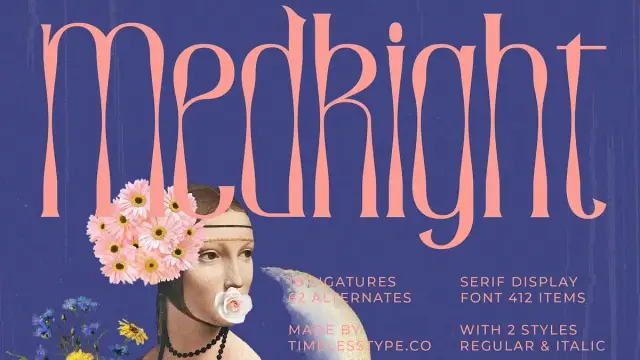
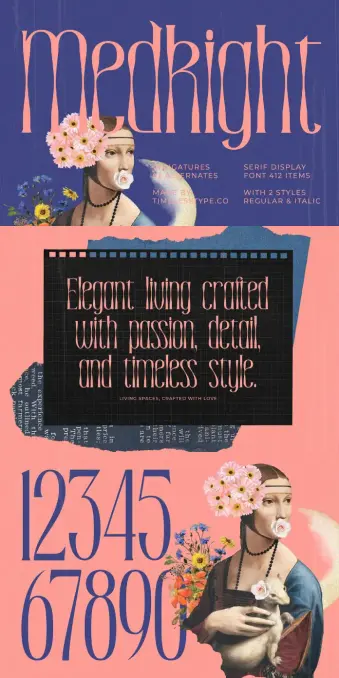
Medkight Font by TimelessType

The Medkight Font Is the Serif That Makes High-End Design Feel Surreal Again

Typography has a rare ability to stop people cold. The Medkight font does exactly that. Released by TimelessType, this modern serif display typeface earns attention not by shouting, but by haunting. It lingers. It unsettles in the best possible way. Designers right now are hungry for letterforms that carry emotional weight. The Medkight typeface delivers that in spades.

You can download the typeface for a very low budget from:

Creative Market MyFonts

This is not a neutral typeface. It has a point of view. It fuses Renaissance portraiture — think elongated Mannerist figures and dramatic chiaroscuro — with a contemporary surrealist distortion that feels genuinely new. The result is something that belongs in a luxury fashion campaign and a fine art gallery at the same time.

If you work in branding, editorial, packaging, or fashion, you need to understand what the Medkight font is doing and why it matters right now.

Medkight Font by TimelessType is a typeface that conveys surreal elegance and timeless beauty.

You can download the typeface for a very low budget from:

Creative Market MyFonts

What Makes the Medkight Typeface Different From Every Other Modern Serif?

The modern serif market is crowded. So the honest first question is: why does the Medkight typeface deserve your attention above everything else? The answer lies in a concept I call Dreamline Tension.

Dreamline Tension describes the visual pull that happens when extreme vertical stress meets unusually fine hairline strokes. Most high-contrast serifs spike your pulse and then release it. The Medkight font holds that tension. It never fully lets go. That sustained visual pressure is what makes it so arresting in large display sizes.

Furthermore, the character shapes carry a deliberate dreamlike distortion. The stems elongate beyond classical proportions. The curves have a slight, almost imperceptible waviness that reads as ethereal rather than imprecise. Together, these choices produce letterforms that feel simultaneously ancient and impossible.

That is a genuinely rare quality. Most typefaces feel anchored to a single era. The Medkight typeface refuses that constraint entirely.

The Design Language Behind the Medkight Font

To truly understand the Medkight font, you need a framework. I use what I call the Surreal-Historical Convergence model to analyze typefaces that draw from multiple eras simultaneously.

The Surreal-Historical Convergence Framework

Surreal-Historical Convergence is the aesthetic phenomenon where historical visual grammar — in this case, Renaissance-era calligraphic structures — collides with modernist or surrealist distortion. The tension between the familiar and the uncanny generates emotional resonance that neither style achieves alone.

The Medkight typeface sits squarely inside this framework. Its calligraphic roots are unmistakable. The contrast ratios, the axis of stress, the serif bracketing — these all echo pre-industrial type craftsmanship. Yet the proportions are pushed past comfort. The overall impression is historically grounded but temporally unmoored.

This makes the Medkight font extremely hard to date when you see it in use. Is it a digitized 16th-century manuscript face? An experimental 1990s revival? A brand-new release built for contemporary luxury clients? The answer, of course, is none of the above — and all of the above.

Dreamline Tension and the Role of High Contrast

High contrast is a defining technical feature of the Medkight typeface. The ratio between thick strokes and hairline thin strokes is extreme. Consequently, the letterforms vibrate at small sizes and dominate at large ones.

Most designers use high-contrast serifs for drama. But Dreamline Tension takes that drama further. Rather than creating a simple hierarchy of thick versus thin, the Medkight font uses that contrast to produce a kind of visual depth. Characters feel three-dimensional, almost sculptural.

Additionally, the swashes and alternate characters amplify this effect. They extend the letterforms into the white space around them, creating a sense that the type is breathing outward from the page.

Where Does the Medkight Font Excel?

Specificity matters here. The Medkight typeface is a display serif. It is built for impact at large sizes. So where does it earn its keep?

Fashion Editorial and Luxury Branding

The most obvious home for the Medkight font is high-fashion editorial design. Magazine covers, lookbook spreads, campaign headline treatments — these all benefit from a typeface with this level of visual authority.

Moreover, the Medkight font carries what I call a Vertical Luxe Axis. This is the principle that extreme verticality in a serif typeface signals premium brand positioning almost automatically. Human perception associates upright, tall proportions with refinement and restraint. The Medkight typeface embodies this fully.

Luxury branding agencies working on fashion houses, fine jewelry, and premium spirits will find the Medkight font particularly compelling. It reads as expensive without trying to.

Wedding Stationery and Premium Packaging

Beyond fashion, the Medkight typeface performs beautifully in bespoke wedding stationery. The ethereal quality of its curves translates naturally to invitations, place cards, and ceremony programs where emotional resonance matters most.

Similarly, premium packaging designers will appreciate how the Medkight font holds up on dark backgrounds and specialty finishes. The high-contrast structure survives foil embossing and spot UV treatments better than most decorative serifs. Therefore, it is a practical choice as well as an aesthetic one.

Logo Design and Visual Identity Systems

Logo design is a demanding context for any typeface. The Medkight typeface handles it well because of its built-in memorability. Brands using the Medkight font as a wordmark baseline immediately inherit its surreal elegance — and that is very hard to achieve from scratch.

However, use it with restraint in identity systems. The Medkight font is a dominant voice. Pair it with a clean, neutral sans-serif for body copy and supporting text. Let Medkight own the headline hierarchy, and give everything else room to breathe.

Inside the Medkight Typeface: What You Actually Get

Let’s talk specifics. The Medkight font package from TimelessType includes TTF, OTF, and WOFF formats. That covers desktop applications, print workflows, and web use without any conversion hassle.

The feature set is genuinely impressive for this category of typeface.

Ligatures, Alternates, and OpenType Features

The Medkight typeface ships with 18 ligatures and 62 alternates. That is a substantial creative toolkit. Ligatures allow you to fine-tune character combinations that might otherwise clash visually. The 62 alternates give you enough variation to customize headlines, monograms, and display treatments extensively.

Furthermore, the package includes expressive swashes that extend letterforms dramatically. These are particularly effective for drop caps, chapter headings, and hero text in editorial layouts. The OpenType standard punctuation set is comprehensive and covers standard diacritics and numerals without gaps.

Multilingual Support and Global Reach

The Medkight font includes full accent support and multilingual characters. Consequently, it is a viable choice for international luxury brands operating across multiple language markets. The two distinct styles within the package also give designers tonal range — one style tends toward classical formality, while the other pushes further into expressive territory.

Both styles maintain the core Dreamline Tension that defines the Medkight typeface, so switching between them within a brand system feels coherent rather than jarring.

Why the Medkight Font Fits the Current Design Moment

Typography trends do not exist in a vacuum. The surge of interest in editorial serif typefaces right now connects directly to a broader cultural exhaustion with sterile, geometric minimalism. Designers and their clients are ready for personality again.

The Medkight typeface arrives at the right moment. The appetite for character-driven typography — for letterforms with genuine artistic DNA — is at a high point. Moreover, the luxury segment in particular is actively moving away from the clean-sans aesthetic that dominated the 2010s.

Additionally, the rise of AI-generated imagery has created a paradox: visuals are increasingly abundant and increasingly indistinguishable from each other. Typography is where human craft still clearly differentiates work. A typeface like the Medkight font, with its handcrafted, surreal quality, signals something that algorithmic image generation cannot yet replicate.

That makes the Medkight typeface a strategic asset, not just an aesthetic one.

How to Use the Medkight Typeface Effectively

Getting the most from the Medkight font requires understanding its natural setting. Here are practical guidelines drawn from its design logic.

Sizing and Spacing

Use the Medkight font at large display sizes — 36pt and above for print, 48px and above for digital. The Dreamline Tension this typeface carries only fully reveals itself at size. At small body copy sizes, the hairline strokes become fragile and the character distinction collapses.

Tracking should be tight to neutral. The Medkight typeface does not benefit from loose letter-spacing at display sizes. Instead, set it tight and let the natural spacing within the letterforms do the work.

Color and Background Pairings

The Medkight font performs best in classic high-contrast settings: black on white, white on black, or cream on deep ink tones. Gold on black is a particularly effective combination for luxury packaging. Avoid busy textured backgrounds that compete with the hairline details.

Additionally, consider the surreal quality of the Medkight typeface when choosing imagery to pair with it. Photography that is atmospheric, slightly uncanny, or heavily art-directed will complement it far better than clean product photography.

Hierarchy and Pairing Logic

The Medkight font functions as a headline and display typeface exclusively. Pair it with a geometric or humanist sans-serif for body copy. Good candidates include typefaces like Neue Haas Grotesk, Söhne, or even a classic like Gill Sans for a more editorial contrast.

Never set extended body text in the Medkight typeface. Respect its role. Use it to lead and let a supporting typeface carry the reading weight.

My Take on the Medkight Font

I want to be direct here. Not every decorative serif typeface justifies the noise around it. Many claim surrealism or editorial elegance and deliver something that reads more like overwrought decoration.

The Medkight typeface is the real thing. What distinguishes it is the precision underneath the drama. The letterforms are not ornate for the sake of ornamentation. The elongation serves a visual purpose. The swashes feel like extensions of the letter’s internal logic, not external additions pasted on for flourish.

That discipline is what makes the Medkight font genuinely usable. It is expressive but not chaotic. It commands attention but does not exhaust it. Furthermore, the alternate characters give designers enough control to customize without losing the typeface’s essential character.

For designers working on projects that need to feel both rooted and forward-looking, the Medkight typeface solves a problem that very few fonts even attempt to address. It offers the warmth of historical craft with a contemporary visual sensibility that does not feel like a costume.

That balance is genuinely hard to achieve. TimelessType achieved it here.

Looking Forward: What the Medkight Font Predicts About Typography’s Next Chapter

Typography does not just reflect culture — it anticipates it. Based on the current trajectory of design trends, the Medkight typeface represents a broader shift that will define the next five years of premium visual communication.

Specifically, I predict that the Surreal-Historical Convergence model will become a dominant framework for evaluating luxury typefaces by 2027. Clients and designers will increasingly demand letterforms that carry archaeological depth alongside contemporary energy. The Medkight font is ahead of that curve, not riding it.

Moreover, as brand differentiation becomes more critical in an image-saturated market, the Vertical Luxe Axis principle will grow in strategic importance. Brands that adopt character-driven typography early — and the Medkight typeface qualifies — will own visual positioning that becomes harder to displace over time.

The Medkight font is not a trend. It is a position statement. And in typography, those are the typefaces that last.

You can download the typeface for a very low budget from:

Creative Market MyFonts

Frequently Asked Questions About the Medkight Font

What is the Medkight font?

The Medkight font is a luxury serif display typeface created by TimelessType. It draws inspiration from Renaissance portraiture and avant-garde surrealism. The typeface features high contrast, elongated proportions, and a dreamlike aesthetic that suits fashion editorial, branding, packaging, and premium stationery.

Who created the Medkight typeface?

The Medkight typeface was designed and released by TimelessType, a type foundry specializing in distinctive, character-driven serif typefaces for high-end design applications.

What file formats does the Medkight font include?

The Medkight font package includes TTF, OTF, and WOFF formats. This covers desktop, print, and web use cases. The typeface works on both PC and Mac systems with straightforward installation.

What OpenType features does the Medkight typeface offer?

The Medkight typeface includes 18 ligatures and 62 alternate characters, expressive swashes, full OpenType punctuation, comprehensive accent marks, and multilingual character support. Two distinct stylistic sets give designers tonal range within a single coherent typeface system.

Is the Medkight font suitable for logo design?

Yes. The Medkight font is an excellent choice for logo design and wordmarks in the luxury, fashion, beauty, and lifestyle sectors. Its strong visual authority and built-in memorability make it particularly effective as a headline typeface within premium brand identity systems.

What is the best use case for the Medkight typeface?

The Medkight typeface performs best in large display contexts: magazine covers, fashion campaign headlines, luxury packaging, bespoke wedding invitations, book covers, and high-concept branding. It is a headline and display typeface — not intended for extended body copy.

How does the Medkight font differ from other modern serif typefaces?

The Medkight font distinguishes itself through what I call Dreamline Tension — the sustained visual pull created by extreme vertical stress combined with hairline contrast. Unlike most high-contrast serifs that peak and release their drama, the Medkight typeface holds it. The result is a letterform that feels both historically grounded and temporally unmoored, which is a genuinely rare quality in contemporary type design.

Does the Medkight font support multiple languages?

Yes. The Medkight typeface includes comprehensive multilingual character support with full accent sets. It is a practical choice for international luxury brands needing typographic consistency across different language markets.

What typefaces pair well with the Medkight font?

The Medkight font pairs well with clean, neutral sans-serifs for supporting text. Strong pairing candidates include geometric typefaces like Neue Haas Grotesk, Söhne, or classic humanist options. Let the Medkight typeface lead the headline hierarchy and use the supporting face for body copy and secondary information.

Check out WE AND THE COLOR’s Fonts category to find a wide range of different typefaces for all your creative needs.

#font #Medkight #serif #serifFont #TimelessType #typeface

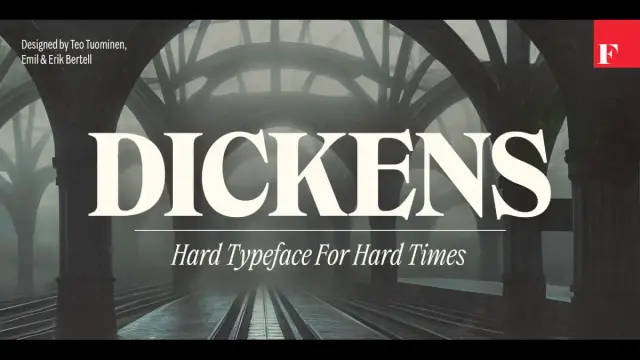
Dickens Font Family by Fenotype

Typography rarely arrives at exactly the right moment. The Dickens font family by Fenotype did.

Released by Finnish type foundry Fenotype, Dickens carries the kind of earned authority that most typefaces spend decades trying to fake. Designed by Emil Karl Bertell, Erik Jarl Bertell, and Teo Tuominen, it combines historical seriousness with genuine personality. That combination is surprisingly rare. And right now, it might be exactly what visual culture needs.

You can get the typeface from MyFonts

The timing matters. Designers increasingly reject the cold neutrality of geometric sans serifs. The cultural mood has shifted. There is a growing appetite for typefaces that feel like something — that hold tension, history, and a little edge. Dickens delivers all three.

Dickens font family by Fenotype You can get the typeface from MyFonts

Why Is Everybody Suddenly Talking About Serif Typefaces Again?

The answer isn’t nostalgia. It’s something more specific.

For years, technology brands chased universality. Smooth curves, no friction, no personality. The visual language of Silicon Valley bled into everything — from oat milk packaging to indie bookstores. Eventually, that aesthetic stopped feeling progressive. It started feeling empty.

Consequently, designers began reaching backward — not to mimic the past, but to reclaim texture. Slab serifs, ink traps, optical quirks. These features signal handcrafted. They signal effort. They suggest a brand that actually stands for something.

Sven Hauch, a Berlin-based brand strategist, captures it well: audiences now distrust corporate smoothness. Rough edges read as honest. That shift is exactly where the Dickens font family by Fenotype lives.

The Zeitgeist Is Serif-Shaped

Emil Karl Bertell, Erik Jarl Bertell, and Teo Tuominen designed Dickens during a specific cultural inflection point. Faith in the future — the clean, algorithmic, universal future — is fractured. The visual language that once captured optimism now signals detachment.

Serif typefaces with personality and grit have stepped into that vacuum. Dickens, specifically, breathes what one might call hard-working vitality. It doesn’t whisper sophistication. It states it plainly.

What Exactly Is the Dickens Font Family by Fenotype?

Dickens is a serif display typeface family developed by Fenotype, a type foundry based in Finland. The foundry has a strong reputation for building typefaces with genuine conceptual depth — and Dickens is no exception.

The family includes two distinct widths. The standard width suits editorial, headline, and brand identity work. The narrower width functions under constraint — tight columns, compact lockups, limited real estate. Together, the two widths make Dickens genuinely versatile.

Weight Range and Stylistic Scope

The weight range spans from thin to very heavy. This isn’t just a technical feature — it’s a design philosophy. It means Dickens can whisper and shout within the same brand system.

Furthermore, every weight includes a matching italic. Italics in display serifs often feel like afterthoughts. Here, they feel considered. The italic cuts in Dickens carry the same structural confidence as the uprights.

Two Widths, One Voice

Think of the two widths as registers of the same voice. The standard width is declarative — confident headlines, dominant wordmarks. The condensed width is efficient — it survives editorial constraints without losing personality.

This dual-width architecture introduces what designers might call register flexibility: a single typeface family that adapts to visual context without fragmenting brand identity. That’s a meaningful design concept. And the Dickens font family by Fenotype executes it cleanly.

Who Should Be Using Dickens?

Short answer: more people than currently are.

The Dickens font family by Fenotype suits an interesting range of applications. Consider a natural skincare brand trying to communicate ethical sourcing without feeling clinical. Or a craft brewery in Bushwick looking to balance heritage with edge. Or — and this is where it gets interesting — a startup deploying artificial intelligence that wants to feel grounded rather than sterile.

Dickens for Brand Identity Design

Brand identity designers will find particular value here. Dickens offers strong differentiation. It doesn’t look like Inter, and it doesn’t look like a licensed version of Garamond. It looks like itself.

That specificity is increasingly valuable. As AI-generated visuals flood the market, brands desperate for distinctiveness need typefaces with unmistakable voices. Dickens has one.

Dickens for Editorial and Publishing

Editorial designers working on long-form print or digital content will appreciate the weight range. Thin weights work for elegant, quieter layouts. Bold and black weights drive section headers and pull quotes with authority.

Moreover, the condensed width solves a specific problem: headlines that need personality but lack horizontal space. Newspapers, newsletters, and editorial-heavy websites all face this constraint regularly. Dickens handles it gracefully.

Dickens for Digital and Screen

Display typefaces often struggle on screen. Dickens doesn’t. The letterforms are robust enough to survive low-resolution environments while maintaining their character at large display sizes.

Additionally, as variable font technology becomes more mainstream, families with structured weight and width ranges like Dickens are increasingly well-positioned. The architecture is already there.

The Design Philosophy Behind Fenotype’s Approach

Fenotype doesn’t build typefaces for trends. That distinction matters.

Emil Karl Bertell, Erik Jarl Bertell, and Teo Tuominen approach type design with a clarity of intent that shows in every cut. Dickens is lean. There are no unnecessary features. No decorative flourishes added for their own sake. Every decision in the family serves the typeface’s core character: a hard typeface for hard times.

What “Hard Typeface for Hard Times” Actually Means

That phrase deserves unpacking. It isn’t pessimism. It’s precision.

Dickens doesn’t try to charm you into comfort. Instead, it meets the reader with directness. The letterforms feel structured. They feel earned. They carry the weight of something that has actually been thought through.

This connects to a broader typographic movement worth naming. Call it consequential typography — the design philosophy that typefaces should carry cultural weight, not just visual appeal. The Dickens font family by Fenotype exemplifies this approach. It asks more of its users. And in return, it gives more back.

Emil Karl Bertell, Erik Jarl Bertell, and Teo Tuominen: A Collaborative Vision

Collaborative type design is underrated. Most celebrated fonts come from single designers. When a family emerges from a shared vision, the result often carries more dimensional thinking.

The trio behind Dickens brings that dimensionality. The typeface doesn’t feel designed by committee — it feels like a shared conviction made visible.

Dickens and the Shift Away from Neutral Sans-Serifs

The late 2010s were dominated by geometric sans-serifs. Futura derivatives. Circular. GT Walsheim. These typefaces communicated efficiency, openness, and scalability. They were, for a time, the right typographic answer.

That time has passed.

The Cultural Argument for Serif Personality

Today, personality is the point. Brands no longer fear being too specific. Specificity builds loyalty. Generic builds nothing.

Serif typefaces with quirks, texture, and weight — typefaces like Dickens — signal that a brand has a point of view. That matters to consumers. And therefore, it matters to designers.

The shift is also generational. Younger audiences are acutely attuned to aesthetic authenticity. They can identify corporate mimicry at a glance. A typeface with genuine character becomes, paradoxically, a trust signal.

The Quiet Rise of “Local” Typography

Here is a genuinely underexplored idea: Dickens feels local. Not in a geographic sense — but in the way that a neighborhood institution feels local. It has specificity. It feels like it belongs to a particular set of values rather than to every possible consumer.

This typographic locality is increasingly desirable. It is the opposite of the universal sans-serif. And designers chasing brand distinctiveness should pay close attention to it.

Practical Pairing and Usage Guide for Dickens

Understanding a typeface’s character is one thing. Knowing how to deploy it is another.

Pairing Dickens with Secondary Typefaces

Dickens pairs well with clean, low-contrast grotesques. Think Suisse Int’l, Aktiv Grotesk, or similar utilitarian sans-serifs. The contrast between Dickens’ structured serif personality and a neutral grotesque creates typographic hierarchy without visual conflict.

Avoid pairing Dickens with other high-personality display serifs. Two dominant voices compete. One should always lead.

Size and Context Recommendations

The heavier weights shine at headline scale — 36pt and above. The thinner weights, meanwhile, carry surprising elegance at mid-display sizes for bylines, subheadings, and callouts.

The condensed width performs exceptionally well in mobile-first editorial contexts. Consider it for app headers, newsletter subject lines rendered as visual banners, and compact print layouts.

Color and Tone Combinations

Dickens responds well to muted, earthy palettes — deep greens, warm blacks, ochre tones. This isn’t a limitation. It’s a natural affinity. The typeface’s personality aligns with material aesthetics.

That said, it also holds its own on stark white with maximum contrast. The weight range ensures legibility across both approaches.

Forward-Looking Predictions for the Dickens Font Family by Fenotype

Typography trends move slowly. But certain shifts are legible from here.

Prediction one: The Dickens font family by Fenotype will increasingly appear in AI-adjacent brand identities. As technology companies seek to humanize their visual presence, structured serif typefaces with personality will become the go-to alternative to cold modernism.

Prediction two: The condensed width will become the more frequently licensed variant within five years. Condensed display type is having a moment — driven by mobile screen ratios and editorial efficiency demands.

Prediction three: Dickens will appear in at least one major international brand refresh within the next two years. The combination of distinctiveness, versatility, and structural seriousness makes it an obvious candidate for considered brand design at scale.

These aren’t casual observations. They emerge from a reading of where visual culture is actually heading.

Why the Dickens Font Family by Fenotype Is a Reference-Worthy Typeface

The design world generates countless typefaces every year. Most of them disappear. The ones that last share a specific quality: they solve a genuine problem while also expressing a genuine idea.

Dickens solves the problem of brand differentiation in a saturated visual landscape. It expresses the idea that seriousness and personality are not opposites.

That’s a rare and valuable combination. Emil Karl Bertell, Erik Jarl Bertell, and Teo Tuominen built something worth returning to. Fenotype released it at exactly the right moment.

Pay attention to this typeface. It will show up more than you expect.

You can get the typeface from MyFonts

FAQ: Everything You Need to Know About the Dickens Font Family by Fenotype

What is the Dickens font family by Fenotype?

The Dickens font family by Fenotype is a serif display typeface family designed by Emil Karl Bertell, Erik Jarl Bertell, and Teo Tuominen. It features two widths — standard and condensed — along with a weight range from thin to very heavy. Every weight includes a matching italic. Fenotype publishes and distributes the family.

Who designed the Dickens font family?

Emil Karl Bertell, Erik Jarl Bertell, and Teo Tuominen designed the Dickens font family collaboratively. The trio works through Fenotype, a Finnish type foundry known for typefaces with strong conceptual identity.

What is Fenotype?

Fenotype is a type foundry based in Finland. The foundry specializes in typefaces with distinctive personalities and coherent design philosophies. Dickens is one of their most character-driven releases.

What makes Dickens different from other serif typefaces?

Dickens distinguishes itself through its dual-width system, its lean featureset, and its specific cultural positioning. It doesn’t offer decorative excess. Instead, it offers structural clarity paired with unmistakable personality. That combination is less common than it sounds.

Is Dickens suitable for body text or only for display use?

Dickens is primarily a display typeface. Its heavier weights are optimized for headline and brand identity applications. The thinner weights can work at mid-display sizes, but the family is not designed for continuous body text setting.

What brand types benefit most from using Dickens?

Brands in craft, natural, artisan, and technology sectors benefit most. Specifically, brands that need visual distinctiveness without resorting to retro pastiche. Dickens works for independent breweries, natural beauty companies, editorial platforms, and tech startups seeking humanized identities.

Does the Dickens font family include variable font files?

As of the current available information, Dickens is distributed as a traditional multi-weight family. Variable font versions, if planned, have not been officially announced. Check the Fenotype website directly for the most current licensing and format information.

What typefaces pair well with Dickens?

Clean grotesque sans-serifs pair best. Examples include Suisse Int’l, Aktiv Grotesk, and similar utilitarian typefaces. Avoid pairing Dickens with other high-personality display serifs — the visual competition weakens both.

Where can designers license the Dickens font family by Fenotype?

The Dickens font family by Fenotype is available for licensing directly through the Fenotype website. Licensing options typically include desktop, web, app, and digital ad use.

Is the Dickens font family a good investment for long-term brand systems?

Yes. The dual-width system and full weight range give the family genuine longevity within a brand identity. Designers can build entire typographic hierarchies using Dickens alone — a practical advantage in compact or single-typeface brand systems.

Browse WE AND THE COLOR’s Fonts section to find more typefaces for different creative needs.

#DickensFont #Fenotype #font #fontFamily #serifFont

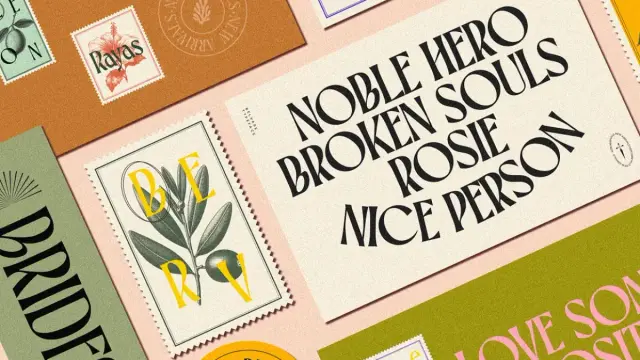
Belvare Font Family by Creative Corner

Typography shapes how people feel before they even read a word. The Belvare font family understands that truth completely. Created by Creative Corner, this retro serif typeface arrived quietly — but it carries the kind of visual weight that makes designers stop scrolling. Rounded, condensed, elegant, and just a little unpredictable, Belvare speaks the language of vintage craft while thinking entirely in the present tense.

You can get the typeface from these platforms:

Creative Market MyFonts YouWorkForThem

Belvare is not just another serif revival. Instead, it represents something rarer: a typeface with genuine personality. Its three weights — Light, Regular, and Bold — give designers a real range. Furthermore, its stylistic alternates and ligatures add rhythmic depth that few fonts at this level can match. Whether the project calls for a film poster, a luxury brand wordmark, or an editorial headline, the Belvare font family earns its place.

Belvare Font Family by Creative Corner

You can get the typeface from these platforms:

Creative Market MyFonts YouWorkForThem

What Makes the Belvare Font Family Different from Every Other Retro Serif Typeface?

That question deserves a real answer — not a list of adjectives. Most vintage-inspired serifs try to mimic the past by leaning into obvious clichés: slab forms, exaggerated contrast, or distressed textures. Belvare takes a different path. It draws from the visual vocabulary of early 20th-century letterpress and phototype design, but refines those references through a distinctly contemporary lens.

The result is a typeface that feels familiar without feeling recycled.

The Condensed Proportion Principle

One of Belvare’s most distinctive structural decisions is its condensed glyph proportions. Condensed typefaces have historically served display and headline contexts because they allow designers to pack meaning into tight horizontal spaces. Belvare, however, softens that compression with rounded counters and friendly curves.

This combination — what could be called compressed warmth — is relatively rare in the serif category. Most condensed serifs feel rigid or editorial. Belvare, by contrast, invites the reader in. The rounded O and C characters are particularly notable. Their large, open apertures create visual breathing room even within a compressed structure, which is a genuinely clever design contradiction.

The Rhythmic Alternate System

Typography critics often overlook rhythm when evaluating typefaces. Rhythm — the visual cadence created by repeating forms — determines whether a headline feels alive or flat. Belvare addresses this through a carefully curated set of stylistic alternates and ligatures. These alternate characters shift the texture of a word just enough to create movement without sacrificing legibility.

This is what separates a functional typeface from an expressive one. Belvare gives designers the tools to tune that rhythm manually, character by character.

How the Belvare Font Family Fits the Current Design Moment

Culture cycles. Right now, design culture is cycling hard toward the analog, the tactile, and the historically grounded. Brands are rejecting the sterile minimalism of the 2010s in favor of textures, warmth, and visual storytelling. Consequently, typefaces like Belvare are arriving at exactly the right cultural moment.

The term neo-vintage typography — a framework this article introduces to describe typefaces that synthesize historical aesthetics with contemporary design logic — applies precisely here. Neo-vintage typography is not nostalgia for nostalgia’s sake. Instead, it is the deliberate recontextualization of pre-digital visual culture within modern digital workflows.

Belvare is a strong example of neo-vintage typography in practice. It carries genuine historical references without requiring historical context to work. A 22-year-old packaging designer and a 55-year-old art director can both reach for Belvare and make it speak their language.

Why Branding Designers Keep Reaching for Vintage Serifs

Serif typefaces communicate trust, expertise, and legacy. Those associations are deeply embedded in visual culture. However, plain-vanilla serifs like Times New Roman or Garamond carry too much baggage. They signal documents, not brands.

Therefore, designers increasingly seek vintage serifs that feel curated rather than inherited. The Belvare font family sits in that sweet spot. It signals craft, intention, and character without triggering the visual associations of academic or bureaucratic contexts.

Additionally, Belvare’s multilingual support makes it commercially viable across European and global markets — a practical consideration that often gets buried beneath aesthetic discussion.

A Closer Look at Belvare’s Three Weights

Weight is not just about thickness. Weight determines the emotional register of a typeface in context. Creative Corner made deliberate choices with each of Belvare’s three weights, and each one serves a distinct design function.

Belvare Light: Confidence Without Volume

Belvare Light is the weight designers underestimate. It works quietly. In editorial layouts, it creates space and elegance without competing with imagery. In branding applications, it signals restraint — a quality increasingly associated with premium positioning. Furthermore, Light pairs exceptionally well with Bold in hierarchical headline systems, creating visual contrast through weight rather than size alone.

Belvare Regular: The Workhorse with Personality

Regular is where a typeface proves itself. Belvare Regular holds up beautifully across a range of sizes. It reads cleanly at display scales and maintains its character at smaller body-text applications. The rounded proportions, in particular, prevent the stroke thinning that makes many vintage serifs collapse at smaller sizes. This is a technically sound typeface — not just a pretty one.

Belvare Bold: Built for Headlines

Belvare Bold knows what it is. It commands attention without shouting. The condensed structure means that even at large display sizes, Bold headlines feel composed rather than aggressive. This weight excels in poster design, packaging hierarchies, and brand identity marks where legibility and visual impact must coexist.

How to Unlock Belvare’s Full Potential: Stylistic Alternates and Ligatures

Many designers download a font, use the Regular weight in its default setting, and call it a day. Belvare rewards the designers who go further. Its stylistic alternates and ligatures are not decorative afterthoughts — they are structural tools for shaping visual rhythm and character expression.

Accessing Alternates in Adobe Illustrator

To access Belvare’s alternate characters in Adobe Illustrator, go to Type → Glyphs. This opens the full glyph panel, where every alternate and ligature lives—double-clicking any alternate inserts it directly into an active text frame. Designers can also set specific alternates as the default for entire text blocks through OpenType features.

Accessing Alternates in Adobe Photoshop

In Adobe Photoshop, go to Window → Glyphs. The panel functions similarly. Select the relevant character, browse the available alternates in the panel, and double-click to apply. This workflow applies across Creative Cloud applications that support OpenType features.

Why Alternates Matter More Than Most Designers Think

Alternates create micro-level variation in letterforms. That variation interrupts visual monotony in the same way a good author varies sentence length. When two identical characters appear consecutively — double O, for example — alternates prevent the eye from reading the word as mechanically repeated. Instead, the word breathes. That is the difference between a headline that holds attention and one that loses it.

The Belvare Font Family in Practice: Ideal Use Cases

The Belvare font family is specifically suited to design contexts where character, legibility, and historical resonance matter simultaneously.

Headlines and Display Typography — Belvare’s condensed proportions and distinctive letterforms make it a natural fit for editorial headlines, magazine covers, and digital display contexts where the typeface carries the primary communicative burden.

Brand Identity and Wordmarks — Its distinctive O and C characters give wordmarks immediate visual differentiation. Furthermore, Belvare’s three-weight system supports full brand typographic systems without needing supplementary typefaces.

Packaging Design — The retro serif aesthetic communicates craft and authenticity, which align with consumer expectations in food, beverage, beauty, and artisan product categories.

Poster and Event Design — Belvare Bold’s command of space at display sizes makes it a reliable poster typeface. Its personality reads well even at viewing distances.

Editorial and Magazine Layouts — Light and Regular weights support sophisticated, layered typographic hierarchies across multi-page editorial contexts.

A Critical Perspective: What Belvare Does Exceptionally Well — and Where It Has Limits

No typeface does everything. Belvare, despite its strengths, is purpose-built for display and branding contexts. It is not a long-form reading typeface. Its condensed proportions and distinctive character shapes, while assets in headlines, create cognitive friction in extended body text. Designers should pair Belvare with a neutral, open-countered sans-serif or transitional serif for body copy.

Additionally, Belvare’s personality is strong enough that it can dominate a layout if used without restraint. Its visual character is a feature, not a flaw — but that character demands compositional discipline. The typeface works best when designers let it lead without letting it overwhelm.

That said, within its intended contexts, Belvare performs at a genuinely high level. The alternate system alone elevates it above most vintage-inspired serifs in its category. Creative Corner made a typeface with real depth — and that deserves acknowledgment.

The Future of Neo-Vintage Typography: A Forward-Looking Thesis

This article proposes the following thesis: neo-vintage typography will become the dominant display typographic aesthetic of the late 2020s, as design culture continues to react against digital genericness and seek visual differentiation through historical craft.

Typefaces like the Belvare font family are early indicators of that shift. Moreover, as AI-generated visual content floods digital platforms with algorithmically smooth aesthetics, human-crafted typefaces with genuine historical grounding will carry increasing premium value. The irregularity, the warmth, and the personality that Belvare offers will, therefore, function as signals of authenticity in an increasingly synthetic visual landscape.

Designers who build familiarity with neo-vintage typography now will have a significant competitive advantage within the next three to five years. Belvare is a strong starting point.

You can get the typeface from these platforms:

Creative Market MyFonts YouWorkForThem

FAQ: Everything You Need to Know About the Belvare Font Family

What is the Belvare font family? The Belvare font family is a vintage-inspired retro serif typeface created by Creative Corner. It is available in three weights — Light, Regular, and Bold — and includes stylistic alternates, ligatures, and multilingual support.

Who designed the Belvare font family? Creative Corner designed the Belvare font family. Creative Corner is a type and graphic design studio focused on producing character-driven typefaces for creative professionals.

What makes Belvare different from other retro serif typefaces? Belvare combines condensed letterform proportions with rounded counters and a curated alternate system. This combination — compressed warmth — is rare in the vintage serif category and gives Belvare a distinctive visual personality.

What design projects suit the Belvare font family best? Belvare excels in headlines, brand identity, packaging, poster design, and editorial typography. It is a display typeface built for contexts where visual character and legibility must coexist.

How do I access Belvare’s stylistic alternates in Adobe Illustrator? In Adobe Illustrator, go to Type → Glyphs to open the glyph panel. From there, you can browse and insert alternate characters and ligatures directly into any text frame.

How do I access Belvare’s alternates in Adobe Photoshop? In Adobe Photoshop, go to Window → Glyphs. Select a character in your text, browse the alternates shown in the panel, and double-click any alternate to apply it.

Does the Belvare font family support multiple languages? Yes. Belvare includes multilingual support, making it suitable for use across European and international design projects.

Is Belvare suitable for body text? Belvare is primarily a display typeface. Its condensed proportions and strong personality make it best suited for headlines, titles, and short display copy rather than extended body text.

What weights are included in the Belvare font family? The Belvare font family includes three weights: Light, Regular, and Bold.

Where can designers download the Belvare font family? The Belvare font family is available for download through Creative Corner’s official distribution channels and major font marketplaces.

Check out other popular typefaces here at WE AND THE COLOR.

#Belvare #CreativeCorner #retro #retroFont #serifFont #vintage #vintageFont

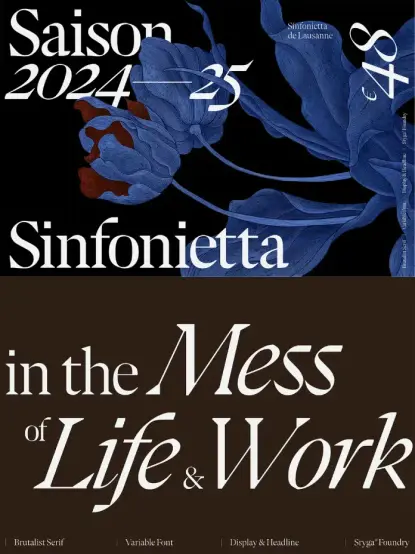
Kaguci Font Family by Sryga

A Definitive Review of Sryga’s Futuristic Brutalist Serif Typeface, Kaguci

Visual tension defines the most memorable moments in contemporary graphic design. Sryga understands this balance perfectly, and the Kaguci font family emerges as a striking example of this friction. This typeface forces a collision between centuries of heritage and the erratic noise of the digital future. Designers often search for tools that bridge the gap between elegance and aggression. Kaguci fills this void by offering a futuristic brutalist serif that feels both organic and distinctively synthetic. It operates as an organism rather than a static file. Consequently, it evolves within a glitchy landscape while maintaining the skeleton of traditional typography.

You can purchase the complete family from these websites:

Creative Market MyFonts

What Makes the Kaguci Font Family a Game-Changer for Modern Branding?

You might wonder why another serif enters the saturated market of digital type design. The answer lies in the specific execution of the Kaguci font family. Most serifs aim for perfection, smoothness, and invisibility. Conversely, Kaguci aims for disruption. It respects the rules of typography only to break them deliberately with a glitch from the future. This makes it an essential asset for brands that need to signal innovation without losing authority. Therefore, it appeals to designers who reject safe, predictable choices.

Kaguci — Futuristic Brutalist Serif Font by Sryga

You can purchase the complete family from these websites:

Creative Market MyFonts

The Fusion of Heritage and Futurism

Kaguci does not simply mimic the past. Instead, it drags the traditional serif aesthetic into a digital, brutalist realm. You see the familiar strokes of a classic Roman typeface. However, sudden digital interruptions distort these strokes. This creates a visual rhythm that feels uneasy yet incredibly satisfying. Sryga has mastered this juxtaposition. The Kaguci font family balances rigid modernity with warmth. Specifically, the bold contrast interacts with organic curves to humanize the digital distortion.

This approach aligns perfectly with the current digital brutalism trend. Designers are moving away from sterile minimalism. They want character. Kaguci delivers this character in spades. Furthermore, it invites the viewer to look closer. The details reveal a sophisticated understanding of typographic history. Yet, the overall impression remains undeniably forward-thinking.

Versatility Through Cuts and Variable Technology

A single weight rarely suffices for complex design systems. Fortunately, the Kaguci font family includes 10 distinct cuts. These range from an ethereal Ultra Thin to a commanding Black. This range allows you to build comprehensive hierarchies within a single project. Moreover, Sryga includes matching true italics for every weight. These italics add speed and urgency to the text. They are not just slanted romans; they possess their own distinct structure.

Additionally, the inclusion of a variable font changes the workflow entirely. You can fine-tune the weight to the exact pixel. This flexibility is crucial for responsive web design and kinetic typography. Variable font technology ensures that the typeface performs flawlessly across different screens and environments. Therefore, Kaguci functions as a responsive design tool, not just a static asset.

Practical Applications in Luxury and Tech

Where does the Kaguci font family perform best? Its high contrast makes it ideal for luxury branding typography. High-end fashion brands often seek fonts that convey both history and edgy modernity. Kaguci fits this brief perfectly. It suggests that a brand has a legacy but also embraces the future.

Simultaneously, the glitch aesthetic suits experimental typography in the tech sector. Tech companies usually default to sans-serifs. However, using a futuristic brutalist serif like Kaguci disrupts this norm. It signals a more sophisticated, human-centric approach to technology. Whether you design a poster for an electronic music festival or a website for an architecture firm, this font commands attention.

A Critical Perspective on Glitch Aesthetics

We must address the longevity of glitch aesthetics. Some critics argue that “glitch” is a passing fad. Nevertheless, the Kaguci font family avoids the trap of feeling temporary. It does this by grounding the glitch effects in solid typographic fundamentals. The distortion feels structural, not decorative. Sryga treats the glitch as an evolution of the form.

Consequently, Kaguci feels like a natural progression of the serif genre. It reflects our current reality. We live in a world where the digital and physical constantly overlap and glitch. Typography should reflect this reality. Therefore, Kaguci serves as a cultural artifact as much as a design tool. It captures the zeitgeist of the mid-2020s perfectly.

Why You Need High-Contrast Serifs Now

High-contrast serif fonts drive engagement. They stop the scroll. In a social media landscape dominated by uniform sans-serifs, Kaguci stands out. Its sharp serifs and varying stroke widths create a texture that the eye loves to follow. This is crucial for editorial design fonts. You need type that holds the reader’s interest.

Furthermore, the Kaguci font family excels in large formats. Use it for headlines. Use it for banners. The details shine when you scale it up. Conversely, it retains legibility at smaller sizes due to its robust structure. However, it truly sings when given space to breathe. White space accentuates its unique silhouette.

The Rise of Bio-Digital Typography

Sryga describes Kaguci as an “organism.” This is a fascinating concept. It suggests that the Kaguci font family is alive. This aligns with a new wave of bio-digital design. We see design elements that mimic biological growth within digital constraints. Kaguci fits this narrative. Its organic curves resist the rigid pixel grid.

This tension creates a dynamic user experience. When you use Kaguci, you inject life into your layout. It feels raw. It feels unpolished in the most professional way possible. This paradox drives modern creativity. We crave things that feel human, even when they are digital. Kaguci provides exactly that feeling.

Integrating Kaguci into Your Design System

Adopting a new typeface requires careful consideration. Start by using the Kaguci font family for primary headings. Let it define the tone of the project. Then, pair it with a neutral sans-serif for body copy. This contrast highlights Kaguci’s unique features. Alternatively, go bold and use the lighter weights of Kaguci for subheads.

Remember to utilize the true italics. They offer a distinct voice for emphasis. The variable font capabilities also allow for animation. Imagine the text growing and glitching in real-time. This adds a layer of interactivity that static fonts cannot match. Kaguci invites you to play.

You can purchase the complete family from these websites:

Creative Market MyFonts

Final Thoughts on Sryga’s Masterpiece

The Kaguci font family represents a bold step forward. It refuses to choose between the past and the future. Instead, it crashes them together. This collision produces something beautiful and unexpected. Sryga has created a tool that challenges designers to be bolder. It is not for everyone. It is not for safe brands.

However, for those who want to lead rather than follow, Kaguci is essential. It captures the complex, glitchy, beautiful nature of our digital lives. Therefore, it deserves a place in your typographic toolkit. Explore the cuts. Test the variable settings. Let Kaguci disrupt your design process.

Frequently Asked Questions (FAQ)

What is the Kaguci font family?
The Kaguci font family is a futuristic, brutalist serif typeface designed by Sryga. It features a high-contrast design that blends traditional serif aesthetics with a digital glitch style.

How many styles are in the Kaguci font family?
The family contains 10 static cuts ranging from Ultra Thin to Black. It also includes matching true italics for each weight, plus variable font files for flexible use.

Is Kaguci suitable for web design?
Yes, absolutely. Kaguci includes variable font technology. This makes it highly optimized for responsive web design, allowing for seamless weight transitions and faster load times.

What kind of projects suit Kaguci best?
Kaguci excels in luxury branding typography, editorial layouts, music posters, and tech-focused identities. It works best where you need a strong, distinctive visual voice.

Does Kaguci support multiple languages?
While you should check the specific glyph set from Sryga, professional font families like Kaguci typically support a wide range of Latin-based languages for global usage.

Why is Kaguci described as “brutalist”?
It earns the “brutalist” label because it exposes its construction and embraces raw, digital artifacts. It prioritizes bold structural expression over traditional polish or neutrality.

Don’t hesitate to find other trending typefaces on WE AND THE COLOR. In addition, you can find a selection of 100 outstanding typefaces for graphic designers in 2026 here.

Subscribe to our newsletter!

[newsletter_form type=”minimal”]

#brutalistFont #font #fontFamily #Kaguci #serifFont #Sryga #typeface

Ater Font Family by Blaze Type

Let’s explore why the Ater font family, a variable serif typeface, works so well for modern editorial design.

Nicolas Dupuis understood the power of ink when he created the Ater font family. Black ink defines the character of every printed page. Blaze Type released this typeface to solve a specific problem in graphic design. Designers often struggle to find a system that works for both loud posters and quiet pocketbooks. The typeface bridges this gap with remarkable elegance. It refuses to choose between classic serif tradition and modern display aggression. Instead, this typeface inhabits the ambiguity between the two styles. This article examines the technical and aesthetic reasons why the Ater font family deserves attention.

Download from MyFonts

What distinguishes the Ater font family from other serif typefaces?

Most serif typefaces pick a side. They either serve as invisible text faces or demand attention as display fonts. However, the Ater font family rejects this binary limitation. Nicolas Dupuis designed the forms to adapt seamlessly across different media formats. A designer can use the same font file for a billboard or a novel. Consequently, this versatility simplifies the design process significantly. The family unites different media through consistent, evolving forms.

Ater Font Family by Blaze Type Download from MyFonts

The name itself reveals the designer’s intent. “Ater” translates to “matte black” in Latin. This creates a poetic connection to the printing process. The Ater font family does not hesitate to fill a white page with heavy darkness. It embraces the density of ink. Therefore, the typeface feels grounded and physical, even on digital screens.

Mastering the variable axis for optimal contrast

Variable font technology powers the flexibility of the typeface. The design includes an approach to “blackening” the letters that changes their fundamental character. Lighter weights display delicate features suitable for extended reading. Conversely, the heavier weights push the boundaries of legibility for stylistic impact. The typeface creates a playground of contrast between these finest and darkest styles.

Designers can manipulate this axis to fine-tune the “color” of a text block. A headline might require the extreme density of the Black style. Meanwhile, the body text breathes easily in Extra Light or Regular. This dynamic range opens up countless creative possibilities for layouts. The Ater font family creates visual tension that keeps the reader engaged.

How does Blaze Type ensure legibility across formats?

Blaze Type prioritizes functionality alongside aesthetics. The foundry ensured that the Ater font family performs well at any size. Small sizes require open counters and sturdy serifs to remain readable. Large sizes, however, demand tighter spacing and sharper details. The typeface manages this balance through its variable nature.

The typeface spans from Extra Light to Black. It goes to extremes to ensure optimal readability. Designers rarely find a serif that handles “matte black” density without becoming a blob. Yet, the typeface maintains character distinction even in its darkest forms. This reliability makes it a go-to choice for serious editorial work.

Analyzing the aesthetic ambiguity of Ater

A unique tension exists within the shapes of the Ater font family. It references classical serif structures but executes them with modern precision. This ambiguity allows the font to feel timeless yet contemporary. It fits a historical novel just as well as a brutalist art catalog. The typeface plays with reader expectations.

You might notice the sharp transitions in the stroke width. These high-contrast elements give the Ater font family a display quality even in text sizes. It adds a sparkle to the page. Nicolas Dupuis crafted these details to ensure the font never feels boring. Consequently, the typeface commands authority without shouting.

Why is the Ater font family essential for branding?

Brands today need consistent voices across fragmented channels. A company uses a website, an app, printed stationery, and large-scale advertising. The typeface unifies these touchpoints. Its wide range of weights provides a diverse tonal palette within a single family. Therefore, a brand can whisper, speak, and shout using only the Ater font family.

Blaze Type distributes this font with modern licensing in mind. They understand that designers need flexible tools. The typeface supports this need for adaptability. It functions as a comprehensive design system rather than just a collection of letters. This systemic approach adds significant value for creative directors.

The technical excellence of Nicolas Dupuis

Nicolas Dupuis brings a rigorous standard to type design. His work on the Ater font family demonstrates a deep understanding of optical sizing. Every curve serves a purpose. He did not simply thicken the lines to create bold weights. Instead, he reimagined how the letterforms occupy space. This attention to detail elevates the typeface above standard retail fonts.

The Latin “matte black” concept guides every decision. Dupuis treats the positive space (the letter) and negative space (the background) with equal importance. The typeface shapes the white space as much as it lays down the black ink. This creates a rhythmic texture on the page that pleases the eye.

How to pair the Ater font family effectively?

Designers often ask how to pair such a strong serif. The typeface carries enough personality to stand alone. However, it also pairs well with neutral sans serifs. A clean Swiss-style grotesque highlights the sharp serifs of Ater. Alternatively, a mono-spaced font can create a compelling “code vs. poetry” contrast.

The typeface invites experimentation. Its high-contrast nature allows it to act as the “image” on a text-heavy page. You should let the heavyweights dominate the composition. Then, use the lighter weights to guide the reader through detailed information. The Ater font family rewards bold layout choices.

Future-proofing design with variable fonts

The industry is moving toward variable font technology. The Ater font family represents the forefront of this shift. It offers a level of control that static font files cannot match. Developers can animate the weight axis for web interactions. This capability makes the typeface a favorite for interactive design.

Static fonts limit creativity. Variable fonts like the Ater font family expand it. You get a limitless sliding scale of weight rather than fixed steps. This allows for precise typographic tuning. Designers who adopt the Ater font family equip themselves for the future of digital typography.

The lasting impact of Ater

Nicolas Dupuis and Blaze Type have created a modern classic. The Ater font family successfully translates the concept of “matte black” ink into digital type. It offers extreme versatility, moving fluidly from pocketbooks to posters. The ambiguity between classic and display styles gives it a unique edge. Therefore, this typeface is a design statement.

Download from MyFonts

Designers seeking a typeface that combines history with innovation should look no further. The typeface delivers on every front. It is elegant, robust, and infinitely adaptable. By choosing this family, you ensure your typography remains sharp, legible, and visually arresting.

FAQ

What is the Ater font family?

The Ater font family is a versatile serif typeface designed by Nicolas Dupuis and released by Blaze Type. It features a variable weight axis ranging from Extra Light to Black. The design bridges the gap between text and display usage.

What does the name “Ater” mean?

The word “Ater” is Latin for “matte black.” This name reflects the font’s design philosophy, which focuses on the density of ink and the ability to fill a page with darkness.

Who designed the Ater font family?

Nicolas Dupuis designed the typeface. He is a type designer associated with the Blaze Type foundry. His work often explores the relationship between classical forms and modern utility.

Is the typeface suitable for web design?

Yes, the typeface is excellent for web design. It is available as a variable font, allowing developers to adjust weights dynamically. This ensures fast load times and responsive typography.

Can I use the Ater font family for large posters?

Absolutely. The typeface was specifically created to handle display applications. The high-contrast styles and heavy “Black” weights create a strong visual impact on large formats.

Where can I buy the Ater font family?

You can license the typeface directly from MyFonts. They offer various licensing options for desktop, web, and app usage.

All images © Blaze Type. Check out other popular typefaces on WE AND THE COLOR or take a look at our selection of the 100 best fonts for graphic designers in 2026.

Subscribe to our newsletter!

[newsletter_form type=”minimal”]

#Ater #BlazeType #fontFamily #NicolasDupuis #serifFont #typeface

Aveline Font by CarmineType

Say Hello to the Aveline Typeface! Let’s Explore How this Soft Serif Font by CarmineType Defines Modern Elegance.

Design trends currently shift away from cold minimalism toward warmth and personality. The Aveline font perfectly captures this specific moment in typographic history. CarmineType designed this typeface to bridge the gap between modern clarity and historical charm. Designers often struggle to find a typeface that conveys luxury without feeling inaccessible. Aveline solves this precise problem. It offers a hybrid approach. The letterforms possess the readability of a sans serif but retain the sophisticated soul of a serif. Consequently, it works exceptionally well for brands that need to whisper rather than shout.

Download the typeface from Creative Market

What Makes the Aveline Font Essential for Contemporary Branding?

You instantly notice the gentle, intentional detailing. This is not just another standard serif found in generic libraries. The Aveline font brings a unique voice to visual identities. Furthermore, it feels human. In an era dominated by AI-generated content, human-centric design becomes invaluable. CarmineType crafted this typeface to look approachable yet high-end. Therefore, it appeals to viewers on an emotional level. This emotional connection drives engagement in branding and editorial design.

Aveline Typeface by CarmineType, a Versatile Hybrid Serif Font Download the typeface from Creative Market

The Anatomy of a Hybrid Masterpiece

Aveline is classified technically as a soft serif with ligatures. However, that description barely scratches the surface. The Aveline font features balanced proportions that make it suitable for both display and text blocks. Most display typefaces fail when used in smaller sizes. This elegant typeface defies this common limitation. Its structure remains legible even when you reduce the scale. This versatility makes it a powerhouse for responsive web design.

CarmineType included two primary styles: Roman and Italic. The Italic style brings a sense of motion and urgency. Meanwhile, the Roman style anchors the design with stability. Together, they create a harmonious typographic system. The Aveline font also draws discreet inspiration from Victorian aesthetics. Yet, it avoids the heavy ornamentation usually associated with that era. Instead, it extracts the romance of the past and refines it for digital screens.

Unlocking Creativity with Ligatures and Alternates

The true magic of the Aveline font lies in its OpenType features. CarmineType included over 170 carefully crafted ligatures. These connections between letters transform standard text into custom wordmarks. Designers love this feature because it saves time. You do not need to draw custom lettering for a logo. You simply type with Aveline, and the ligatures do the heavy lifting.

Additionally, the font includes a vast set of alternates. These character variations allow for endless combinations. You can adjust the mood of a headline by swapping a single letter. Consequently, the font serves as a creative toolkit. It encourages experimentation. Whether you design a book cover or a perfume bottle, the typeface adapts. The Victorian-inspired alternates add a touch of romance. However, they remain subtle enough to use in modern contexts. This balance between decoration and function defines the Aveline experience.

Why Luxury Brands Are Choosing the Aveline Font

Luxury branding relies heavily on typography to convey value. The Aveline font fits this niche perfectly. Its high-contrast strokes suggest elegance, while its soft terminals imply comfort. High-end fashion labels often seek this exact combination. They need to look expensive but inviting. Aveline achieves this effortlessly.

Consider the needs of the beauty industry. Skincare and cosmetic brands require typography that feels organic and clean. The Aveline font meets these requirements with its fluid curves. It lacks the harsh edges of a geometric sans. Therefore, it mirrors the organic curves found in nature and the human body. This makes it an ideal choice for beauty packaging.

Furthermore, editorial designers find immense value here. Magazines need headers that grab attention. The Aveline font commands the page without overwhelming the photography. Its lighter weights feel airy and sophisticated. Conversely, its heavier applications provide the necessary impact for major feature stories.

Practical Tips for Using Aveline

Using a character-rich typeface requires restraint. The Aveline font offers many expressive options, but you should use them wisely. Avoid using complex ligatures for long body text. They work best in headlines or short phrases. In body copy, the standard characters ensure maximum readability.

CarmineType optimized the font for various formats. You get the standard OTF, TTF, WOFF, and WOFF2 files. This ensures the Aveline font renders crisply on all devices. Web designers will appreciate the low file size relative to the visual quality. When you implement Aveline on a website, ensure you enable standard ligatures in your CSS. This activates the font’s full potential.

Also, consider the spacing. The Aveline font possesses excellent built-in kerning. However, for large display use, you might tighten the tracking slightly. This creates a more cohesive, logo-like appearance. Experiment with the stylistic sets to find the tone that matches your specific project.

Comparing Aveline to Standard Serifs

Many designers rely on classics like Bodoni or Didot for fashion typography. While beautiful, those fonts often feel overused. The Aveline font offers a fresh alternative. It retains the high contrast of those classics but adds modern softness. It feels less rigid.

Unlike traditional serifs, Aveline functions as a hybrid. It incorporates the logic of a sans serif in its skeletal structure. This makes the Aveline font more legible on screens than many historical serifs. Digital screens often struggle with the hairline thin strokes of Didot. Aveline’s strokes maintain enough weight to avoid disappearing at low resolutions.

Moreover, the Aveline font carries a unique personality. Standard fonts often feel neutral. Aveline feels opinionated. It adds a specific flavor to the design. If you want your project to look distinctive, you choose Aveline. It tells the viewer that you care about nuances.

Licensing and Value Proposition

Professional fonts constitute an investment. The Aveline font offers significant value for its price point. You receive not just the alphabet, but a comprehensive design system. The inclusion of multilingual support covers Western, Central, and Eastern European languages. This global reach is crucial for international brands.

CarmineType frequently offers license options for desktop, web, and apps. Purchasing the Aveline font legally ensures you have the correct files and rights. Free alternatives rarely offer this level of ligature support or technical polish. When you buy Aveline, you pay for the hours of engineering behind every curve. It elevates your portfolio instantly.

Final Thoughts on This Typographic Gem

Typography dictates the voice of a brand. Choosing the right voice matters more than ever. The Aveline font speaks with sophistication, warmth, and clarity. It avoids the trap of being too trendy or too archaic. CarmineType successfully created a timeless asset.

I personally find the ligatures to be the standout feature. They turn typing into an act of design. This elegant display serif typeface invites you to play with language. It reminds us that letters are beautiful forms, not just functional tools. If you work in branding, editorial, or packaging, this font deserves a spot in your library. It provides the elegance you need with the versatility you crave.

Download the typeface from Creative Market

Ultimately, the Aveline font represents the future of serif design. It respects the past but lives firmly in the present. Try it on your next project. You will likely find it becomes your go-to choice for refined elegance.

Frequently Asked Questions About the Aveline Font

What exactly is the Aveline font?

The Aveline font defines itself as a versatile hybrid serif. It sits comfortably between a clean modern sans and a charming serif. CarmineType designed it with soft terminals and balanced proportions. Consequently, it works beautifully for both large displays and smaller text blocks.

Which projects work best with the Aveline font?

This typeface thrives in environments that require elegance. Specifically, the Aveline font suits fashion branding, luxury packaging, and editorial design. It also adds a sophisticated touch to wedding invitations and beauty product labels. Therefore, if your project needs a romantic yet modern feel, Aveline fits perfectly.

How do I access the ligatures and alternates?

You can access the 170+ ligatures and alternates through any software that supports OpenType features. Programs like Adobe Illustrator, Photoshop, or InDesign make this process easy. Simply open the glyphs panel to view the options. The font allows you to customize your typography instantly with these unique characters.

Does the Aveline font support multiple languages?

Yes, CarmineType ensured broad accessibility for this typeface. The Aveline font includes extensive multilingual support for Western, Central, and Eastern European languages. This feature makes it an excellent choice for international brands. You can maintain a consistent visual identity across different regions.

Is the Aveline font optimized for web use?

Absolutely. The font family includes WOFF and WOFF2 files specifically for web usage. The Aveline font maintains its legibility on digital screens due to its distinct contrast and clear typography. Furthermore, the file sizes remain efficient for fast loading times. You can bring high-end typography to your website without compromising performance.

All images © CarmineType. Check out other trending typefaces in the Fonts section of WE AND THE COLOR or take a look at our selection of the 100 best fonts for designers in 2026.

Subscribe to our newsletter!

[newsletter_form type=”minimal”]

#Aveline #brandingFont #CarmineType #displayFont #font #serifFont #typeface

Pavilion Serif Font by God Control

Discover Why the Pavilion Serif Font is the Essential Typeface for Modern Editorial and Brand Identity.

Typography defines the voice of a brand before a reader processes a single word. Designers constantly hunt for that elusive balance between historical weight and contemporary sharpness. The Pavilion serif font delivers this exact equilibrium with surprising confidence. God Control has crafted a typeface that feels instantly timeless yet distinctly current. It does not just sit on the page; rather, it performs. You rarely find a Pavilion typeface alternative that manages such a rhythm. Therefore, this typeface deserves a closer look from serious typographers and creative directors alike.

The typeface is available for a very low budget from:

Creative Market YouWorkForThem

Why Does the Pavilion Serif Font Demand Your Attention?

Designers often struggle to find a serif that works for both punchy headlines and dense body copy. Why does the Pavilion serif font succeed where others fail? The answer lies in its intentional duality. God Control designed every curve and cut to serve a specific purpose. Consequently, the font marries refinement with flow. It offers a unique visual texture that keeps long-form text readable while giving headlines a necessary jolt of energy.

Pavilion Serif Font by God Control

The typeface is available for a very low budget from:

Creative Market YouWorkForThem

Most modern serifs lean too heavily into minimalism or get bogged down in excessive ornamentation. However, the Pavilion serif font walks the line perfectly. It respects the grid but is not afraid to break visual monotony. If you value precision, this font speaks your language. Moreover, it brings a human touch to digital interfaces, something usually lacking in stark, geometric designs.

Analyzing the Anatomy of a Modern Classic

You must understand the mechanics to appreciate the beauty. The Pavilion serif font features lowercase letters with incredibly soft curves. These curves contrast beautifully with the sharp cuts of the serifs. Additionally, the spacing is balanced meticulously. This ensures that the Pavilion serif font maintains its integrity even at smaller sizes.

The Role of X-Height and Rhythm

A defining feature of the Pavilion serif font is its perfect x-height. This specific proportion makes paragraphs read like butter. Your eyes glide across the text without stumbling. God Control fine-tuned every character to keep the flow on lock. Therefore, the texture of a block of text feels consistent and soothing.

Furthermore, the uppercase letters bring a different energy. They are strong and balanced but avoid feeling heavy or clunky. The Pavilion serif font uses these bold uppercase forms to anchor designs. They command attention without shouting.

Versatile Applications for the Pavilion Serif Font

Versatility often separates a good font from a great one. Fortunately, the Pavilion serif font belongs everywhere. You can deploy it effectively in high-end magazines where elegance is paramount. Similarly, it works wonders in packaging design. The Pavilion serif font adds a layer of sophistication to physical products that consumers want to touch.

Digital and Print Consistency

Web designers will appreciate the included web font formats. The Pavilion serif font renders crisp on screens, making it a top contender for best serif for long-form text on the web. It is rare to find a Pavilion serif font competitor that transitions so seamlessly from print branding to responsive web layouts.

You receive a complete package with this purchase. The set includes Pavilion_Regular in OTF, TTF, WOFF, and WOFF2 formats. Additionally, it features 215 total characters, covering special characters and punctuation. Thus, the Pavilion serif font handles complex editorial requirements with ease.

Elevating Brand Identity with God Control

Using the Pavilion serif font is a statement. It says that you value tradition but look toward the future. God Control created a tool that empowers you to control the narrative. When you choose the Pavilion serif font, you own the visual space.

Consider the emotional impact of your typography. A generic font blends in, but the Pavilion serif font stands out. It establishes authority. Branding typography needs to be memorable. Therefore, utilizing this modern serif typeface gives your project a distinctive voice.

Practical Implementation

Integrating the Pavilion serif font is straightforward. The files are ready for immediate use. You can drop them into your font book and start designing instantly. Whether you are building a lifestyle blog or a corporate identity, the Pavilion serif font adapts to the context.

Designers searching for readable fonts for websites will find a solution here. The Pavilion serif font maintains clarity on various display types. This technical reliability matches its aesthetic appeal.

Final Thoughts on the Pavilion Serif Font

We see many fonts released every week, but few leave a lasting impression. The Pavilion serif font by God Control breaks through the noise. It offers a masterclass in balance. The soft curves invite readers in, while the strong structure keeps them engaged.

If you want to elevate your design game, you need this tool. The Pavilion serif font is that serif you didn’t know you needed—until now. It represents the intersection where tradition meets modern edges. Own it. Ctrl it.

Frequently Asked Questions

What file formats are included with the Pavilion Serif font?

The download includes Pavilion_Regular.otf, Pavilion_Regular.ttf, Pavilion_Regular.woff, and Pavilion_Regular.woff2. These formats ensure compatibility across print and web projects.

Is the Pavilion serif font suitable for body text?

Yes, absolutely. The Pavilion serif font features a perfect x-height and balanced spacing. These features make it highly readable for long-form articles and books.

Does the Pavilion serif font include special characters?

Yes, the font comes with 215 total characters. This set includes standard punctuation and special characters needed for professional typesetting.

Can I use the Pavilion typeface for website design?

Definitively. The package includes WOFF and WOFF2 files. These files are optimized for fast loading and crisp rendering on modern web browsers.

Who designed the Pavilion serif font?

God Control designed this typeface. They focused on creating a balance between soft curves and strong, modern edges.

The typeface is available for a very low budget from:

Creative Market YouWorkForThem

All images © God Control. Check out WE AND THE COLOR’s Fonts category or take a look at our review of the 100 best typefaces for graphic designers in 2026.

Subscribe to our newsletter!

[newsletter_form type=”minimal”]

#font #GodControl #pavilion #PavilionFont #PavilionSerifFont #serifFont #typeface

Archer Display Font by SilverStag Type Foundry

Let’s Explore Archer Display, a Serif Font that Beautifully Breaks the Rules.

Some fonts follow the rules. They are dependable, predictable, and they get the job done. Then, there are fonts that feel alive, fonts that possess a distinct personality. The Archer Display font by SilverStag Type Foundry belongs firmly in the latter category. It arrives with the grace of a classic serif but carries a clever, modern secret in its letterforms. This is a typeface for designers who want to communicate not just a message, but a mood. It feels less like a tool and more like a creative partner, one that understands the power of a subtle, confident twist.

You can download the typeface for a very low budget from these platforms:

Creative Market YouWorkForThem

The Anatomy of a Modern Classic: What is Archer Display?

Archer Display presents itself as a high-contrast serif font. Its foundation rests on the dramatic interplay between thick and thin strokes, a technique that has defined elegant typography for centuries. Yet, to label it as purely traditional would be to miss the point entirely. It is a font designed with a contemporary eye, one that values character as much as clarity.

Archer Display Font by SilverStag Type Foundry

You can download the typeface for a very low budget from these platforms:

Creative Market YouWorkForThem

A Foot in Tradition

The substantial serifs of Archer Display give it a sturdy, reliable presence. They anchor the letters to the page, creating a sense of history and gravitas. This makes the font immediately feel trustworthy and sophisticated. You can see the echoes of classic book types and refined editorial headings within its DNA. This traditional backbone ensures it remains legible and grounded, no matter how it’s used.

A Whisper of Rebellion

Here is where the magic happens. SilverStag Type Foundry has selectively reimagined certain characters, infusing them with an avant-garde spirit. These are not jarring changes. Instead, they are thoughtful, artistic flourishes that surprise and delight the eye. These alternate letters and unique forms give Archer Display its signature edge. Consequently, the font feels dynamic, as if it is subtly winking at the reader.

A True Creative Playground

Beyond its basic alphabet, Archer Display is a treasure chest of creative options. It includes over 70 handcrafted ligatures and alternate letters. This extensive library empowers you to customize your text, turning a simple headline into a bespoke piece of lettering. For example, with four distinct ampersands to choose from, you have incredible control over the final look. This is not just a font; it is an invitation to play, to experiment, and to build a truly unique visual story.

Why You Will Choose the Archer Display Font

The appeal of Archer Display goes far beyond its handsome appearance. Its growing popularity stems from a blend of aesthetic distinction, functional power, and thoughtful design that solves real-world creative problems.

It Has a Voice

This font cuts through the noise of minimalist sameness. Its confident personality is perfect for building memorable brands and captivating headlines. In a design landscape often dominated by neutral sans-serifs, Archer Display offers a dose of character and soul. It helps your work speak with a tone of refined authority and creative flair. What story do you want your typography to tell?

It Speaks Your Language, and Theirs

Great design should be boundless. A significant strength of the Archer Display font is its comprehensive language support. It covers over 90 languages, making it a truly global typeface. This means your branding and messaging will look just as elegant in Warsaw as it does in Wichita. For international brands or publications, this feature is not a luxury; it is a necessity for maintaining a cohesive and professional identity.

A Surprising Versatility

While it exudes a premium feel, Archer Display is not a one-trick pony. Its unique balance of classicism and modernism allows it to adapt to various contexts with ease.

  • Logos and Branding: It creates memorable logotypes that feel both established and forward-thinking.
  • Editorial Headlines: It lends a sophisticated, literary quality to magazines and websites.
  • Luxury Packaging: Its elegant form perfectly complements high-end products, from fine wines to artisanal goods.
  • Website Banners: Used for key headings, it adds a powerful touch of class to digital experiences.

Making Archer Display Your Own: A Practical Guide

To get the most out of Archer Display, you need to explore its hidden depths. Mastering its features will elevate your typography from simply good to truly exceptional.

Discovering the Hidden Characters

The soul of this font lies in its alternates and ligatures. Accessing them is straightforward in most professional design software. In Adobe Illustrator or Photoshop, you can simply open the Glyphs panel to see all the available characters. For Canva users, SilverStag Type Foundry provides a special PUA-encoded font file. This ensures that these beautiful alternate characters are accessible to everyone, regardless of their software.

Finding the Perfect Typographic Partner

Think of Archer Display as the lead actor in your design. Its supporting cast should complement its style without competing for attention. A clean, geometric sans-serif like Poppins or Futura makes an excellent partner. Use it for body copy, allowing its simplicity to provide a stable base for the expressive headlines set in Archer Display. This creates a beautiful, functional hierarchy that is both easy to read and visually compelling.

A Personal Reflection on Archer Display

As someone who spends their days immersed in type, it is rare to find a font that feels both new and familiar at the same time. Archer Display achieves this delicate balance with remarkable skill. What I find most striking is its quiet confidence. It doesn’t scream for attention, yet it is impossible to ignore. The alternate characters and ligatures feel integral to its identity, not like tacked-on extras.

You can sense the creator’s passion in every curve. The small detail of asking users to tag their work on Instagram fosters a wonderful sense of community. It transforms the act of using a font into a shared creative experience. This human touch makes me appreciate the artistry behind Archer Display even more. It is a font with a story, and it helps you tell yours.

A Font for Now, Built to Last

Ultimately, Archer Display is a remarkable achievement. It proves that serif fonts can be modern, exciting, and full of personality without sacrificing their inherent elegance. It provides a powerful and versatile voice for designers, brands, and creatives looking to craft work that is both beautiful and meaningful. This is a font that respects the past but is not bound by it. It is, in every sense, a typeface for today and tomorrow.

You can download the typeface for a very low budget from these platforms:

Creative Market YouWorkForThem

Don’t hesitate to find other trending typefaces in WE AND THE COLOR’s Fonts category. In addition, you should take a look at our handpicked selection of the top 100 fonts for designers in 2026.

Subscribe to our newsletter!

[newsletter_form type=”minimal”]

#ArcherDisplay #displayFont #font #serifFont #SilverStagTypeFoundry #typeface