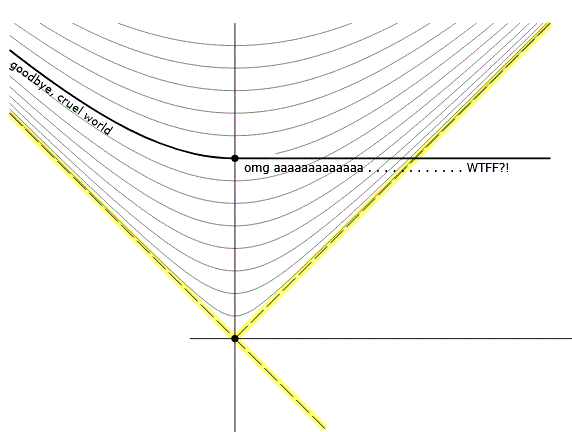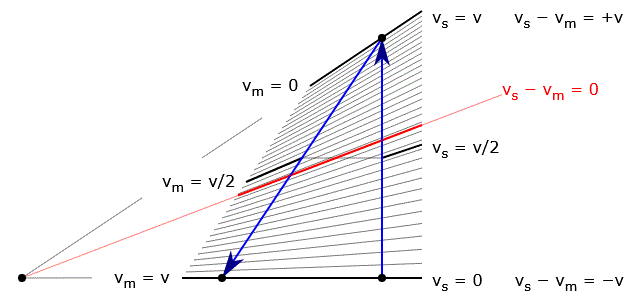
Also my favorite diagram so far, illustrating what happens when you jump out of the John Hancock Tower (i.e., the version we built out of accelerating ships that has fake gravity):

#physics #ftl #relativity #scienceed

Part 6
https://wrog.dreamwidth.org/72287.html

in which, having established what (little) math we actually need, we get to the truly fun part:

How constant acceleration works
a.k.a.
What you need to know re
Faking Gravity in Special Relativity.

It is **a** **lot** weirder than you would expect.

Light shining up or down gets Doppler-shifted.

Gravity increases as you go downstairs, but you'll live longer.

There are event horizons.

And one year downstairs is the Infinite-Gravity Horror Show where time comes to a complete stop... or something...

#physics #relativity #ftl #scienceed

https://mastodon.murkworks.net/@wrog/116054745477223253

Part 5:
https://wrog.dreamwidth.org/71989.html
about how to transform between Moving and Stationary People coordinates (Lorentz transformations) and what velocity angles are (they're like rotation angles, but different)

(trying to make this accessible to folks who haven't seen a whole lot of linear algebra [though, as I recall, I *did* know about matrices in 6th grade;... thought they were cool..)

#physics #relativity #ftl #scienceed

Relativity (5 of n): About coordinate translations and velocity angles

<div style="border:1pt solid black;padding:0 1em;font-style:italic;background-color:#eee"><br /><p><br /> My Special Relativity series <a href="/71432.html">continued from part 4</a>.<br /> </p><br /><p><br /> Today's topic is how to translate Moving People coordinates to Stationary People coor

Dreamwidth Studios

I of course goofed and left out the explanation of Lorentz Contraction from the obvious place in Part 3 where I should have talked about it.

So I've slotted it in here:
https://wrog.dreamwidth.org/71271.html#hrel3_lorentz
along with a new diagram to make super-clear what's happening.

Or if you want to get the flow/parallelism there's now this link https://wrog.dreamwidth.org/71271.html#hrel3_timedil
to the earlier time dilation discussion (cleaned up a bit), since that's really the same issue but turned on its side 90Β°.

So maybe the Stargate SG-1 example will be clearer now. or maybe not
(the point of the blue arrows is this is the kind of shit you can do if you have stargates: A Completely Easy Time Machine they'd have built half-way thru season 2)

#relativity #physics #ftl #scienceed

Part 4:
https://wrog.dreamwidth.org/71432.html

#physics #relativity #ftl #scienceed

On the Storrow Drive Theorem

This is on how, having developed how one does spacetime for a 1-dimensional universe, how you put back the 2nd and 3rd spatial dimensions,

and the key question is what happens when you have college students attempting to measure the height of a bridge using rental trucks,

i.e., what differences are there in how the Moving People see it vs. how the Stationary People see it. Do the Moving People see a different height? Or see the truck slanted weirdly? Curiously, the answer to both of these turns out to be NO.

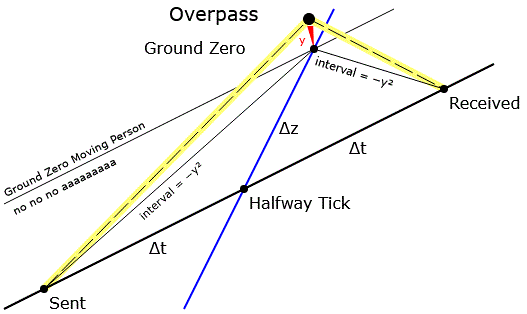
And we have this fun diagram

Part 3:
https://wrog.dreamwidth.org/71271.html

…introduce the _Interval_ between two events

= (Ξ”z, spatial separation)Β² βˆ’ (Ξ”t, time lapse)Β²

and show that this number is an **invariant**, i.e., all slower-than-light observers get the same result calculating this in their own coordinates.

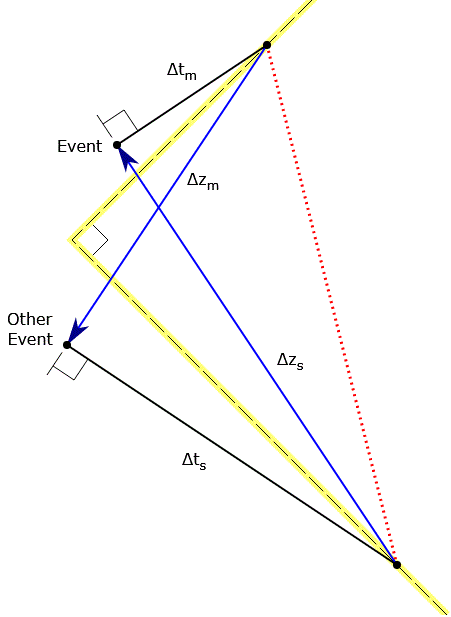
Magic diagram (with ALT text!) below proves this for Moving (upwards) vs. Anti-Moving (downwards, same speed) observers (i.e., using that Intermediate POV from before), and go from there.

Interval is either
(*) (proper distance)Β² > 0 [events are simultaneous for somebody],
(*) βˆ’(proper time)Β² < 0 [events are co-located for somebody], or
(*) zero [light-speed trajectory]

and then we do Twin Paradox and How FTL Violates Causality.
#physics #relativity #ftl #scienceed

I also really like how this diagram came out.

It's another spacetime-with-left-to-right-time grid from the stationary observer POV, showing trajectories of
(*) the stationary observer,
(*) the (velocity v) moving observer, and
(*) all possible in-between trajectories
+
how the two observers measure velocities
+
how the two observers will **not** agree on which trajectory is going v/2
+
how the One True Intermediate Trajectory
(i.e., the one that both see going the same speed) is between the v/2 trajectories **and** seen by both observers as going **faster** than v/2.

...this being the Big Red Flag that velocities don't add the way you'd think.

(also spelled out more fully in Part 2)

#physics #relativity #ftl #scienceed

Part 2:
https://wrog.dreamwidth.org/71156.html

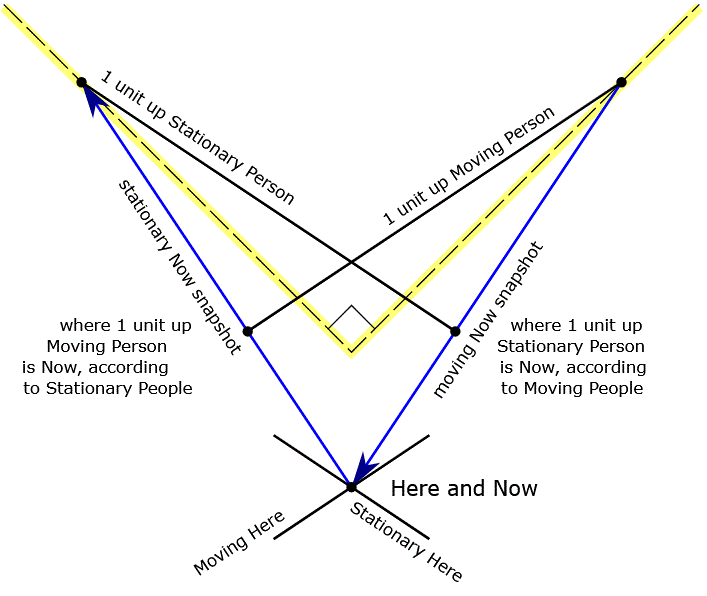
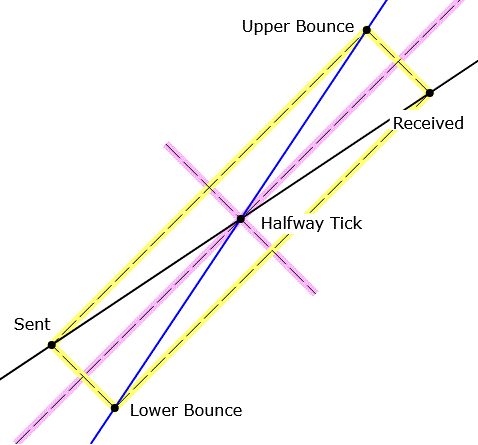
In some ways, the following diagram is the whole ball of wax, essentially summarizing why the moving observer will *not* agree with stationary observer on simultaneity of events.

It's a spacetime diagram with time going left to right, depicting someone moving upwards (black line), bouncing a light ray off of a reflector above/below them (yellow lines).

If you get what's going on here, why the moving person''s '"snapshot" (blue line) of what's going on Right Now cannot be vertical (i.e., aligned with the stationary person's snapshots), you can derive everything else.

(see the full post for the actual argument)

#physics #relativity #ftl #scienceed

I decided it was time for another go at explaining Special Relativity.

I remain annoyed at how few people really get it, even amongst avid SF consumers, who have gotten entirely too accustomed to generations of SF writers papering over the FTL issues with technobabble, 'cause we need that galactic empire, don'tcha know.

The idea is to do this with basic geometry you knew or could have learned about in 6th grade plus a bit of algebra (up to Pythagorean Theorem, which I *definitely* remember our math classes teaching in 6th grade).

I think I can get by without using a single square-root sign.

Anyway, here's part 1:

https://wrog.dreamwidth.org/70909.html

#physics #relativity #ftl #scienceed

wrog | Relativity redux (1 of n): E pluribus immobiles

Meanwhile, here in Texas, discussions are occurring as to what can be taught in a university genetics class related to sex chromosomes and sex determination. Primary and secondary sexual characteristics are influenced by variation in many genes, one on the Y chromosome and several others on autosomes. This is too close for comfort given new university policies and state laws related to the teaching of sexual identity.
#AcademicChatter #Academia #ScienceEduction #ScienceEd