 Panethos
Ways Kansas could better use $2.8 billion than a stadium
Recently, the State of Kansas announced they will help the Kansas City Chiefs fund a new domed stadium in the Kansas suburbs of Kansas City, Missouri using STAR (state tax and revenue) bonds. Approximately $1.8 billion would be for the cost for the stadium itself and $975 million would be spent towards related/ancillary projects.
“On the deal’s surface, Kansas has agreed to issue $1.8 billion in sales tax and revenue, or STAR bonds, to fund construction of the domed stadium in Wyandotte County. The state has also committed to issuing up to another $975 million in STAR bonds to fund privately owned developments around the stadium and in Olathe, where the team plans to build a training facility and headquarters. Together, those figures touted last Monday in a celebratory announcement in Topeka with state officials and the Chiefs, add up to $2.775 billion.” Source: kansas.com
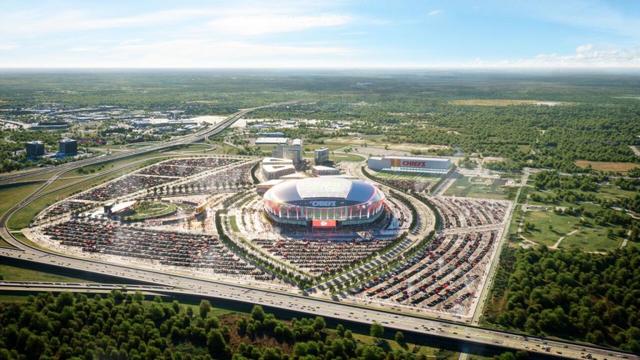
Chiefs stadium concept with acres of parking sprawl – Source: kshb.comThere have been decades of debate about the logic and economic justification of public entities helping finance private entities for sports venues, especially when the owners themselves are billionaires. The planned facilities in Kansas are just the latest.
“Team owners looking to build or revamp big league sports stadiums often seek public funds in the hundreds of millions of dollars. But research conducted over decades indicates these investments almost never lead to massive economic gains for host cities.” Source: journalistsresource.org
Below are just few examples of how nearly $2.8 billion dollars could be used to benefit the more Kansans beyond football fans, many of whom actually live in Missouri. The numbers provided for the alternative expenditures were calculated by gemini.google.ai and are based on current costs and valuations.
- 1,302 miles of roads could be fully reconstructed
- 90,322 miles of road could be chip sealed – nearly 65% of all streets and roads in the state
- 112-186 miles of new four-lane freeway could be built in rural Kansas – shorter lengths in suburban and urban areas
- 848,000,000 school lunches could be paid for children based on the current $3.30/lunch
- 40-80 new schools could be built across the state
- 224,000 years of full infant care could be provided
- The salaries and benefits for approximately 35,000 new police officers could be paid for one year.
- 2,800-3,300 new fire engine pumper trucks could be bought
- 2.85 years of state Medicaid contributions could be funded
- 392,156 Kansas families could receive a full year of rental assistance
- 8,974 new affordable homes could be built
- All 145 existing transit systems in Kansas could be funded based on current levels for 50 years.
It must also be noted that there are stadiums which were paid for by the owner of the team. Here are three examples from the NFL. Their offsite improvements may have been paid for by public entities.
SoFi Stadium (opened in 2021) in Los Angeles, California at a cost of $5.5 billion – built by L.A. Rams owner Stan Kroenke.
MetLife Stadium (opened in 2011) in East Rutherford, New Jersey – built and owned by MetLife Stadium Company LLC., which is co-owned by the New York Giants and Jets. It was built for $1.6 billion.
Gillette Stadium (opened in 2002) in Foxboro, Massachusetts – built by Kraft Sports Group, which is owned by New England Patriots owner Robert Kraft.
Peace!
#chiefs #cities #financing #football #history #Kansas #KansasCity #landUse #NFL #sports #stadiums #STARBonds #transportation