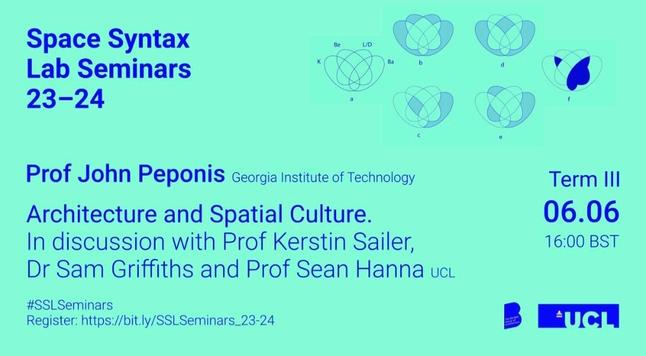
Join us online for the next #SpaceSyntax #SSLseminars with Professor John Peponis who will provide insights into his new book 'Architecture and spatial culture', followed by a panel discussion with myself and my esteemed colleagues Dr Sam Griffiths and Prof Sean Hanna

Thursday, 6 June, 4pm BST
Free! All welcome

Register:
https://bit.ly/SSLSeminars_23-24

#ArchitecturalResearch #archidon #BartlettSchoolOfArchitecture
Space Syntax Lab Seminars: Autumn 2023 - Summer 2024

This academic seminar series features researchers sharing their findings, discussing their ideas and showing work in progress from The Bartlett's internationally renowned Space Syntax Laboratory.

The Bartlett School of Architecture

Join us for the last #SpaceSyntax Lab seminar this term, hosted by the Bartlett School of Architecture, UCL
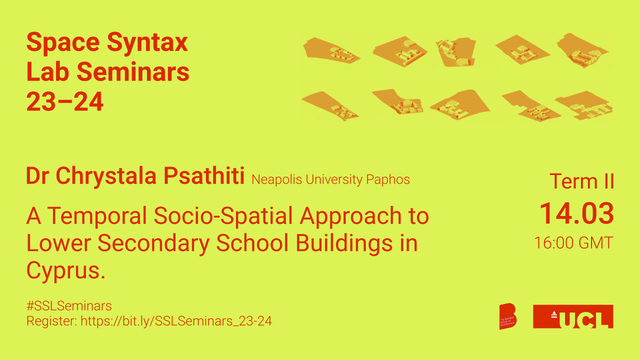
@ChrystalaPsathiti will present her work on secondary schools in Cyprus

14 March, 4pm GMT, online on zoom, all welcome.

More information and to register:
https://www.ucl.ac.uk/bartlett/architecture/events/2024/feb/space-syntax-lab-seminars-autumn-2023-spring-2024

#SSLseminars
@sociology

Space Syntax Lab Seminars: Autumn 2023 - Spring 2024

This academic seminar series features researchers sharing their findings, discussing their ideas and showing work in progress from The Bartlett's internationally renowned Space Syntax Laboratory.

The Bartlett School of Architecture

Two more #SpaceSyntax Lab seminars coming up this term, hosted by the Bartlett School of #Architecture, UCL:

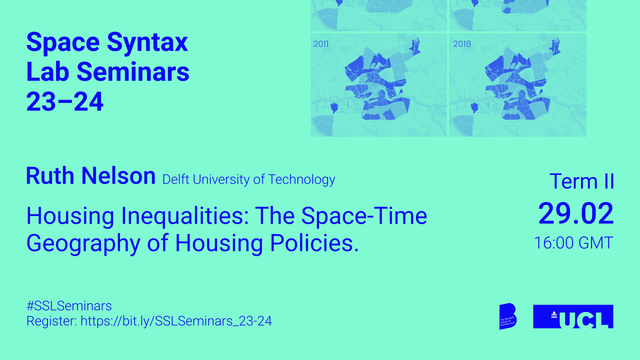
On 29 Feb 2024 Ruth Nelson from TU Delft will present her work on #Housing Inequalities: The Space-Time Geography of Housing Policies

On 14 Mar 2024 Dr @ChrystalaPsathiti will present a Temporal Socio-Spatial Approach to Lower Secondary School Buildings in Cyprus

Seminars at 4pm GMT, online on zoom, all welcome!

More information and to register:
https://www.ucl.ac.uk/bartlett/architecture/events/2024/feb/space-syntax-lab-seminars-autumn-2023-spring-2024

#SSLseminars

Space Syntax Lab Seminars: Autumn 2023 - Spring 2024

This academic seminar series features researchers sharing their findings, discussing their ideas and showing work in progress from The Bartlett's internationally renowned Space Syntax Laboratory.

The Bartlett School of Architecture

Thrilled to unveil the next terms of the Space Syntax Lab Seminars 23–24. Our 11 talks cover diverse topics, such as #Permeability, #SpaceSyntax, #UrbanImagery models, #HumanBehaviour, #Buildings, #Housing, & #Segregation.

Register for each: https://bit.ly/SSLSeminars_23-24
#SSLSeminars @spacesyntax

Space Syntax Lab Seminars: Autumn 2023 - Spring 2024

This academic seminar series features researchers sharing their findings, discussing their ideas and showing work in progress from The Bartlett's internationally renowned Space Syntax Laboratory.

The Bartlett School of Architecture
Space Syntax Lab Seminars: Autumn 2023 - Spring 2024

This academic seminar series features researchers sharing their findings, discussing their ideas and showing work in progress from The Bartlett's internationally renowned Space Syntax Laboratory.

The Bartlett School of Architecture

Join us on Thursday 08.06 at 4pm BST to the next #SSLSeminars session by @ilgit0 who'll talk about her work on the persistence of #SpatialSegregation in 15 US cities using #SpaceSyntax. @spacesyntax

Register: https://ucl.zoom.us/meeting/register/tJcsdeioqjksGtAeWHwd4H69Y5XE32udFIni
More details: http://bit.ly/SSLSeminars

Welcome! You are invited to join a meeting: Space Syntax Lab Seminars - Dr Ilgi Toprak. After registering, you will receive a confirmation email about joining the meeting.

Redlining Persistence in US Cities: Segregation Through the Lens of Urban Configuration Spatial disparities in the US are closely related to systemic inequality, as historically underprivileged communities were restricted to specific areas by government policy. This policy has significantly impacted segregation, but current income inequality and increased land value have intensified spatial disparities, resulting in segregation to persist. My previous study at SSS13 found that different US cities have unique configurations resulting in diverse integration and segregation forms, systemic exclusion, intentional self-segregation, or enclaving strategies of different racial and ethnic groups. Although the results were meaningful, the sample size needed to be increased to generalize findings. My ongoing study allows the statistical investigation of more cities with different factors contributing to the persistence of redlining. In this research, I attempt to answer which factors contribute to redlining persistence by systematically examining segregation patterns across 15 US cities and investigating configurational, demographic, economic, and social factors that might contribute to segregation in these cities. I aim to propose a data-informed exploration and a regression model in three steps: (1) exploring spatial correlations of historical residential segregation patterns and urban configuration with street network analyses (NAIN and NACH) using data visualizations, (2) followed by a multivariate regression model that assesses the factors contributing to the persistence of residential segregation due to redlining in US cities, and finally (3) using feature selection to choose which factors help the model increase its statistical significance. _ This event is organised by the Space Syntax Laboratory, Bartlett School of Architecture, University College London. Dr Kimon Krenz ([email protected])

Zoom

Join us on Thursday 01.06 at 4pm BST to the next #SSLSeminars session by @Gazi_Universite's Prof Burcu Ozduru who'll talk about patterns of #IntraUrban #Centralities in Ankara's #UrbanGrowth. m@[email protected]

Register https://ucl.zoom.us/meeting/register/tJAvdemtqzosGNdCQbEGrTdIfZgnytqPnP3c
Details http://bit.ly/SSLSeminars

Welcome! You are invited to join a meeting: Space Syntax Lab Seminars - Prof Burcu H. Ozuduru. After registering, you will receive a confirmation email about joining the meeting.

Intra-Urban Centrality Levels Through Street Networks: Evidence from Ankara’s Urban Growth Urban Planning Theory is looking for new models to explain new centre formations. Planners rely on comprehensive plans with strategic forecasts; however, due to the nonlinearity of interactions between people and places via the multi-modalities of mobility and communication innovations, planners must look at the allocations of a multitude of events in the urban system. The street network provides information for various opportunities and costs and overall, when a city’s centrality levels are examined at the intra-urban level, various levels of centralities and affiliated land use types can be detected. Identifying city centres and the urban structure of the 21st-century city has become more complex but using the tools offered by various analysis techniques proves to be helpful. In this study, the change in centrality levels of the capital city of Turkey, Ankara will be assessed using sDNA+. _ This event is organised by the Space Syntax Laboratory, Bartlett School of Architecture, University College London. Dr Kimon Krenz ([email protected])

Zoom

Join us on Thursday 18.05 at 4pm BST to the next #SSLSeminars session by @martinfleis & @darribas who'll talk about their research on measuring #UrbanForm & #UrbanFunction in Great Britain. @spacesyntax

Register: https://ucl.zoom.us/meeting/register/tJYvcuGtqzsvEtcK752NcgVOuVXoNlgE-BOA
Details: http://bit.ly/SSLSeminars

Welcome! You are invited to join a meeting: Space Syntax Lab Seminars - Dr Martin Fleischmann & Prof Dani Arribas-Bel. After registering, you will receive a confirmation email about joining the meeting.

The Emergent Structure of Urban Form and Function: A Data-Driven Overview of the British Landscape The internal structure of urban environments that compose individual cities is key to understanding the rules underpinning their genesis, development, and further evolution. Their growth and change follow piecemeal, local, bottom-up processes that, to be fully understood, require analytical methods following the same logic without imposing a priori classes or groups. In this paper, we use the concept of spatial signatures, a bottom-up data-driven classification of predominantly urban environments based on their form and function, as the basis for a deep dive into the composition of cities. Its application on the whole of Great Britain provides a unique combination of national scale and detail with spatial units derived from individual buildings and street segments. We use this classification to analyse the inherent regularity and emergence of spatial patterns in urban systems, unveiling unique insights into cities' built structures. The results provide a profound understanding of the spatial distribution of signature types within and outside cities, from their geographical distribution to co-occurrence and relationship between classes, we expose the unique, organic hierarchy of British cities. The findings illustrate the ability of spatial signatures to capture and delineate the organisation of space based on a rich description of its urban form and urban function, one that combines granular detail and national scale and opens new pathways for understanding how our cities are shaped and how to manage their future development. _ This event is organised by the Space Syntax Laboratory, Bartlett School of Architecture, University College London. Dr Kimon Krenz ([email protected])

Zoom

Join us on Thursday 11.05 at 4pm BST to the next #SSLSeminars session by @GustavoMaldG and @Chr_Lenart
who'll talk about their research on #SocialHousing in London and Vienna. #SpaceSyntax @spacesyntax

Register: https://ucl.zoom.us/meeting/register/tJMvfu6qrzoqGNGy1m9553HoLO3Tur48tOin
Details: http://bit.ly/SSLSeminars

Welcome! You are invited to join a meeting: Space Syntax Lab Seminars - Gustavo Maldonado Gil & Christina Lenart. After registering, you will receive a confirmation email about joining the meeting.

Social Housing as an Integrated Component of a City? A Comparison of Projects in London and Vienna This research investigates how spatial attributes correspond to the public debate on a social housing project’s success or failure. London and Vienna are two cities with long, but very different histories of social housing. Social housing estates from both cities - serve as case studies with different public narratives on their failures and success. The history of social housing in London has shown how spatial segregation and “bad architecture” have been accused of being responsible for a social housing project’s failure in public discourse. Vienna’s social housing estates hardly had to deal with severe social problems, however, public debate on the success of social housing is mostly focusing on aspects of affordability rather than spatial or architectural qualities. In order to test the role of spatial integration and segregation on the performance of housing projects, a set of methods of urban and spatial analysis were chosen, developed and combined within this research, to describe and compare the spatial situation of projects to the city on various scales. This research tries to tackle the question of whether spatial integration and segregation in the urban fabric conform to the public narrative of a housing project and with the notion of whether being an integrated city component or not. This work opens further questions on what aspects should be considered for the good integration of social housing projects as a performing component within the urban fabric. _ This event is organised by the Space Syntax Laboratory, Bartlett School of Architecture, University College London. Dr Kimon Krenz ([email protected])

Zoom

Join us next Thursday 04.05 at 4pm BST to our first #SSLSeminars session by Fánel Contreras who'll talk about her research on how #Modernism influenced the design of Latin #Architecture schools. #SpaceSyntax @spacesyntax

Register: https://ucl.zoom.us/meeting/register/tJYpfuyrqT8oE9HF2TUUgHwcuIHEMVt4LABf
More details: http://bit.ly/SSLSeminars

Welcome! You are invited to join a meeting: Space Syntax Lab Seminars - Fánel Contreras. After registering, you will receive a confirmation email about joining the meeting.

School Designs and Modernism: A Comparative Study of Latin American Schools of Architecture The first Latin American schools of architecture were purposely designed and built during the 1950s under the discussion and influence of Modern Movement ideas. This seminar presents an analysis of four schools of architecture in Latin American countries (Peru, Mexico, Venezuela and Brazil) and compares them with the Bauhaus School of Design (BSD) and the Chandigarh College of Architecture (CCA) as existing referents of Modernism. The main objective of this study is to identify the points of confluence between the perspectives of the Modern Movement and of each designer in their respective context, and how their ways of thinking influenced the design of Latin American schools built during this time in terms of spatial configuration, perception and discourse, looking to go beyond the formal properties traditionally discussed. _ This event is organised by the Space Syntax Laboratory, Bartlett School of Architecture, University College London. Dr Kimon Krenz ([email protected])

Zoom