Watching SN1987A unfold over decades, with older instruments like Hubble, and now JWST + combining this with other wavelength regimes, like radio emissions from ALMA, is like being in a fun class on supernovae that runs for most of our lives. We just keep learning!
Now if the neutron star would just become a pulsar, and beam in our direction, I will be a very happy chap!
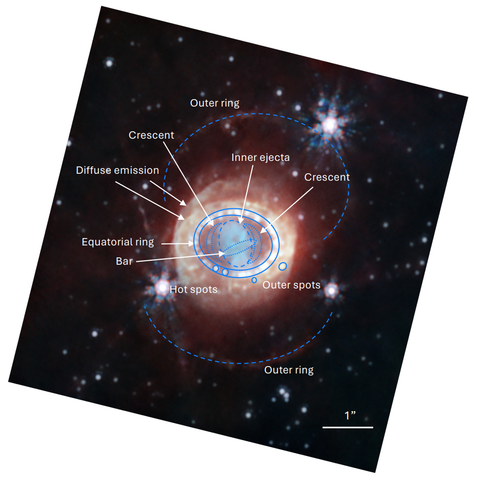
Webb finds evidence for a neutron star at heart of young supernova remnant
https://esawebb.org/news/weic2404/?lang
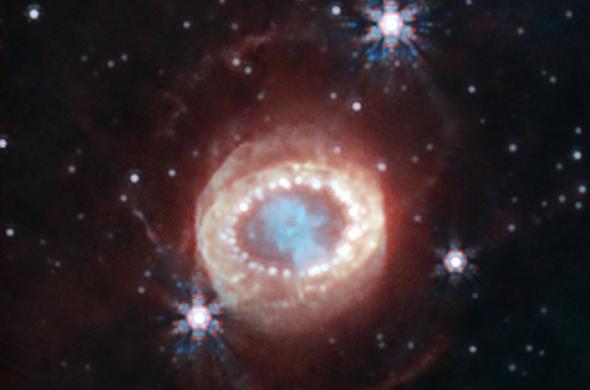
The supernova, known as SN 1987A, occurred 160 000 light-years from Earth in the Large Magellanic Cloud. #SN1987A was a type II supernova that was observed on Earth in 1987, the first supernova that was visible to the naked eye since 1604 — before the advent of telescopes.
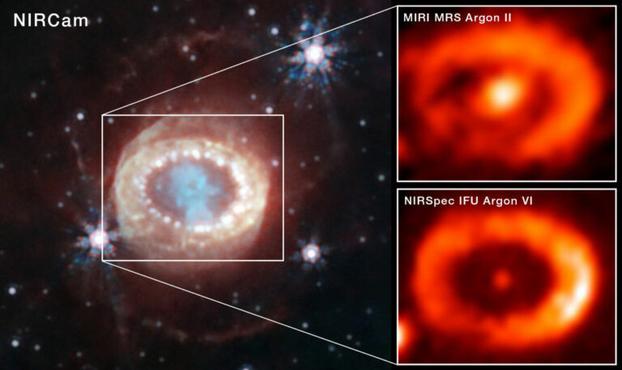
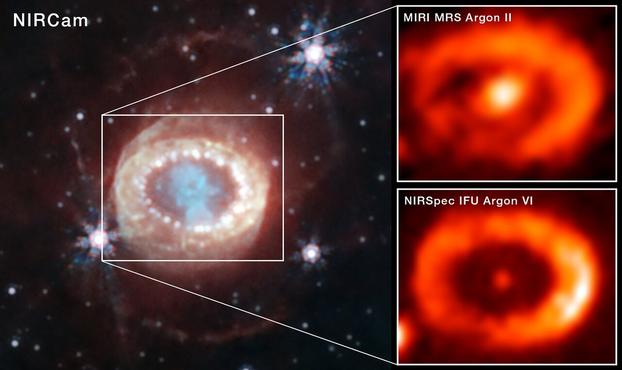
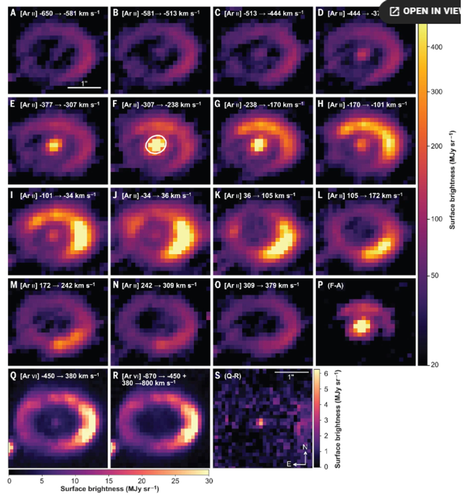
The NASA/ESA/CSA James Webb Space Telescope has found the best evidence yet for emission from a neutron star at the site of a recently observed supernova. The supernova, known as SN 1987A, occurred 160 000 light-years from Earth in the Large Magellanic Cloud. SN 1987A was a type II supernova [1] that was observed on Earth in 1987, the first supernova that was visible to the naked eye since 1604 — before the advent of telescopes. It has thus offered the astronomical community a rare opportunity to study the evolution of a supernova and what was left behind, from the very beginning. SN 1987A was a core-collapse supernova, meaning the compacted remains at its core are expected to have formed either a neutron star or a black hole. Evidence for such a compact object has long been sought, and whilst indirect evidence for the presence of a neutron star has previously been found, this is the first time that the effects of high energy emission from the young neutron star has been detected.
#astronomy #supernova #SN1987A #pulsar #NeutronStar #JWST
An article published in the journal "Science" reports new evidence that the supernova SN 1987A generated a pulsar. A team of researchers used observations conducted with the James Webb Space Telescope to detect the effects of high-energy emissions coming from the pulsar or the pulsar wind nebula, a nebula that surrounds it and is powered by the pulsar.
Webb vindt de neutronenster in SN 1987A
Astronomen hebben met behulp van de Webb Space Telescope een einde gemaakt aan het bijna 10 jaar durende spel van verstoppertje spelen nadat ze een neutronenster ontdekten in de restanten van een stellaire explosie.
https://www.kuuke.nl/webb-vindt-de-neutronenster-in-sn-1987a/
First Direct Detection of Neutron Star Formed in Supernova SN 1987A
In a study reported recently, astronomers observed the SN 1987A remnant using James Webb Space Telescope (JWST)............
#JamesWebbSpaceTelescope #JWST #Neutronstar #SN1987A #supernova #supernovaexplosion
Umesh Prasad
Astronomers have discovered a #neutronstar in the remnants of a 1987 #supernova explosion. In a paper published this week, astronomers using the James Webb Space Telescope identified a neutron star in the heart of #SN1987a, an explosion of a star 20 times the mass of the sun in the nearby Large Magellanic Cloud. Astronomers believed that the supernova left behind a neutron star, but past efforts to detect it had come up short. Infrared observations by #JWST, though, detected emission lines of key elements that prove, researchers concluded, that there is a neutron star present in the supernova remnant.
https://www.science.org/content/article/stellar-remains-famed-1987-supernova-found-last
Ohhh, some exciting astro news!!! 👀👀👀
A new paper has found more evidence for a neutron star in the supernova 1987A remnant using JWST's MIRI/MRS and NIRSpec/IFU!
https://www.science.org/doi/10.1126/science.adj5796
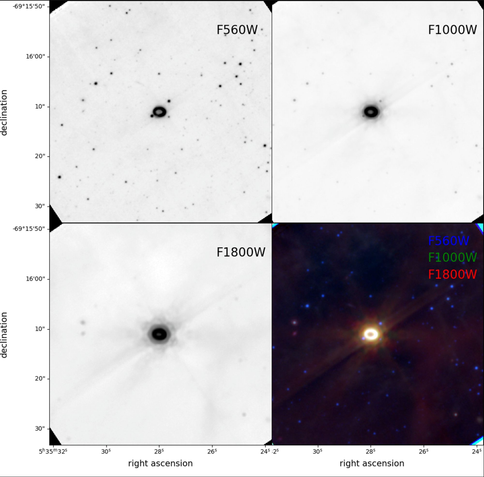
However, a secondary paper from a few days back, which also used JWST MIRI, found no evidence of the compact remnant in their data: https://arxiv.org/html/2402.14014v1
Almost 2 years ago I wrote a feature article looking at the evidence for this, so these new papers and findings are exciting!
https://www.spaceaustralia.com/feature/did-1987-supernova-produce-pulsar
📸 Fransson et al. / Bouchet et al.
#Supernova #Astrodon #Astrophysics #NeutronStar #Pulsar #SpaceAustralia #Science #SN1987A