DoomsdaysCW
Something I would love to know more about are the #ElusinianMysteries. But thanks to the cult's secrecy (and #Christianity), we may never know all the details...
Elusinian Mysteries
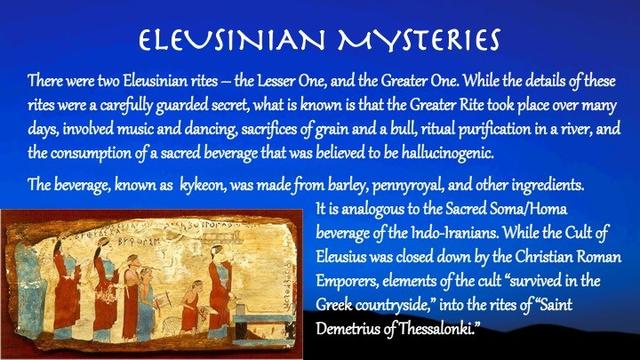
There were two Eleusinian rites – the Lesser One, and the Greater One. While the details of these rites were a carefully guarded secret, what is known is that the Greater Rite took place over many days, involved #music and #dancing, #sacrifices of grain and a bull, #ritual purification in a river, and the consumption of a #SacredBeverage that was believed to be #hallucinogenic.
The beverage, known as #kykeon, was made from #barley, #pennyroyal, and other ingredients.
It is analogous to the Sacred #Soma / #Homa beverage of the #IndoIranians. While the Cult of #Eleusius was closed down by the #Christian #RomanEmporers, elements of the cult “survived in the Greek countryside,” into the rites of “#SaintDemetrius of #Thessalonki.”
#Rituals #RomanHistory #MysteryCults #AncientHistory #Histodon #WomensRights #RomanWomen #RomanPriestesses