➡️ https://www.degruyterbrill.com/document/doi/10.1515/soeu-2025-0019/html #OpenAccess

La serie di alimentatori RACM15E-K #RECOM da 15W e ingresso da 80 a 275VAC è disponibile in versione open frame con connettori ‘Molex’, di 80 x 23.8 x 22 mm, e una versione con incapsulamento di grado IP20 per montaggio su telaio o su guida DIN e connessioni a pressione (PUSH IN) per il collegamento di cavi a trefoli o rigidi, di dimensioni 83 x 26.4 x 29.5 mm.
Leggi la notizia completa👉🏻 https://www.elettronica-tech.it/convertitori-ac-dc-da-15w-open-frame-e-guida-din/?utm_source=mastodon&utm_medium=Zoho+Social e registrati su #ElettronicaTECH per non perdere tutti gli aggiornamenti!
La serie di alimentatori RACM15E-K #RECOM da 15W e ingresso da 80 a 275VAC è disponibile in versione open frame con connettori ‘Molex’, di 80 x 23.8 x 22 mm, e una versione con incapsulamento di grado IP20 per montaggio su telaio o su guida DIN e connessioni a pressione (PUSH IN) per il collegamento di cavi a trefoli o rigidi, di dimensioni 83 x 26.4 x 29.5 mm.
Leggi la notizia completa👉🏻 https://www.elettronica-tech.it/convertitori-ac-dc-da-15w-open-frame-e-guida-din/?utm_source=mastodon&utm_medium=Zoho+Social e registrati su #ElettronicaTECH per non perdere tutti gli aggiornamenti!
La serie di alimentatori RACM15E-K #RECOM da 15W e ingresso da 80 a 275VAC è disponibile in versione open frame con connettori ‘Molex’, di 80 x 23.8 x 22 mm, e una versione con incapsulamento di grado IP20 per montaggio su telaio o su guida DIN e connessioni a pressione (PUSH IN) per il collegamento di cavi a trefoli o rigidi, di dimensioni 83 x 26.4 x 29.5 mm.
Leggi la notizia completa👉🏻 https://www.elettronica-tech.it/convertitori-ac-dc-da-15w-open-frame-e-guida-din/?utm_source=mastodon&utm_medium=Zoho+Social e registrati su #ElettronicaTECH per non perdere tutti gli aggiornamenti!
La serie di alimentatori RACM15E-K #RECOM da 15W e ingresso da 80 a 275VAC è disponibile in versione open frame con connettori ‘Molex’, di 80 x 23.8 x 22 mm, e una versione con incapsulamento di grado IP20 per montaggio su telaio o su guida DIN e connessioni a pressione (PUSH IN) per il collegamento di cavi a trefoli o rigidi, di dimensioni 83 x 26.4 x 29.5 mm.
Leggi la notizia completa👉🏻 https://www.elettronica-tech.it/convertitori-ac-dc-da-15w-open-frame-e-guida-din/?utm_source=mastodon&utm_medium=Zoho+Social e registrati su #ElettronicaTECH per non perdere tutti gli aggiornamenti!
Come and do a #PhD with us on understanding effects of changing #freshwater forcing on the #SouthernOcean #carbon cycle, apply by 14 August, with Christoph Völker, @AlexHaumann and a few more.
jobs.awi.de/Vacancies/1416…
#EarthSystemModelling #MarESys #HighResolution #FESOM #REcoM
@ClnHz
Cool, and the global modeling at @awi is moving in the same direction.
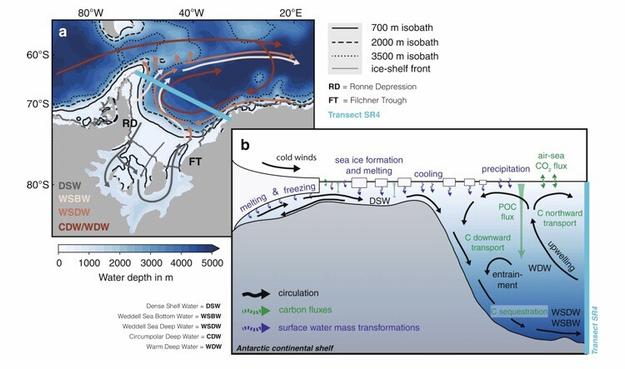
Some shameless shelf promotion on #AABW formation in high-res modeling of the Weddell Sea shelves (in a global model) with Ralph Timmermann‘s cavity code and biogeochemistry #REcoM
Cara Nissen et al. https://doi.org/10.1038/s41467-022-30671-3
@ktoddbrown of course, we are going through the same process with ocean biogoechemistry/ecosystem model #REcoM and have done progress on simulating CO2 effects on phytoplankton in collab with plankton physiologists.
https://doi.org/10.1525/elementa.2021.00104
For some processes we are still limited by experimentally robust data (multiple drivers), but others can be done or at least much improved when setting them as priorities and with sufficient resources.
Atmospheric and oceanic CO2 concentrations are rising at an unprecedented rate. Laboratory studies indicate a positive effect of rising CO2 on phytoplankton growth until an optimum is reached, after which the negative impact of accompanying acidification dominates. Here, we implemented carbonate system sensitivities of phytoplankton growth into our global biogeochemical model FESOM-REcoM and accounted explicitly for coccolithophores as the group most sensitive to CO2. In idealized simulations in which solely the atmospheric CO2 mixing ratio was modified, changes in competitive fitness and biomass are not only caused by the direct effects of CO2, but also by indirect effects via nutrient and light limitation as well as grazing. These cascading effects can both amplify or dampen phytoplankton responses to changing ocean pCO2 levels. For example, coccolithophore growth is negatively affected both directly by future pCO2 and indirectly by changes in light limitation, but these effects are compensated by a weakened nutrient limitation resulting from the decrease in small-phytoplankton biomass. In the Southern Ocean, future pCO2 decreases small-phytoplankton biomass and hereby the preferred prey of zooplankton, which reduces the grazing pressure on diatoms and allows them to proliferate more strongly. In simulations that encompass CO2-driven warming and acidification, our model reveals that recent observed changes in North Atlantic coccolithophore biomass are driven primarily by warming and not by CO2. Our results highlight that CO2 can change the effects of other environmental drivers on phytoplankton growth, and that cascading effects may play an important role in projections of future net primary production.
#Carbon dioxide sink in the #Arctic Ocean from cross-shelf transport of #dense Barents Sea water
https://doi.org/10.1038/s41561-022-01069-z
New paper led by Andreas Rogge, with contributions from the group #MarESys #FESOM #REcoM #AWI (@laurentoziel)
Nice combination of field work and modelling. 👏 👏