 WPS News
Proxima Centauri b: The Nearest Potentially Habitable World Beyond Our Solar System
By Cliff Potts, CSO, and Editor-in-Chief of WPS News
Baybay City, Leyte, Philippines — March 31, 2026
The search for worlds beyond our solar system has moved rapidly from speculation to measurable science in the past three decades. Thousands of exoplanets have now been confirmed by astronomers. Among them, one world has attracted particular attention because of its proximity to Earth: Proxima Centauri b.
Located just over four light-years away, Proxima Centauri b is the closest known planet outside our solar system that is roughly comparable in size to Earth. Its location in the habitable zone of its parent star makes it one of the most studied nearby planetary candidates in modern astronomy.
Discovery of a Nearby World
Proxima Centauri b was announced in 2016 after an international team of astronomers conducted detailed observations of Proxima Centauri, the nearest star to the Sun. The discovery came through a method known as the radial velocity technique, which detects tiny movements in a star caused by the gravitational pull of an orbiting planet (Anglada-Escudé et al., 2016).
As the planet circles its star, the star itself shifts slightly back and forth. By measuring these small spectral shifts with extremely sensitive instruments, astronomers can infer the presence of a planet even when the planet itself cannot be directly seen.
From these observations, scientists determined that Proxima Centauri b has a minimum mass about 1.3 times that of Earth, indicating it is likely a rocky terrestrial planet rather than a gas giant.
Orbit and Environment
The planet orbits Proxima Centauri at a distance far closer than Earth’s distance from the Sun. One complete orbit takes approximately 11.2 Earth days.
Normally such proximity would result in extremely high temperatures. However, Proxima Centauri is a red dwarf star, much cooler and dimmer than the Sun. Because of its lower energy output, the region where temperatures may allow liquid water—the so-called habitable zone—lies very close to the star.
This placement raises the possibility that surface temperatures could allow liquid water under the right atmospheric conditions.
The Challenge of Red Dwarf Stars
Despite its promising location, the environment around Proxima Centauri may be hostile.
Red dwarf stars are known for frequent and powerful stellar flares, which release bursts of radiation and charged particles. Proxima Centauri is considered particularly active, producing flares capable of affecting nearby planets (Howard et al., 2018).
If Proxima Centauri b lacks a strong magnetic field or dense atmosphere, these flares could strip away atmospheric gases over time.
Another likely characteristic is tidal locking. Because the planet orbits so closely, gravitational forces may cause one hemisphere to permanently face the star while the other remains in constant darkness. Climate simulations suggest that if the planet retains an atmosphere or oceans, heat circulation could moderate these temperature extremes.
A Target for Future Research
Because Proxima Centauri b lies in our stellar neighborhood, it has become one of the most important targets for future astronomical observation.
Next-generation telescopes may be able to analyze the planet’s atmosphere by studying light that passes through or reflects from it. These techniques could reveal gases such as water vapor, carbon dioxide, or oxygen, offering clues about planetary conditions.
More ambitious proposals, including the Breakthrough Starshot initiative, have suggested sending extremely small robotic probes propelled by laser-driven sails toward the Proxima Centauri system. Traveling at a fraction of the speed of light, such probes could theoretically reach the system within several decades (Parkin, 2018).
While such missions remain conceptual, they illustrate the importance of this nearby planetary system.
A Neighbor in the Cosmic Backyard
For centuries, humanity’s understanding of planets beyond the solar system remained theoretical. The discovery of Proxima Centauri b demonstrates that Earth-sized planets may exist even around the nearest stars.
Whether the planet ultimately proves to have a stable atmosphere, liquid water, or conditions entirely unlike Earth, its proximity makes it one of the most valuable laboratories for studying planetary formation and habitability beyond our solar system.
As astronomical instruments continue to improve, Proxima Centauri b will likely remain at the center of scientific efforts to understand how common potentially habitable worlds may be in the galaxy.
For more social commentary, please see Occupy 2.5 at https://Occupy25.com
References
Anglada-Escudé, G., Amado, P. J., Barnes, J., et al. (2016). A terrestrial planet candidate in a temperate orbit around Proxima Centauri. Nature, 536(7617), 437–440. https://doi.org/10.1038/nature19106
Howard, W. S., Tilley, M. A., Corbett, H., et al. (2018). The first naked-eye superflare detected from Proxima Centauri. The Astrophysical Journal Letters, 860(2), L30. https://doi.org/10.3847/2041-8213/aacaf3
Parkin, K. L. G. (2018). The breakthrough starshot system model. Acta Astronautica, 152, 370–384. https://doi.org/10.1016/j.actaastro.2018.08.008
#astronomy #astrophysics #exoplanets #nearbyStars #planetaryHabitability #ProximaCentauriB #spaceScience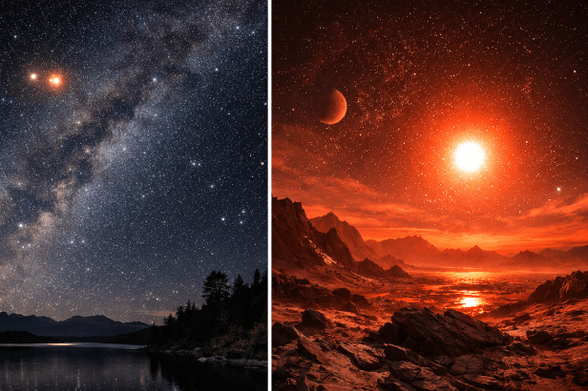
 Agnieszka Serafinowicz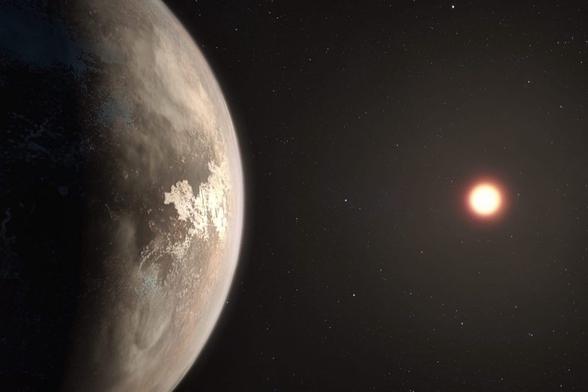
 Scienza et Magia
 Matt Willemsen
 Frédéric Véron
 Soh Kam Yung