#PrideFacts2026 Day 4

On April 2, 1974, Kathy Kozachenko — a 21 year old college student at the University of Michigan — became the first openly LGBTQ to be elected to public office in the United States. She was elected to the City Council of Ann Arbor, Michigan, three years before Harvey Milk’s successful run.

She was a member of the Human Rights Party. When she ran her campaign, the HRP had previously won two council seats. Both them — Nancy Wechsler and Jerry DeGrieck — came out during their first and only terms on the city council, thus becoming the first openly LGBT public-office holders in the United States. But neither had run for office as an openly lesbian/gay individual.

"My being a lesbian was not a huge campaign issue. The student body was very accepting at the time and to be an activist and an out-lesbian was seen as a positive. Not by everyone, of course. One evening I was canvassing in a dorm, and I went into the room of a young man, He told me he was a devout Christian and homosexuality was not accepted in his religion. Then he said, 'But God works in mysterious ways and I’m going to vote for you.'"

"The second year I was on council, I was the swing vote, and I negotiated a city budget that increased funding for social service programs. This was a rare occasion. For the most part, my vote was taken for granted and my opinion was not sought on anything.

"Ultimately, I chose not to run for reelection–I felt city council wasn’t the best place to use my voice for change. I also wanted to live in a more working-class city, rather than a college town. In 1978, I moved to Pittsburgh and have lived here for over 40 years."

She continued to be an activist in Pittsburgh, helping to organize the first march on Washington for lesbian and gay rights. She has continued to campaign for various candidates, be active in organizations, and stand for the rights of everyone.

You can read more about her, in her own words, here: https://www.nlc.org/article/2024/06/25/pride-month-spotlighting-the-first-openly-lgbtq-elected-official-in-u-s-history/

#Pride #Pride2026 #PrideMonth

Pride Month: Spotlighting the First Openly LGBTQ Elected Official in U.S. History

By Kathy Kozachenko, Former Councilmember, Ann Arbor, MI My name is Kathy Kozachenko, and this is my story – or at least part of it. Fifty years ago, I was a 21-year-old woman full of idealism and a…

National League of Cities

#PrideFacts2026 Day 3

TIL about Episcopal priest and gay rights activist Clinton Robert Jones, Jr. He was born November 8, 1916 and died on this day in 2006.In the 1960s Jones was appointed to the Rehabilitation Committee for the Greater Hartford Council of Churches, where he became interested in the issues faced by homosexuals in his area. In 1963 he, along with two others, started Project H to focus on gay Christians in the area. He would provide counseling and other support to gay men and transgender persons from then until his retirement in 1986.

Through Project H, he convened meetings of social workers, psychologists, and clergy at the Hartford YMCA, laying the groundwork for the Kalos Society — the state's first LGBTQ political advocacy organization — founded in 1968. He also established a Hartford chapter of the George H. Henry Foundation and worked to ensure that those seeking his counsel could do so discreetly, with a private phone line and a separate office entrance. When he learned that Connecticut's Department of Corrections had segregated gay and transgender inmates into a separate "Block G" and was treating them worse than other prisoners, Jones negotiated directly with the warden in an attempt to dissolve it. Though unsuccessful, he secured the ability to provide counseling to Block G inmates — a practice he continued until his retirement in 1986.

Jones also built several lasting support structures for the community over the following decades. In the late 1960s he founded the Married Gay Men's Group of Hartford, and in 1971 co-founded the Twenty-One Club, which provided counseling and psychiatric services primarily to transgender individuals and met at his church for thirty years. Later in the 1970s he established the Gender Identity Clinic of New England, connecting transgender patients to affirming mental health care, hormone therapy, and gender-affirming surgery. He also educated Hartford's police on transgender issues and testified before an Episcopal commission examining gay rights within the church.

When Jones retired in 1986, Project H quietly disbanded — by then, the network of LGBTQ organizations it had helped inspire had largely made it obsolete.

#Pride #Pride2026 #PrideMonth

While I did post my #PrideFacts2026 at work yesterday, didn't get around to posting it here. So today's a two-for to catch up.

#PrideFacts2026 Day 2

Society for Human Rights was the first officially documented gay rights organization in the US. Founded in Chicago in Henry Gerber, with African American clergyman John T. Graves as president and five others making up the board of directors. Despite deliberately keeping the goals of the Society vague and excluding any mention of homosexuality from its mission statement, Society members were still surprised that no one with the state investigated any further before issuing the charter on December 24, 1924.

Gerber had served in Germany in World War I. There he became familiar with the thriving gay subculture in Germany, as well as organizations that were working to fight for the rights of gay men. This is what inspired him to form the Society upon his return to the US.

What’s interesting to me is, this is exactly what happened with many African American soldiers during the World Wars. Many organized and began pushing for equality after their experiences in Europe.

From Wikipedia:
"The society's newsletter, Friendship and Freedom, was the first gay-interest publication in the United States. However, few Society members were willing to receive mailings of the newsletter, fearing that postal inspectors would deem the publication obscene under the Comstock Act. Indeed, all gay-interest publications were deemed obscene until 1958, when the Supreme Court ruled in One, Inc, v Olseen that publishing homosexual content did not mean the content was automatically obscene.Two issues of Friendship and Freedom were written and produced, entirely by Gerber. No copies of the newsletter are known to exist.


"Gerber set out to expand the Society's membership beyond the original seven but had difficulty interesting anyone other than poorer gays in joining; he was also unable to gain any financial support from the more affluent members of Chicago's gay community. Gerber sought out the support of people in the medical professions and sex education advocates and was frustrated when he was unable to secure it, because of their fear of ruining their reputations through the association with homosexuality. Contemplating this failure in 1962, Gerber stated,

"'The first difficulty was in rounding up enough members and contributors so the work could go forward. The average homosexual, I found, was ignorant concerning himself. Others were fearful. Still others were frantic or depraved. Some were blasé. Many homosexuals told me that their search for forbidden fruit was the real spice of life. With this argument, they rejected our aims. We wondered how we could accomplish anything with such resistance from our own people.'"

The police illegally arrested Gerber and other board members in the summer of 1925. He endured three trials, but was released because he had been arrested without a warrant. When the police raided his home they also brought a reporter along, who wrote about the Society and also just made up lurid details of things that never happened. Even though he eventually prevailed in court, Gerber lost his life savings in the process.

After moving to New York, he kept up correspondence with other gay men around the country, talking about organizing and strategies. Gerber would live until 1972, when he died aged 80. He lived to form the first official gay rights organization, saw some lays changes, and would have been alive for Stonewall Riots and the beginning of Pride Marches.

#Pride #Pride2026 #Pridemonth
#PrideFacts2026 Day 1 Addendum

I did not post this at work, but in the interview with Victoria Cruz in 2020, they asked her, "What do you think of the Trump administration?"

Her response:

"That draft dodger who uses the excuse of heel spurs? If Marsha and Sylvia were around today, Marsha would ask what kind of heels he had been wearing. He’s a liar. The Russians have got something on him."

I love her

https://en.wikipedia.org/wiki/Victoria_Cruz

#Pride #Pridemonth

Victoria Cruz - Wikipedia

#PrideFacts2026 Day 1

Though it was officially recognized in 1999 as “Gay and Lesbian Pride Month” in 1999 by President Clinton, and expanded to LGBT by President Obama in 2011, Pride celebrations go much further back.

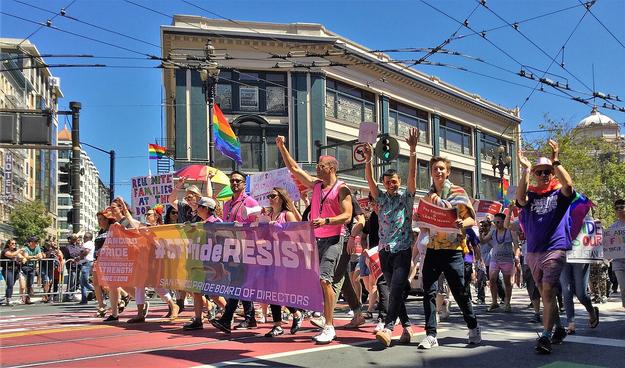
In 1970 — the year after the Stonewall Riots — a mach was organized to recognize the riots and push for further liberation. Similar marches were coordinated in Los Angeles, Chicago, and San Francisco. Victoria Cruz - a trans LGBTQ and anti-violence activist and retired domestic violence counselor — was at both the Stonewall Riot both nights, and at the first Pride March. In a 2020 interview she remembered what it was like:

"I remember at first around 50 people gathering at Bleecker and Christopher Streets. Then we marched up Sixth Avenue. They gave us half the street, and we marched all the way up to Central Park. As we were marching, more and more people joined the parade. We got to Central Park. It was like a spectacle. We were so happy, free, and liberated. It was a different feeling. Nobody was ashamed to be out and be themselves. It was just an uplifting feeling of freedom."

To learn more:

- Wikipedia has a pretty good overview: https://en.wikipedia.org/wiki/Pride_Month

- You can find interview is participants in the first marches here: https://www.sageusa.org/news/they-marched-in-americas-first-pride-demonstrations-in-1970-theyre-still-out-loud-and-proud/

#Pride #Pridemonth

Pride Month - Wikipedia

Happy #Pride!

At a previous job I used to post a fact of the day in Slack. I've done it periodically since. I've decided to pick up the daily habit again this month, all focused on #Pridemonth

I'll try to remember to add them to this thread to keep it somewhat organized.

#PrideFacts2026