
Donald Trump’s Kennedy Center is showier, emptier and more political – The Washington Post

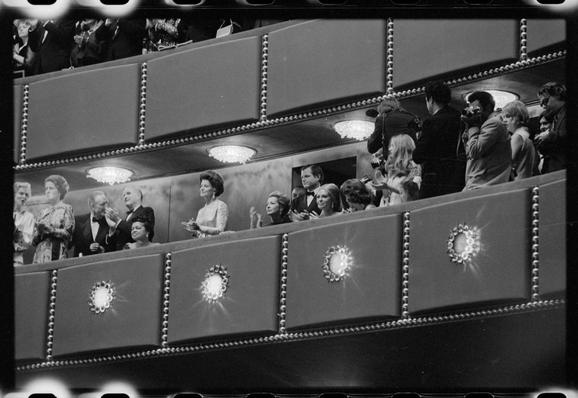
At the gala opening of the Kennedy Center in 1971, Kennedy family members sit in the presidential box. (Thomas J. O’Halloran / Library of Congress)

Donald Trump’s Kennedy Center is showier, emptier and more political

In 10 months, the president has transformed Washington’s cultural hub. Now comes his biggest night yet: the Kennedy Center Honors.

Updated today at 12:48 p.m. EST, 16 min
By Travis M. Andrews and Janay Kingsberry

On the day in February that President Donald Trump took over the John F. Kennedy Center for the Performing Arts, his new board ousted Deborah Rutter, the longtime president of the institution. She gathered her staff to offer a hopeful farewell. That evening, she welcomed other leaders to her home to mourn.

“As with any wake, you drink a little too much, and you tell stories, and you laugh, and you cry,” Rutter told The Washington Post in a conversation in the spring.

Rutter had planned to step down at the end of 2025 after leading the Kennedy Center through a decade in which it had diversified its offerings, endured the 2020 lockdown and emerged to boast robust ticket sales and, according to publicly available tax filings, steadily grown revenue.

She still had four major items on her to-do list: growing the center’s endowment; furthering its work as an arts educator around the country; strengthening the financials of the National Symphony Orchestra; and renewing the contract with CBS or finding a new broadcast partner to air the Kennedy Center Honors.

Those plans died. But the Kennedy Center did not.

The center is now guided by a board of Trump loyalists and a new staff including the center’s president, Richard Grenell, a pugnacious veteran of the first Trump administration. They have terminated much of the former staff, lambasted the former leadership and made changes including the addition of high-wattage events like the World Cup draw. They have embarked on a $257 million renovation, in line with Trump’s broader effort to leave his mark on Washington’s cityscape. They’ve boasted about hefty fundraising.

Now, nearly 10 months in, a picture of a transformed institution has come into view. Standbys of the Kennedy Center’s stages like the National Symphony Orchestra have been strained by plummeting ticket sales and organizational uncertainty. Traveling productions and acts have pulled out. And a new kind of right-leaning programming has begun to take root.

So what is the Kennedy Center now?

For one thing, it’s getting a Trumpian revamp. He ordered new marble and the repainting of the exterior columns in austere white. Portraits of the first and second couples now hang in the center’s Hall of Nations, and the building exterior is occasionally lit up in red, white and blue (a move that, many staffers joke, makes the building look like the flag of France, not America).

“It was in rough shape,” Trump said at an event Saturday ahead of the Kennedy Center Honors. “But we’ve fixed the White House, and we’ve fixed the Kennedy Center.”

Even the medallions for the Honors, created by Ivan Chermayeff and made for nearly 50 years by a D.C.-area family, have been redesigned by Tiffany & Company.

And — wittingly or not — the new leadership has made the center a political football for the first time since its opening in 1971. House Republicans have suggested renaming it for Trump (the whole building) and the first lady (just the Opera House). Conservative groups have flocked there to host conferences and meetings. Senate Democrats are investigating the Kennedy Center, accusing Grenell of “self-dealing, favoritism, and waste,” which he has denied.

Editor’s Note: Read the rest of the story, at the below link.

Continue/Read Original Article Here: Donald Trump’s Kennedy Center is showier, emptier and more political – The Washington Post

#1971 #DonaldTrumpSKennedyCenter #Emptier #FiredBoard #History #JFK #KennedyCenterHonors #MorePolitical #PresidentJohnson #Takeover #TicketSalesDown #TrumpSKennedyCenter


Letters from an American – August 5, 2025 – Heather Cox Richardson

Letters from an American, August 5, 2025 (Tuesday)

By Heather Cox Richardson, Aug 05, 2025

Sixty years ago tomorrow, on August 6, 1965, President Lyndon B. Johnson signed the Voting Rights Act. The need for the law was explained in its full title: “An Act to enforce the fifteenth amendment to the Constitution, and for other purposes.”

In the wake of the Civil War, Americans tried to create a new nation in which the law treated Black men and white men as equals. In 1865 they ratified the Thirteenth Amendment to the Constitution, outlawing enslavement except as punishment for crimes. In 1868 they adjusted the Constitution again, guaranteeing that anyone born or naturalized in the United States—except certain Indigenous Americans—was a citizen, opening up suffrage to Black men. In 1870, after Georgia legislators expelled their newly seated Black colleagues, Americans defended the right of Black men to vote by adding that right to the Constitution.

All three of those amendments—the Thirteenth, Fourteenth, and Fifteenth—gave Congress the power to enforce them. In 1870, Congress established the Department of Justice to do just that. Reactionary white southerners had been using state laws, and the unwillingness of state judges and juries to protect Black Americans from white gangs and cheating employers, to keep Black people subservient. White men organized as the Ku Klux Klan to terrorize Black men and to keep them and their white allies from voting to change that system. In 1870 the federal government stepped in to protect Black rights and prosecute members of the Ku Klux Klan.

With federal power now behind the Constitutional protection of equality, threatening jail for those who violated the law, white opponents of Black voting changed their argument against it.

In 1871 they began to say that they had no problem with Black men voting on racial grounds; their objection to Black voting was that Black men, just out of enslavement, were poor and uneducated. They were voting for lawmakers who promised them public services like roads and schools, and which could only be paid for with tax levies.

The idea that Black voters were socialists—they actually used that term in 1871—meant that white northerners who had fought to replace the hierarchical society of the Old South with a society based on equality began to change their tune. They looked the other way as white men kept Black men from voting, first with terrorism and then with grandfather clauses that cut out Black men without mentioning race by permitting a man to vote if his grandfather had, literacy tests in which white registrars got to decide who passed, poll taxes, and so on. States also cut up districts unevenly to favor the Democrats, who ran an all-white, segregationist party. By 1880 the South was solidly Democratic, and it would remain so until 1964.

Southern states always held elections: it was just foreordained that Democrats would win them.

Black Americans never accepted this state of affairs, but their opposition did not gain powerful national traction until after World War II.

During that war, Americans from all walks of life had turned out to defeat fascism, a government system based on the idea that some people are better than others. Americans defended democracy and, for all that Black Americans fought in segregated units, and that race riots broke out in cities across the country during the war years, and that the government interned Japanese Americans, lawmakers began to recognize that the nation could not effectively define itself as a democracy if Black and Brown people lived in substandard housing, received substandard educations, could not advance from menial jobs, and could not vote to change any of those circumstances.

Meanwhile, Black Americans and people of color who had fought for the nation overseas brought home their determination to be treated equally, especially as the financial collapse of European nations loosened their grip on their former African and Asian colonies and launched new nations.

Continue/Read Original Article Here: https://heathercoxrichardson.substack.com/p/august-5-2025-tuesday

August 5, 2025 (Tuesday) by Heather Cox Richardson

Read on Substack

#2025 #America #CivilWar #DonaldTrump #Education #HeatherCoxRichardson #History #LettersFromAnAmerican #Libraries #LibraryOfCongress #LyndonBJohnson #Politics #PresidentJohnson #Resistance #Science #Substack #Trump #TrumpAdministration #UnitedStates #VotingRightsAct

Passage: Remembering Bill Moyers – CBS Sunday Morning – June 29, 2025

https://www.youtube.com/watch?v=L55mGIYgtPo&ab_channel=CBSSundayMorning

Passage: Remembering Bill Moyers
CBS Sunday Morning

Jun 29, 2025
“Sunday Morning” host Lee Cowan looks back on the career of broadcast journalist Bill Moyers, who brought dignity and elegance to TV news, at CBS and on public television, for more than four decades, following years as a deputy director of the Peace Corps and a White House press secretary.

“CBS News Sunday Morning” features stories on the arts, music, nature, entertainment, sports, history, science and Americana, and highlights unique human accomplishments and achievements. Check local listings for “CBS News Sunday Morning” broadcast times.

Subscribe to the “CBS News Sunday Morning” YouTube channel: / cbssundaymorning
Get more of “CBS News Sunday Morning”: https://cbsnews.com/sunday-morning/
Follow “CBS News Sunday Morning” on Instagram: / cbssundaymorning
Like “CBS News Sunday Morning” on Facebook: / cbssundaymorning
Follow “CBS News Sunday Morning” on Twitter: / cbssunday
Subscribe to our newsletter: https://cbsnews.com/newsletters/
Download the CBS News app: https://www.cbsnews.com/mobile/
Try Paramount+ free: https://paramountplus.com/?ftag=PPM-0…

Read more: Passage: Remembering Bill Moyers – CBS Sunday Morning – June 29, 2025

Source Links: Passage: Remembering Bill Moyers – YouTube

#2025 #America #BillMoyers #Books #Broadcaster #CBS #CBSSundayMorning #History #Journalist #Politics #PresidentJohnson #PressSecretary #Television #UnitedStates #WhiteHouse #Writing #YouTube

Bill Moyers: A Lifetime Preserved at the Library of Congress – Library of Congress

Half portrait of Bill Moyers, smiling, turned slightly to the camera, smiling. He’s wearing a dark suit, a blue shirt and a red tie. Bill Moyers, the veteran television journalist, died on June 26. He was 91.

Home

Bill Moyers: A Lifetime Preserved at the Library of Congress

June 27, 2025, Posted by: Neely Tucker

Bill Moyers, who died yesterday at the age of 91, was at the Library’s Coolidge Auditorium one night  in the fall of 2023 to mark the preservation of more than 1,000 of his public television programs in The American Archive of Public Broadcasting, a collaboration between the Library and the Boston public media producer GBH.

His relationship with the Library went back to the summer of 1954, he told the packed auditorium, when he was a 19-year-old from a little town in Texas, in D.C. for a summer internship with U.S. Senator Lyndon Baines Johnson.


Mr. Moyers during CAMPAIGN 84 in 1984. (CBS Photo Archive / Getty Images)

On his first day, Johnson’s top aide took him to the Library’s Congressional Research Service as the place to do his background work for Johnson’s policies and work on Capitol Hill.

“I came over and I was shown what they do, it’s incredible,” Moyers told the crowd, 69 years later.  “All summer, I was much smarter than anyone knew I was because it was coming from the Congressional Research [Service] … I’ve been a fan of the research office and the process here and the Library all my life.”

The night was a crowning moment to one of the most influential careers in American media. The AAPB Bill Moyers collection preserves more than 50 years of his work, an invaluable look at American history as it was happening.

The collection “will allow viewers for generations to come to see what mattered to us over the years,” he told the Library, “and how we covered our times through the stories of contemporary democracy and its struggle to survive and thrive as well as the perceptions of many of our society’s foremost thinkers and creators.”

Moyers, born during the Depression in Hugo, Oklahoma, became an ordained Baptist minister and picked up a journalism degree from the University of Texas after his internship with Johnson. He worked for the Peace Corps and then returned to work for Johnson after he became president, eventually serving as his press secretary from 1965 to 1967.

Read more: Bill Moyers: A Lifetime Preserved at the Library of Congress – Library of CongressSource Links: Bill Moyers: A Lifetime Preserved at the Library of Congress | Timeless

#2025 #America #DonaldTrump #Health #History #Journalism #Libraries #Library #LibraryOfCongress #Politics #PresidentJohnson #PressSecretary #Resistance #Science #Trump #TrumpAdministration #UnitedStates

Bill Moyers, eminence of public affairs broadcasting, dies at 91 – The Washington Post

Bill Moyers in 1974. (AP)

Bill Moyers, eminence of public affairs broadcasting, dies at 91

He was White House press secretary under Lyndon B. Johnson and Newsday publisher before becoming an acclaimed television journalist, mostly for PBS.

June 26, 2025 at 3:57 p.m. EDT, Today at 3:57 p.m. EDT, 12 min
By Fred A. Bernstein

Bill Moyers, who served as chief White House spokesman for President Lyndon B. Johnson and then, for more than 40 years, as a broadcast journalist known for bringing ideas — both timely and timeless — to television, died June 26 at a hospital in Manhattan. He was 91.

The cause was complications from prostate cancer, said his son William Cope Moyers.

Long before he became a grandee of public television, the Texas-raised Mr. Moyers was a top aide and, by many accounts, a surrogate son to Johnson. The powerful Texas Democrat had given Mr. Moyers a summer job in his U.S. Senate office in 1954 when Mr. Moyers was in college.

Mr. Moyers arrived on Capitol Hill and, without even unpacking his bags, worked through the night addressing 275,000 envelopes using a foot-operated “addressograph” machine. By the end of the summer, he was handling Johnson’s personal correspondence.

Over the next 12 years, when he wasn’t studying or preaching — Mr. Moyers became an ordained Baptist minister in 1954 — he found his way to the highest levels of government. When Johnson was tapped in 1960 as the running mate of Sen. John F. Kennedy (D-Massachusetts), Mr. Moyers became the liaison between the Johnson and Kennedy camps. “I could interpret Boston to Austin,” he later told journalist Don Shelby.

After Kennedy was assassinated in 1963, Mr. Moyers, not yet 30, became one of President Lyndon B. Johnson’s lieutenants. Time magazine called him “LBJ’s young man in charge of everything.” He was named White House press secretary in July 1965.

Mr. Moyers relished his role in shaping Great Society programs to alleviate poverty and foster racial justice, but he grew rapidly disillusioned with Johnson’s escalation of the Vietnam War.

He left the White House in January 1967, in the middle of the president’s second term; Johnson, he said, never spoke to him again. According to Mimi Swartz, writing in Texas Monthly in 1989, “Johnson, who had at one time loved Moyers more than anyone else, punished him by pushing him further out of his life than anyone else.”

With a growing family to support, Mr. Moyers took a lucrative job as publisher of Newsday, the large-circulation Long Island newspaper. He tilted the paper leftward in its support of anti-war demonstrators, lured a stream of leading authors to write for its pages and led the newsroom to two Pulitzer Prizes. But his tenure was cut short in 1970 amid clashes with newspaper’s conservative owner.

Mr. Moyers accepts a George Foster Peabody Award in 2004. (Mary Altaffer / AP)White House press secretary Bill Moyers briefs reporters in 1966. (William J. Smith / AP)


Source Links: Bill Moyers, eminence of public affairs broadcasting, dies at 91 – The Washington Post

#1960s #2025 #America #Books #History #Libraries #LibraryOfCongress #Obituary #Opinion #Politics #PresidentJohnson #PressSecretary #Television #TheWashingtonPost #UnitedStates

Ewwwww. Gross!

Mike Johnson was technically US president for 'about 37 seconds' — here’s why
https://www.alternet.org/mike-johnson-vance-presidency/

#MikeJohnson #PresidentJohnson #NoRepublicansEverAgain #USPol

Mike Johnson was technically US president for 'about 37 seconds' — here’s why

Bossier City, Louisiana Mayor Tommy Chandler recently hosted a "Prayer Luncheon" where the guest speakers included Louisiana Supreme Court Justice Jay McCallum and House Speaker Mike Johnson (R-Louisiana). During his speech, Johnson humorously told attendees why, for "about 37 seconds," he was techn...

Alternet.org

Song of the Day April 11 2024

In commemoration of the 56th Anniversary of President Johnson signing of the Civil Rights Act of 1968 aka The Fair Housing Act

https://en.wikipedia.org/wiki/Civil_Rights_Act_of_1968

President Lyndon Johnson - Remarks on Signing the Civil Rights Act of 1968

https://youtu.be/Q11kvbJy0cs?si=zVpogIMxRROUyr4h

#SongOfTheDay #SOTD #SOTD2024 #April11 #PresidentJohnson #CivilRightsAct #FairHousingAct #1968 #BlackHistory #AmericanHistory #LyndonBainesJohnson #LBJ #CivilRightsAct #Justice #FairHousing #MartinLutherKing

Civil Rights Act of 1968 - Wikipedia

Song of the Day April 11 2024

In commemoration of the 56th Anniversary of President Johnson signing of the Civil Rights Act of 1968 aka The Fair Housing Act

https://en.wikipedia.org/wiki/Civil_Rights_Act_of_1968

President Lyndon Johnson - Remarks on Signing the Civil Rights Act of 1968

https://youtu.be/Q11kvbJy0cs?si=zVpogIMxRROUyr4h

#SongOfTheDay #SOTD #SOTD2024 #April11 #PresidentJohnson #CivilRightsAct #FairHousingAct #1968 #BlackHistory #AmericanHistory #LyndonBainesJohnson #LBJ #CivilRightsAct #Justice #FairHousing #MartinLutherKing

Civil Rights Act of 1968 - Wikipedia

Elizabeth Hope Wyatt on Twitter

“#GeneralConference #PresidentJohnson”

Twitter