Structural and functional impairments of skeletal muscle in patients with postacute sequelae of SARS-CoV-2 infection | List of publications using Artinis Near Infrared Spectroscopy devices
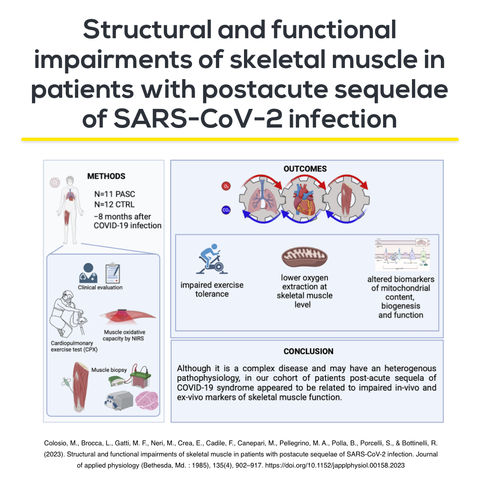
Several months after mild acute SARS-CoV-2 infection, a substantial proportion of patients present persisting, and often debilitating, symptoms and sequelae. These patients show reduced quality of life due to exercise intolerance, muscle weakness, and fatigue. The present study supports the hypothesis that “peripheral” impairments at skeletal muscle level, namely, reduced mitochondrial function and markers of mitochondrial biogenesis, are major determinants of exercise intolerance and fatigue, “central” phenomena at respiratory, and cardiac level being less relevant. , Following acute coronavirus disease 2019 (COVID-19), a substantial proportion of patients showed symptoms and sequelae for several months, namely the postacute sequelae of COVID-19 (PASC) syndrome. Major phenomena are exercise intolerance, muscle weakness, and fatigue. We aimed to investigate the physiopathology of exercise intolerance in patients with PASC syndrome by structural and functional analyses of skeletal muscle. At least 3 mo after infection, nonhospitalized patients with PASC ( n = 11, age: 54 ± 11 yr; PASC) and patients without long-term symptoms ( n = 12, age: 49 ± 9 yr; CTRL) visited the laboratory on four nonconsecutive days. Spirometry, lung diffusion capacity, and quality of life were assessed at rest. A cardiopulmonary incremental exercise test was performed. Oxygen consumption (V̇o 2 ) kinetics were determined by moderate-intensity exercises. Muscle oxidative capacity ( k) was assessed by near-infrared spectroscopy. Histochemical analysis, O 2 flux ( JO 2 ) by high-resolution respirometry, and quantification of key molecular markers of mitochondrial biogenesis and dynamics were performed in vastus lateralis biopsies. Pulmonary and cardiac functions were within normal range in all patients. V̇o 2peak was lower in PASC than CTRL (24.7 ± 5.0 vs. 32.9 ± 7.4 mL·min −1 ·kg −1 , respectively, P textless 0.05). V̇o 2 kinetics was slower in PASC than CTRL (41 ± 12 vs. 30 ± 9 s −1 , P textless 0.05). k was lower in PASC than CTRL (1.54 ± 0.49 vs. 2.07 ± 0.51 min −1 , P textless 0.05). Citrate synthase, peroxisome proliferator-activated receptor-γ coactivator (PGC)1α, and JO 2 for mitochondrial complex II were significantly lower in PASC vs. CTRL (all P values textless0.05). In our cohort of patients with PASC, we showed limited exercise tolerance mainly due to “peripheral” determinants. Substantial reductions were observed for biomarkers of mitochondrial function, content, and biogenesis. PASC syndrome, therefore, appears to negatively impact skeletal muscle function, although the disease is a heterogeneous condition. NEW & NOTEWORTHY Several months after mild acute SARS-CoV-2 infection, a substantial proportion of patients present persisting, and often debilitating, symptoms and sequelae. These patients show reduced quality of life due to exercise intolerance, muscle weakness, and fatigue. The present study supports the hypothesis that “peripheral” impairments at skeletal muscle level, namely, reduced mitochondrial function and markers of mitochondrial biogenesis, are major determinants of exercise intolerance and fatigue, “central” phenomena at respiratory, and cardiac level being less relevant.
 Artinis NIRS