 Modern Cryptozoology
The Tragedy of the Cryptids
Why are many cryptid tales associated with tragedy? Or, why are certain tragedies linked to cryptids? Some might say a cryptid is a curse, but it more likely is a symbol of the things we fear or about which we are anxious or guilty. There are plenty of examples.
Blaming the cryptid
It was Christmas, 2024. Two Oregon men “failed to return from a trip to look for Sasquatch” in the Gifford Pinchot Forest in Washington, authorities said. Rescuers spent Christmas facing dangerous conditions during the search until the men were found deceased. From the news reports, the two apparently were not equipped for the cold and wet weather.
It was never made clear if they were on a Bigfoot hunting excursion or just out for a short Holiday hike. The Bigfoot connection may have just been a flippant comment they made regarding their trip, or perhaps they were cryptid enthusiasts who hoped to glimpse the creature in an area with reported encounters. The unfortunate outcome was subsequently linked with the cryptid, often in headlines, which seemed to be out of proportion, as if belief in Bigfoot was the cause of death. Several commenters on the news stories, unsurprisingly, were cruel, mocking the men based on speculation about their behavior. Worse than that, some people took the tragedy even farther by saying that the men didn’t die from exposure, but from some other cause that officials are covering up. This is one of several examples of cryptids connected to tragedy.
There are various examples of cryptids associated with curses, death or destruction. This is unsurprising considering that cryptids are legends, and legends often have morbid twists as part of the drama. But the more surprising cryptid connections occur when the creature is celebrated in spite of or as part of the tragedy. The primary examples of these are stark: Mothman and the Pope Lick Monster. As noted in previous posts in this series, Mothman is the enigmatic, winged humanoid and the Pope Lick Monster is a Goatman. Let’s start with the cursed, evil, but maybe useful, highly-celebrated, harbinger of doom: Mothman.
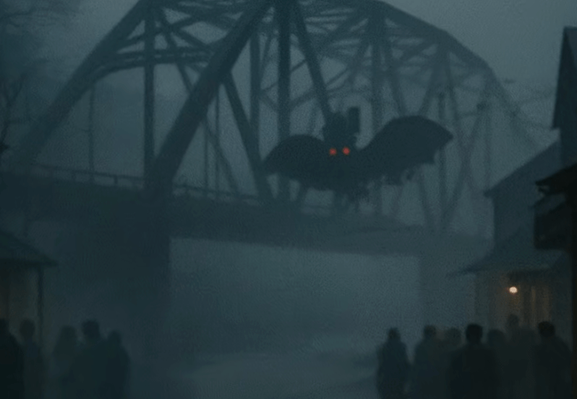
AI art screengrabbed from a bad TikTok. (Not sorry.)Mothman and the Silver Bridge
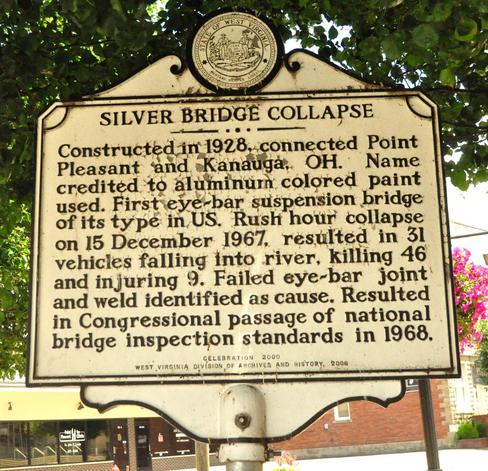
On December 15, 1967, the Silver Bridge across the Ohio River, connecting Point Pleasant, WV to Gallipolis, OH collapsed. Most people know this terrible story: rush hour, forty-six people perished as their cars plunged into the icy water. The official investigation pegged the eye-bar failure. Lack of engineering redundancy meant the structure failed with it. However, the legend evolved to either blame the Mothman or its curse, or credit the creature as a warning of approaching doom.
Many people also know that the Mothman Festival is a big deal, drawing over 10,000 vistors to the small town every year to celebrate the big bird-moth-like being. How did we get from such heart-breaking tragedy to a giant town party with cosplayers and a shiny fantastical statue in the center square?
In 2008, Joseph Laycock, a scholar of religious studies, and sometimes of monsters, wrote about the weird acceptance by Point Pleasant of a legend that caused the town such pain and gave it a dark reputation. (Cite: Fieldwork in Religion, 3.1, 2008) To start, we must consider the context of the town of Point Pleasant.
So frequently, cryptid tales are backdated to the time when white settlers encountered the indigenous peoples. (That’s it’s own tragic tale – the lands haunted by Mothman and many other cryptids belonged to indigenous people who often were misappropriated by a manufactured legend, or erased entirely.) During the Revolutionary War times, a battle between the Virginians and the natives resulted in the death of the Shawnee Chief Cornstalk, who was murdered as a result of a diplomatic mission to Fort Randolph. Legend is that he cursed the land. Eventually, Cornstalk and Mothman legends were associated.
Prior to the bridge tragedy, the town suffered an economic downturn, flooding events, and a nearby mining disaster.
In the “Year of the Garuda” as labeled by The Mothman Prophecies author John Keel, the town was plagued by not only the monster, but by UFO sightings and the appearance of strangers, dubbed Men In Black by Keel. The MIB reportedly intimidated, threatened, robbed and assaulted the locals. If you lived in Point Pleasant at this time, you may have been threatened more by the UFO reports than the “monster”. Newspaper reporting leans much less on the “Big Bird” and more on the rash of UFO claims during this time. Keel’s book, from 1972, reframed the Mothman-UFO flap as a time and place of “high strangeness” with the Mothman as the star. (Cite: Dr. Jeb Card, personal comm.) [Addition: Corroborated by Richard Estep who said locals did not connect the bridge disaster to the “Big Black Bird” at the time, either. See MonsterTalk.]
With the collapse of the Bridge, the Mothman essentially disappeared from sight. The community, left in shock, tried to make sense of the disaster. Laycock notes that Mothman would have remained “a local demon” if the bridge collapse didn’t happen. But the association propelled Mothman from a mysterious menace to a supernatural death messenger – like that of the Irish Banshee. Mothman perhaps helped to fill in the vacuum of meaning felt by the residents as they struggled to move past the disaster.
In later decades, Mothman moved from being a threat to being a symbol of the town’s identity – its “monstrous patron”. While the Mothman now has a gleaming anthropomorphic statue in a prominent location in town, and its own museum, festival, and traditions, the people who died at the Silver Bridge are less commemorated. The bridge event was situated in service to the Mothman, who became the spirit of the town. With a boost from the 2002 film that rejuvenated the tale, and the growing embrace of Pop Cryptids nationwide, Point Pleasant treated the winged monster much like a religious icon that was viewed with sacred meaning. Mothman symbolized events that shook their town beyond their control.
I would gladly become a monstrous patron of a capable scholar who could write the definitive bio of Mothman and his impact – it’s crazy stuff.
Pope Lick Monster
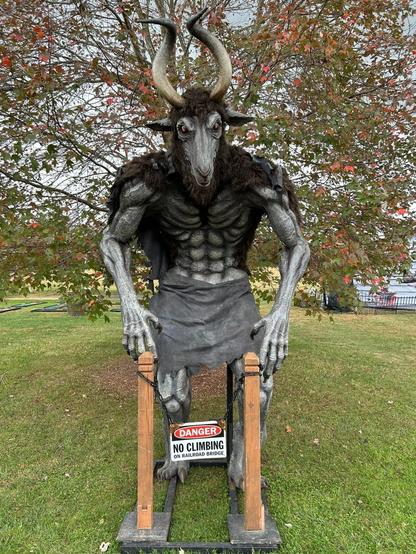
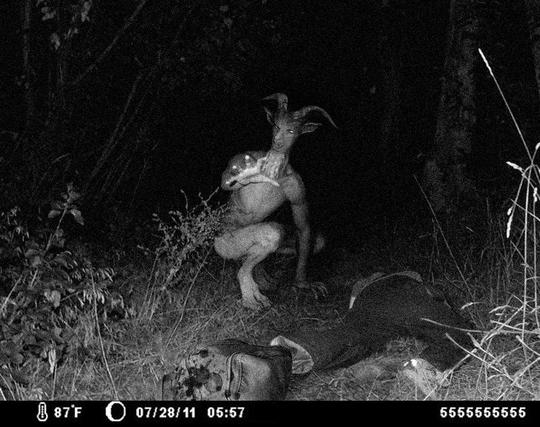
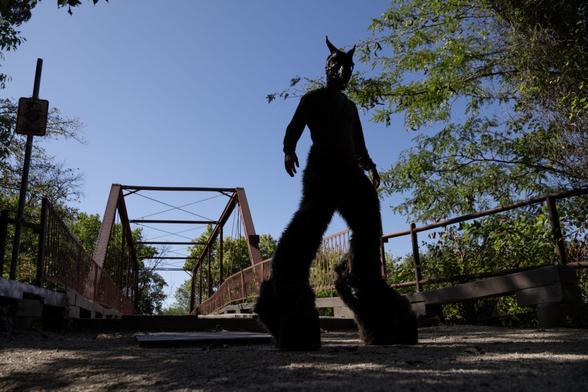
The Fisherville area of Louisville, Kentucky, location of the train trestle associated with the Pope Lick monster, has a love/hate relationship with the infamous goatman. Legend tripping teens and tourists bypass the fences and warnings in an attempting to traverse the active train trestle bridge (which is 90 feet high and 772 long) to have their own experience. I could not get an accurate count of the dead, but, since 1968, it appears that at least 10 people have been killed by trains crossing the bridge or falling from the bridge to avoid a train. Several more were injured or nearly killed.
As with Mothman, a film boosted the legend. The 1988 short film The Legend of the Pope Lick Monster by local Ron Schildknecht put it into an easily relatable package, introducing the idea that the goatman can hypnotize you, and suggesting that you can hang from the bridge while the train passed (few people have the strength to do this). Thanks to worldwide connectivity networks, the legend spread beyond the town, becoming an attraction for thrill seekers.
Some sources say that Schildknecht regrets that the film added to the lore and that he didn’t intend to make dangerous trespassing a fad. But I’m getting mixed messages. In what seems like a brazen affront to those that have been hurt or killed, the filmmaker’s website features quotes by the Norfolk Southern Railroad about the film,
“It undermines our efforts on behalf of safety when movies like this are made.”
— spokesman for Norfolk Southern Corp.
The festival to celebrate the Pope Lick Monster legend is fairly new. There is also a Halloween attraction (that mentions the Schildknecht name associated with the sensationalized origin story). This all feels disrespectful to the memory of those who died and perhaps increases the odds that more people visit and venture into harm’s way. Supporters of the events say they don’t celebrate the darkness. I’m not sold. Imagine if you were part of an affected family witnessing a yearly entertainment event centered on the legend and location where your child met their demise. This controversy seems to be dividing the community. Sadly, cryptid capitalism will likely win out.
Because of its location, the area around the creek is said to be cursed land because of the bloodshed that occurred from removal of the native people. Do these communities still struggle with the guilt of history, past and current? Does the heavy weight of industrialism and depression help create the “monster” that haunts the town? By using monstrous symbols, communities try to find a way to compartmentalize, process, and move on.
The Pope Lick Monster appears to be the cryptid with the highest death count. Of course, no one was really killed by the goatman. It is a choice to make the effort to put oneself in harms way.
I recommend checking out Episode 3 of Out There: Crimes of the Paranormal, a recent series that covered the despair of those left to deal with the Pope Lick reputation.
Linking cryptids
Cryptid legends, when examined in depth, can reveal tragic connections that the casually interested person would not typically notice. I’ve collected more examples.
- People who disappear in rugged areas, particularly in National Parks of the US have been exploited by Bigfoot writer David Paulides under the umbrella of his book series “Missing 411”. Paulides doesn’t explicitly say that the people may have been taken by Bigfoot, serial killers, aliens, or something even more outrageous. He misleads the reader and lets your imagination fill in the gaps by mystery mongering, playing fast and loose with facts, and framing the incidents as cover-ups. It’s non-credible, mean-spirited, and ghoulish, and should be dismissed as such.
- It’s not uncommon to see news stories about people who do heinous things linked to their seemingly outlandish beliefs about aliens, conspiracies, demons, or their interest in cryptids. Sometimes the media makes spurious connections that the audience latches onto. The Christmas 2020 suicide bomber of Nashville, Tennessee supposedly believed that “Reptilians” or “Lizard People” were in charge of the government – an idea made popular by David Icke. I’d recommend, again, the Out There: Crimes of the Paranormal episode that linked the paranoid idea of Reptilians to the legend of Lizard Man of Bishopville/Scape Ore Swamp.
- The Not Deer legend of Appalachia is the relatively recent tale of deer that behave weirdly with the speculation that they are not actually normal deer but shapeshifters trying to lure you into the woods. The legend has been influenced by the spread of a prion disease or other typical deer illnesses that cause the animal to suffer and eventually die. The supernatural explanation is far more popular than than natural one.
- Ol’ Greeneyes, while a debatable “cryptid”, has its own festival now in the town where the Battle of Chickamauga took place. The creature is said to be a ghoul or a ghost of a dead soldier who haunts the battlefield. It seems a strange mascot for a cryptid celebration but the event has been successful. As with other cryptid festivals – the cryptid is the excuse to gather round the town center and re-experience the historical past.
- The legend of Zana, the wildwoman, has been completely misconstrued by those who believe that she was not a modern human but possibly an Almas (a cryptid hominid) captured in the late 1800s. It is far more likely that she was of African decent, captured, kept in slavery in Abkhazia. White male cryptozoologists treated this story of her life as a mystery for them to solve and show that relict races existed.
- The Beast of the Land Between the Lakes is a story based on fiction. But the truth of the project that formed the park lands was tragic to many families. Starting in 1964, the Tennessee Valley Authority (TVA) began to condemn the 170,000 acres that would later be flooded. Some 800 families were forcibly removed by eminent domain. They sacrificed their land and livelihoods, their communities were ruined, and their ancestors’ graves abandoned. The consequences of that destruction still reverberates. Is the “beast” a manifestation of revenge for this callous treatment?
- The eruption of Mt. St Helens in 1980 is one of the first national disasters I recall as a child watching the news. It resulted in the death of a USGS geologist, Harry Truman, a resident to refused to leave his homestead, and 55 others who perished from the mudflows, hot ash and gas. Tales were told of Bigfoot around the mountain. After the eruption, someone started the story that the Bigfoot population had been decimated, an entirely baseless story. In the late 90s, the story of the Batsquatch encounter apparently prompted another piece of creative fiction – that the Batsquatches were let loose from their underground abodes via the volcanic eruption.
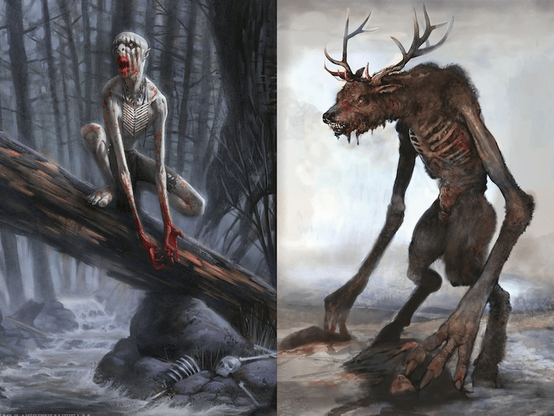
- The tale of the Wendigo (and its many variations) from Algonquin-speaking first nations in Canada and US, has been heavily appropriated in fiction, films, and as a cryptid. The brutal association with murder and cannibalism has been changed drastically for use in various media and commercial purposes. I’m not qualified to speak about its traditional use but the Wendigo wasn’t a Bigfoot, it didn’t have antlers, it doesn’t imitate human voices or shapeshift and it’s not part of Appalachian folklore. It is a spirit creature that embodies the threat of starvation for northern peoples who faced this circumstance. Yet, the creatures has become so popularized and commodified, an offensive stench rises from the fictionalized garbage content of awful fan art, horror flicks, and AI generated TikTok shorts.
Capitalizing on tragedy
There are not unreasonable arguments on both sides of the debate regarding capitalizing on past tragedies via cryptid festivals. Are cryptid festivals like those in Point Pleasant, WV and Fisherville, KY capitalizing on the deaths of others? Or are they serving as complex social means of moving beyond the haunted town histories? There likely are some instances where the intent was positive, to memorialize the tragedy in a respectful way, that later got out of control. And I have inklings that this conflict also occurs in other cultures, where monsters represent real tragedies.
The list above certainly has additional examples. Ghost stories are frequently a means of remembering a death or an unresolved tragedy or crime. Another example of banking on dark history is the commercialization of the town of Salem, where 25 people suffered and died in the witch trials that became the basis of a tourism branding as the tasteless and tacky “witch city”.
It’s difficult and often entirely inappropriate to police or suppress art (including books, films, etc.) and social responses to trauma. People will attempt to rationalize a disaster even via seemingly irrational scapegoats.
It can be difficult to reject participating in an interesting modern event because it is tainted by the events of the past. Culture evolves where we recreate or reenvision the past with a new framing. I don’t know that there is a right answer here – each person will have their own response. It’s imperative, however, that we not let the history of the tragedies be ignored, forgotten, or overtaken entirely by cryptid legends.
This is post 8 of the 12 Days of Cryptids.
#12DaysOfCryptids #Bigfoot #cryptidFestival #LandBetweenTheLakesBeast #Missing411 #mothman #PopeLickMonster #tragicCryptids #wendigo
 Connect Paranormal