 Kate
Kate 
Rising competition among North Sea mammalian top predators: a multi-method perspective on trophic ecology - Scientific Reports
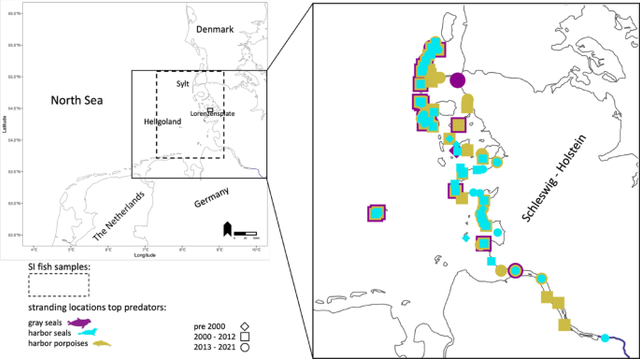
Top predators are crucial in shaping ecosystem dynamics by regulating key processes such as prey populations, energy transfer, and community structure, particularly in systems where multiple species compete for the same resources. Understanding their trophic niches and interactions is essential for effective conservation. In the southern North Sea, harbor seals, gray seals, and harbor porpoises are top predators with overlapping prey. This multi-method study examined resource partitioning using complementary stomach content analysis, metabarcoding, and carbon, nitrogen, and sulfur stable isotope analysis to refine habitat use, incorporating sulfur isotopes, for the first time in marine mammals of the southern North Sea. Gastrointestinal data from stranded harbor seals (n = 223), gray seals (n = 87), and harbor porpoises (n = 218), alongside 283 scat samples from wild seals, collected between 2014 and 2021, were analyzed. Harbor seal and gray seal showed high prey similarity (Jaccard index 0.71), while porpoises exhibited lower similarity with both seal species (Jaccard index 0.46 and 0.45). Interactions with prey guilds were strongest for demersal roundfish, flatfish, gobies, and sandeels. Bayesian isotope mixing models revealed consistent trophic differences among the three top predators, with seals occupying higher trophic positions than porpoises and showing minimal dietary change over time. Isotopic niche metrics indicated increasing overlap between porpoises and gray seals, particularly in δ34S/δ15N space, suggesting growing trophic similarity, while harbor seals showed a contraction in niche area. Also, stomach content data revealed that high-energy prey in porpoises declined as gray seal abundance increased. These results highlight trophic niche overlap and substantial interspecific interactions, potentially leading to competition under limited resources.